


Three names on one quotation
An enquiry arrives for a stainless steel ball valve and the reply comes back with three options: 304, 316 and 316L. To a buyer these look like three grades of the same thing, differing mainly in price. They are not. They are two different alloy families and one different carbon level, and only one of those differences is settled by price. Getting the choice wrong is expensive in a way that shows up months later, in a plant, on a line that nobody thought was aggressive.
The good news is that the decision can be made before the order with three questions and no laboratory: what is in the line, how hot is it, and does anything in that combination make the standard austenitic grades the wrong family altogether. This article takes those questions in order, because they are asked in order, and because the answer to the third one overrides the first two.
Molybdenum is the difference that decides the duty
The 304 and 316 families are the same kind of steel — austenitic stainless, protected by a chromium oxide film — and the meaningful difference between them is molybdenum. The 316 family contains it, the 304 family does not, and molybdenum is what makes the passive film more resistant to local breakdown in the presence of chlorides. That is the whole mechanism, and it explains why the two grades behave so differently in water and so similarly in clean chemical service.
Local breakdown is the failure mode that matters on a valve. It appears as pitting on a surface, as crevice attack in a gap, and on a ball valve there are gaps everywhere: between the ball and the seat, between the seat ring and its pocket, under a gasket, behind the seat spring, at the stem where it passes through the packing. A grade that resists chlorides on a flat plate can still fail at a seat pocket, because a crevice concentrates the chemistry. This is why the choice between 304 and 316 cannot be made from a corrosion chart alone — it has to be made from the water chemistry and from an honest look at where the stagnant volumes are.
Practically, the split falls out like this. Demineralised water, clean steam condensate, most food and beverage products, alcohols, solvents and general indoor air service sit comfortably in 304. Raw water, cooling water, seawater-adjacent duties, chloride-bearing process streams and anything where the chloride figure is unknown or uncontrolled belong in 316 at the very least. Where the chloride load is high and the temperature is elevated at the same time, neither grade is correct and the next section explains why.
What the L actually changes
The L stands for low carbon, and the difference between 316 and 316L is measured in hundredths of a percent of an element that most purchase orders never mention. It matters for one reason: carbon is what combines with chromium at high temperature to form chromium carbides at the grain boundaries, and chromium tied up in a carbide is chromium that is no longer available to keep the passive film intact. The result is a narrow band of reduced corrosion resistance along the grain boundaries, and it appears in the heat affected zone after welding.
That is why the L grades exist and why they are specified on welded fabrications. On a ball valve the question is whether the pressure boundary is welded. A cast or forged body with flanged or threaded ends has no weld on the pressure boundary, so 316 is perfectly adequate and 316L buys very little. A fully welded body, a weld-end valve with a fabricated extension, or a valve that will be welded into a line by the installer is a different case: the heat of welding is applied close to the material, and the L grade is the conventional and sensible answer.
There is a second, less technical reason the L keeps appearing on orders. The L grade is the one most often stocked as bar, plate and forgings in the sizes a valve shop needs, and many project specifications simply name it as the default austenitic grade. Neither reason is a metallurgical argument against 316; both are reasons why the grade on the certificate is often 316L even where 316 would have done. What matters is that the drawing, the certificate and the marking all say the same thing.
Cast or forged: CF8 and CF8M against F304 and F316
This is where most confusion on a valve drawing comes from, and it has nothing to do with alloy selection. The same alloy family carries different designations depending on how the part was made. A cast austenitic body is called CF8 for the 304 family and CF8M for the 316 family. A forged body, or a forged ball or stem, is called F304 or F316, and the low carbon versions follow the same pattern. The alloy is equivalent; the product form, the permitted chemistry ranges, the mechanical properties and the defect types are not.
For a buyer the practical consequence is that CF8 vs CF8M and F304 vs CF8 are comparisons of different things. CF8 against CF8M is a real alloy choice — molybdenum or not. F304 against CF8 is a process choice — forged against cast — and on a ball valve it usually follows size and pressure: smaller and higher pressure bodies tend to be forged, larger bodies tend to be cast, and both are legitimate when the wall thickness, the casting quality control and the testing are right. What should never happen is a drawing that specifies one and a certificate that names the other without anyone noticing, which is a documentation failure rather than a metallurgical one.
On the internals the pattern is similar. Balls and stems are commonly forged or machined from bar, seats and seat rings may be forged or cast depending on the design, and the ball is usually coated or plated on top of whichever it is. That means the grade marked on the body is not the whole material story of the valve, and a purchase order that names only the body grade leaves two thirds of the wetted surface unspecified.
Where stainless is the wrong answer
The 300 series is not an automatic upgrade from carbon steel, and the place it stops being an upgrade is chloride stress corrosion cracking. Austenitic stainless under tensile stress, in a chloride-bearing environment, at elevated temperature, can crack — and the crack is often intergranular and fast, arriving without the wall thinning that would warn an inspector. A ball valve is a stressed component by construction: the body carries pressure, the seat rings are preloaded, the stem is loaded in torsion, and the ball is squeezed between two seats. Every one of those is a tensile stress path.
This is why "we upgraded to stainless" is not a safe sentence in a chloride environment. Moving from carbon steel to 304 in hot chloride service can convert a predictable corrosion allowance into an unpredictable cracking risk. The decision has to come from the material selection diagram or the piping material class that the project has already established, and where no such document exists, from the water chemistry report and the maximum temperature together. Neither the grade name nor the price is a substitute for that pair of numbers.
The same reasoning applies in reverse for some duties. In strongly reducing acids, in dry hydrogen fluoride, and in some caustic and amine environments, the austenitic grades are the wrong family regardless of molybdenum content, and a valve built in 316 because it looked more premium than carbon steel can be a downgrade in real service life.
The seat sets the temperature, not the shell
On a stainless ball valve the body grade gets all the attention and the seat material actually decides what the valve can do. The shell may be rated for a wide temperature band, but the sealing element is what has to remain elastic at the working temperature and what has to keep its shape under preload. That is why the useful temperature limit printed against a ball valve is the seat's, not the body's: PTFE seats work to about 180 °C, PPL to about 280 °C, and PEEK to about 260 °C, with the exact figure depending on pressure because a seat deforms sooner at higher differential.
The practical consequence for grade selection is that a stainless body chosen for corrosion resistance may still be limited by the seat, and the answer to that is not a better body grade but a different seat material. It also means the datasheet needs to be read as a combination: the same valve in 316 with a PTFE seat and in 316 with a PEEK seat are different products with different duties, even though the body line is identical. The seat choices and their limits are set out in more detail in soft and metal seat materials for ball valves.
Duplex and super duplex: the next step up
When the chloride load and the temperature together exceed what the austenitic grades handle, the answer is not 316 with a thicker wall. It is a duplex stainless steel, which combines an austenitic and a ferritic structure and delivers markedly higher resistance to chloride stress corrosion cracking together with roughly twice the yield strength of the 300 series. The higher strength matters on a valve because it allows a lighter body and a slimmer stem for the same pressure class.
Duplex is not a free upgrade either. It is less forgiving to weld, it has a narrower acceptable temperature band at the top end, and it is harder to machine and to source in some product forms. The decision to move to duplex should come from the same material selection document that would have ruled out 304, and the grade selected — the standard duplex or one of the super duplex grades — follows from the chloride level and the temperature rather than from availability. The range and the limits are set out in duplex and super duplex ball valves for seawater.
How the grade should appear in the paperwork
A stainless steel ball valve should arrive with an EN 10204 3.1 certificate that names the heat number and the chemical and mechanical results for the body, the ball and the stem, and the marking on the body should match the heat number on that certificate. The grade designation on the certificate should match the drawing, in the correct product form — CF8M on a cast body, F316 on a forged one, not a mixture of the two that happens to be convenient. Where hardness limits apply for sour service, they are stated against the material and verified separately from the chemistry.
That last point is where a grade selection is most often quietly lost. A valve can be built in the specified alloy and still fail the specification, because the requirement was a heat treatment condition or a hardness limit rather than an alloy name. The grade on the nameplate is a starting point for verification, not the end of it, and the buyer who asked for 316L because the drawing said so deserves a certificate that says 316L rather than one that says 316 and a verbal assurance.
The selection in one table
The table below is the short version, and it is deliberately written in terms of the duty rather than in terms of the alloy. Where a duty sits on a boundary, the deciding question is the chloride level at the working temperature, not the material price.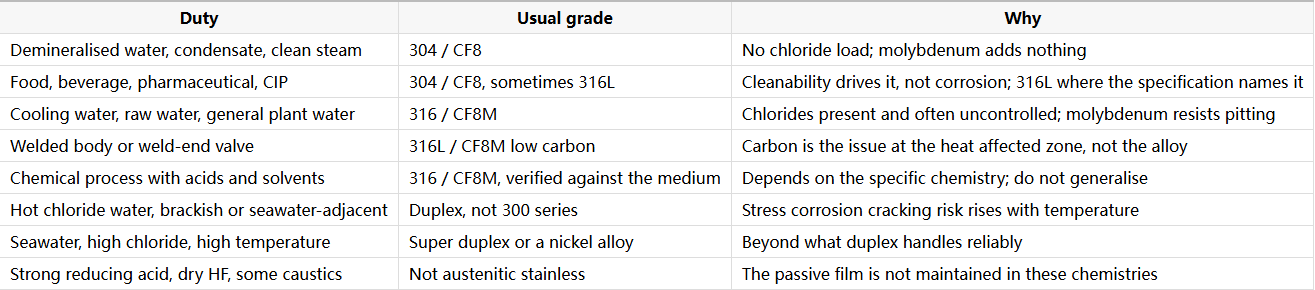
What to put on the enquiry
Four lines make the grade decision unambiguous. The medium, with the chloride figure and any other aggressive species named. The design temperature, because the same water is benign cold and aggressive hot. Whether the pressure boundary is welded, which decides between the standard and the L grade. And the product form expected for each part — body, ball, stem, seat ring — so the certificate can be checked against it without an argument later.
J-VALVES supplies stainless steel ball valves from 1/2 inch to 56 inch (DN15 to DN1400) in ASME Class 150 to 2500, in 304, 316, 316L, duplex and super duplex, in floating, trunnion mounted, three piece, top entry and fully welded patterns, with soft or metal seats and with EN 10204 3.1 certificates naming the heat number for body, ball and stem. Shell tests run at 1.5 times and seat tests at 1.1 times rated pressure to API 598. The range in the standard austenitic grades is set out in the stainless steel flanged ball valve range, and a 304 valve built for fire safe duty is shown in the 304 fire safe floating pattern. Where the medium is unclear, the honest answer is to ask for the water chemistry before quoting a grade, because the difference between 304 and duplex is not a price step — it is a different valve.
Frequently Asked Questions
Is 316 always better than 304 for a ball valve? No. The 316 family contains molybdenum, which improves resistance to chloride pitting and crevice attack, and where chlorides are present that matters. In demineralised water, condensate, clean steam, alcohols and many food products, 304 performs perfectly well and the molybdenum adds cost without adding life. The grade should follow the medium rather than the price ladder.
What is the difference between 316 and 316L? Carbon content. The L grade is the low carbon version, and the reason it exists is welding: carbon combines with chromium at high temperature near a weld and leaves the grain boundaries short of chromium, which is where corrosion starts. On a valve with no weld on the pressure boundary, 316 is adequate; on a fully welded body or a valve that will be welded into the line, the L grade is the conventional choice.
What do CF8 and CF8M mean on a valve body? They are the cast designations for the 304 and 316 families respectively, in the same way that F304 and F316 are the forged designations. CF8 against CF8M is an alloy decision, molybdenum or not. F304 against CF8 is a process decision, forged against cast, and it usually follows size and pressure class rather than corrosion duty.
Can 304 or 316 be used in seawater? Not reliably, and not for a valve. Seawater combines high chloride with a stressed component and, in most services, an elevated temperature, which is the combination that produces chloride stress corrosion cracking in austenitic stainless steels. The grades intended for that duty are duplex and super duplex, and above their range a nickel-based alloy, with the selection coming from the project material specification rather than from the grade name.
Does the body grade decide the temperature rating of a stainless ball valve? Usually not. The seat is normally the limiting component: PTFE seats work to about 180 °C, PPL to about 280 °C and PEEK to about 260 °C, with the exact limit depending on pressure because the seat deforms sooner at higher differential. A higher body grade does not raise that limit, and a change of seat material does.


