

CHINA J-VALVES Offers Various High-quality I ndustrial Ball Valves
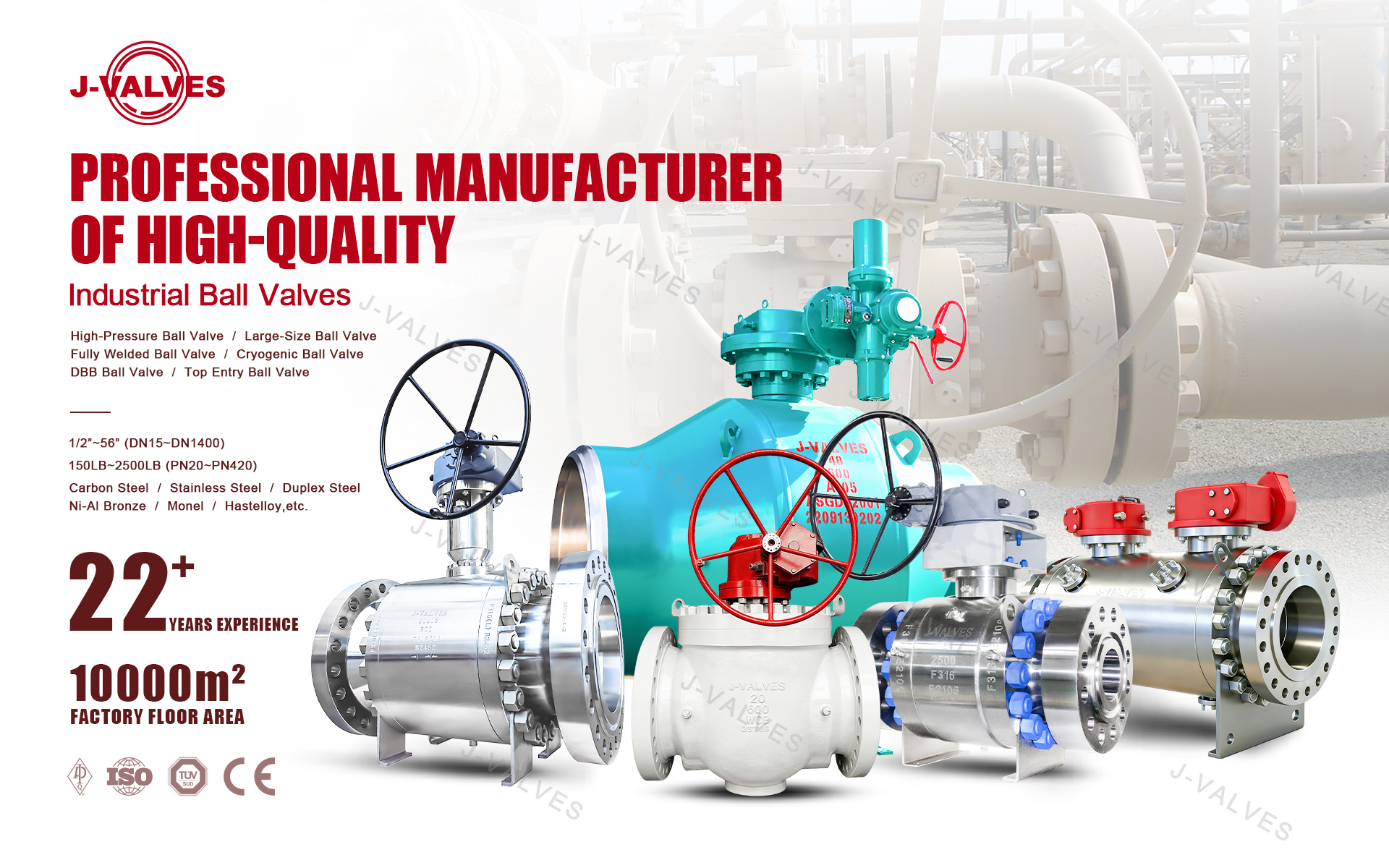
J-VALVES, a distinguished professional ball valve manufacturer rooted in China, takes pride in its extensive product portfolio. Our offerings span a wide range, including trunnion-mounted ball valves, floating ball valves, high-temperature ball valves, high-pressure ball valves, metal-sealed ball valves, ultra-low temperature ball valves, DBB ball valves, Three-way And Four-way Ball Valve, and fully welded ball valves. Each product is a testament to our commitment to precision engineering and reliable performance. Meticulously crafted, they are designed to not only meet but exceed the most stringent industrial demands, ensuring stable operation even under extreme conditions. This enables us to provide our clients with high-value services and makes our valves widely sought-after in industries.
Product Category
Contact Us


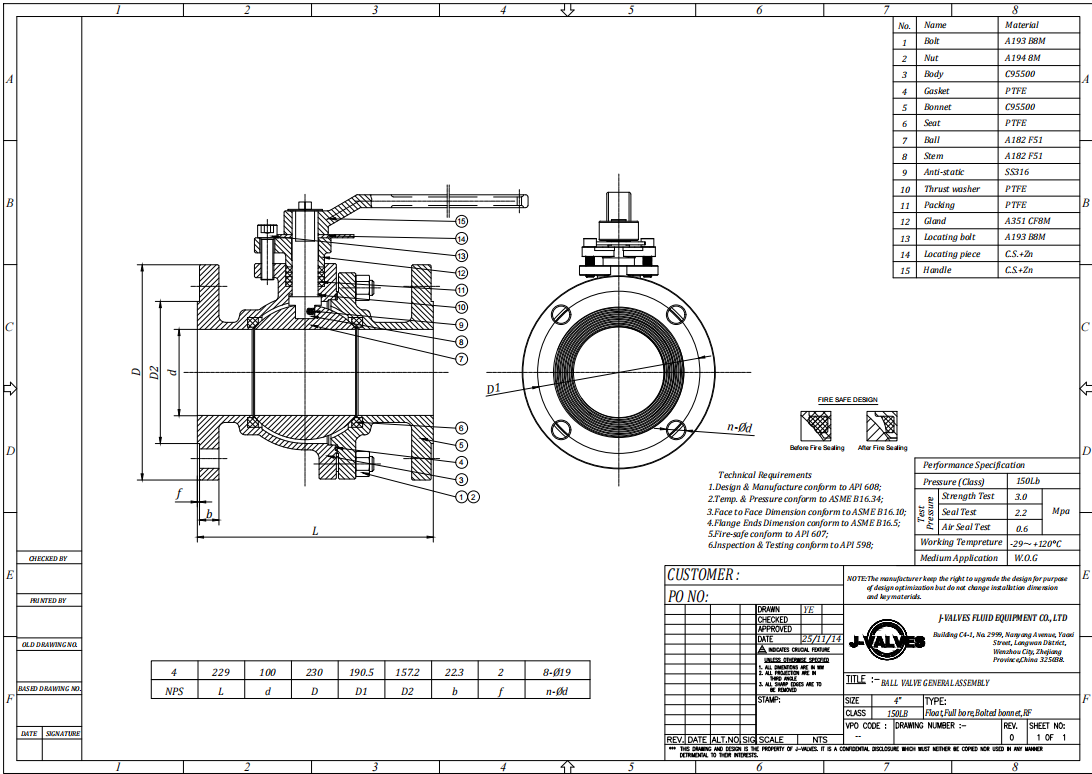
Pressure Class: ASME Class 150, 19.6 bar at 38°C; Class 300 optional
Body Material: ASTM B148 C95800 nickel aluminum bronze
Body Type: Two piece, bolted
Ball: C95800, SS316 hard faced optional
Stem: C95800 or SS316, blowout proof
Seat: PTFE, RPTFE, PPL, or reinforced PTFE
Packing: PTFE or graphite combined packing
End Connection: Threaded NPT / BSPT, flanged RF to ASME B16.5 optional
Service Temperature: -29°C to +150°C standard, +200°C high temperature version
Seawater Velocity Limit: About 6 m/s clean, 4.5 m/s with sand
Design Standard: API 608, ASME B16.34
Test Standard: API 598, ISO 5208
Operation: Lever standard, pneumatic or electric optional
-
Q41F
-
J-VALVES
A C95800 nickel aluminum bronze ball valve is a quarter-turn isolation valve cast in ASTM B148 C95800, a copper alloy with about 9% aluminium, 4.5% nickel and 4% iron, used almost entirely for seawater, brine and marine cooling service. In 1 inch Class 150 it is a floating ball design with a two-piece body, a PTFE or RPTFE seat, and either threaded or raised-face flanged ends. The alloy is chosen because it forms a hard, self-renewing aluminium oxide film that resists flowing seawater, and because it does not pit or crevice corrode the way 316 stainless does in the same water.
J-VALVES casts and machines this valve in sizes from 1/4 to 12 inch, with a service envelope that is genuinely narrower than a stainless valve and more useful within it. The buyers are desalination plant contractors, marine HVAC and cooling system designers, shipyards, aquaculture engineers and seawater fire main installers. This page sets out what C95800 actually is, why it beats 316 in seawater and loses to it everywhere else, the real pressure and temperature limits of a bronze body, the galvanic problem at the flange, and the velocity limit that decides whether the valve lasts five years or twenty.

What C95800 Is, and What the Numbers Say
C95800 is one of the nickel aluminum bronzes, sometimes abbreviated NAB. It is not the same family as the gunmetal and leaded bronzes used for general plumbing, and the difference matters for both corrosion and for lead content.
Element | Typical range | What it does |
|---|---|---|
Aluminium | 8.5 to 9.5% | Forms the protective alumina film and gives the alloy its strength after casting |
Nickel | 4.0 to 5.0% | Stabilises the microstructure and improves resistance to erosion and to selective phase attack |
Iron | 3.0 to 5.0% | Refines the cast structure and suppresses the brittle aluminium-rich phase |
Manganese | 0.8 to 1.5% | Deoxidiser and strengthener |
Copper | Balance | Matrix |
Lead | Not intentionally added | The reason C95800 is acceptable for potable and process water where leaded bronze is not |
Property | C95800 sand cast | CF8M stainless | Why it matters here |
|---|---|---|---|
Minimum tensile strength | About 620 MPa | About 485 MPa | High strength for a cast copper alloy |
Minimum yield strength | About 240 MPa | About 205 MPa | Comparable to stainless, well above gunmetal |
Elongation | About 15% | About 30% | Lower ductility; the alloy is less forgiving of misalignment |
Hardness | About 160 HB | About 150 HB | Hard enough to resist impingement and sand erosion |
Seawater pitting | Resistant | Susceptible above about 30°C in chlorides | The central reason for choosing bronze |
The number that is usually quoted for C95800 is a PREN in the high thirties, comparable to duplex stainless. It is a useful shorthand and a slightly misleading one: the protection mechanism is an aluminium oxide film, not a chromium oxide film, and it behaves differently. The film is tough, it renews in flowing water, and it is the reason the alloy survives sand-laden seawater at velocities where stainless is being eroded.
Why Bronze Beats 316 in Seawater, and Loses Everywhere Else
Seawater is a hostile environment for stainless steel, and the failure mode is not what most people expect. It is not general corrosion. It is pitting and crevice corrosion, concentrated under a gasket, in a thread root, or on a seat pocket where the water is stagnant and the oxygen is depleted. 316 in warm seawater above about 30°C will pit, and a pitted ball valve leaks at the seat rather than through the wall, which makes the failure quiet and late.
C95800 does not rely on a passive chromium film and does not suffer that particular attack. In flowing seawater it holds up for decades, and at the velocities found in a cooling water system it resists impingement and cavitation damage better than any stainless short of super duplex. It is also immune to chloride stress corrosion cracking, which matters on a warm seawater line with residual stress from casting and machining.
Where bronze loses is equally clear. Above about 150°C the alloy loses strength, and the standard product is not rated for the 200 to 250°C band that a stainless valve handles without comment. It is not suitable for many acids and for ammonia, which attacks copper alloys. It is not suitable for dry chlorine or for some hydrocarbon duties. And it is a soft metal in the sense that matters at the flange: a cast bronze body has about half the elongation of a cast stainless body, so it cracks rather than yields when a fitter pulls a misaligned pipe into place with the bolts.
Service | C95800 | CF8M | Super duplex |
|---|---|---|---|
Clean seawater, ambient | Best choice | Pitting risk in stagnant zones | Good, but costly and over-specified |
Seawater with sand | Best choice, resists erosion | Erodes at the seat | Good |
Warm brine to 120°C | Good | Pitting risk above 30°C | Good |
Steam above 200°C | Not suitable | Good | Good |
Dilute acid | Case by case, often not | Usually good | Good |
Ammonia | Not suitable | Good | Good |
Potable water, lead-free requirement | Good, no intentional lead | Good | Good |
The Real Pressure and Temperature Limits
A datasheet that offers a 1 inch bronze ball valve from 150LB to 2500LB is not describing a product that exists. Bronze bodies are practical in Class 150 and Class 300, and in some sizes and configurations Class 400 or 600 with a heavier wall and a specific casting route. Above that, the wall thickness required for the rating and the creep behaviour of the alloy at temperature make it a special item at best, and a supplier who quotes Class 1500 in bronze should be asked for the design calculation rather than the catalogue page.
Parameter | Practical limit | What sets it |
|---|---|---|
Pressure class | Class 150 and 300 standard; 400 to 600 as a special | Wall thickness and casting soundness, not just tensile strength |
Cold working pressure | About 19.6 bar at Class 150, 51.1 bar at Class 300 | ASME B16.34 rating for the material group |
Temperature, standard | -29°C to +150°C | Alloy strength retention and PTFE seat limit |
Temperature, high temperature version | +200°C with a metal or PPL seat | Above this the alloy is out of its useful range |
Size | 1/4 to 12 inch, with 8 inch and above as a special | Casting yield and pattern cost |
Seawater velocity | About 4.5 m/s with sand, up to 6 m/s clean | Impingement and erosion of the seat and body bore |
The temperature ceiling is often misread because the seat fails first. A PTFE seat is good to about 180°C, but the bronze body is only comfortable to about 150°C in continuous service, so the practical limit of the valve is 150°C and the seat is not the constraint. Above that the valve should be a different material, not a different seat.
The Galvanic Problem at the Flange
This is the failure that catches marine engineers, and it is not inside the valve. C95800 is cathodic to carbon steel, and in seawater the potential difference drives the steel into the anode role. A bronze valve bolted between two bare carbon steel flanges in a seawater line will protect itself at the expense of the steel, and the steel loses metal at a rate set by the wetted area ratio, the conductivity and the flow.
The first symptom is usually rust staining and then a leak at the flange face, and by the time it is found the pipe end may be too thin to re-face. The fix is designed in, not added later: an isolating gasket set with insulating washers and sleeves through the bolt holes, a dielectric coating on the mating flange faces, or a short spool piece in a compatible material. On a small 1 inch line, a full isolation kit costs very little and is the difference between a valve that lasts and a pipe that fails behind it.
The couple with stainless is much milder because the potentials are close, so a bronze valve between stainless flanges is normally acceptable without isolation. The couple with aluminium bronze and titanium is the reverse problem: titanium is strongly cathodic and will accelerate attack on the bronze, so a bronze valve should not sit directly against a titanium flange in seawater without a review.
Velocity, Erosion and Selective Phase Attack
Nickel aluminum bronze is chosen for its erosion resistance, but it is not unlimited. Clean seawater can run at up to about 6 m/s through a C95800 body without significant metal loss. Once the water carries sand or silt, the practical limit drops to about 4.5 m/s, because the particles remove the protective film faster than it can reform, and the attack concentrates at the seat edge and on the downstream side of the ball where the flow separates.
The other mechanism is selective phase attack, sometimes called dealuminification. In certain waters — polluted seawater, low flow, high chloride with low oxygen, or where the alloy has been poorly cast with an unfavourable phase balance — the aluminium-rich phase is preferentially corroded and the alloy loses strength from the inside. Good casting practice with the specified iron and nickel content is the defence, and it is one of the reasons to buy from a foundry that controls chemistry rather than one that only controls dimensions. A hardness and microstructure check on a sample casting is cheap insurance on a large order.
In a 1 inch line at normal cooling water flows the velocity is rarely the problem. On a pump discharge or a bypass line it can be, and the cure is a larger valve or a different alloy rather than a thicker wall.
Seats, Ends and the Details That Decide Life
The seat is PTFE or RPTFE as standard, PPL where the temperature approaches 150°C, and metal where abrasive sand is present and a small leak is acceptable. A soft seat in a bronze valve on seawater is normal and correct; the alloy protects the body, the seat protects the seal, and the seat is the part that is expected to be replaced.
Threaded ends are NPT or BSPT, and bronze threads need care. The alloy galls more readily than stainless, a taper thread in a soft material is easy to over-tighten, and a cracked end is not repairable. Use a sealant rated for the service, make up to a specified torque rather than to feel, and never use the valve body as a lever to align pipe. Flanged ends are to ASME B16.5 Class 150, and the same caution applies with more force: a bronze flange will crack before a steel one yields, and the crack starts at a bolt hole.
Internally, a bronze floating ball valve is a simple object: a ball, two seats, a stem with an anti-blowout shoulder, and a body joint. The parts that fail in service are the seat and the stem packing, in that order. Both are replaceable on a two-piece body, and on a marine valve that is the difference between a maintenance item and a replacement item.

Testing, Standards and Documentation
The design reference is API 608 for the general requirements and ASME B16.34 for the pressure and temperature ratings of the body. Testing follows API 598, with a shell test at 1.5 times the rating and a seat test at 1.1 times, judged to ISO 5208. For a 1 inch Class 150 valve the shell test is 29.4 bar and the seat test 21.6 bar.
Documentation includes an EN 10204 3.1 certificate for the casting with the chemical analysis, which is the document that proves the alloy is C95800 and not a lower grade substituted in the foundry, plus the mechanical results and the shell and seat records. Where the valve goes into a potable water system, a lead content declaration and a material compliance statement for the wetted parts are added. Where it goes into a classification society project, the class certificate is issued against the drawing and the material certificate together.

Where This Valve Is Used
Duty | Why C95800 |
|---|---|
Reverse osmosis and desalination trains | Warm concentrated brine defeats 316; bronze holds up and is lead-free |
Seawater cooling for ships and plants | Velocity and sand tolerance, no pitting in stagnant branches |
Marine HVAC and ballast systems | Long life in intermittent flow, replaceable seats |
Aquaculture and fish farm headers | Seawater plus biological load; copper alloys also resist biofouling |
Seawater fire main | Reliable operation after long idle periods, which is where stainless seizes |
Brine and salt processing | Chloride resistance at moderate temperature |
One additional property deserves a mention because it is rarely written down: copper alloys are hostile to marine organisms. A bronze valve in a seawater intake fouls less than a stainless one, and on a small line that has sat idle for a season, the difference is whether the valve still turns.
What to Put on the Enquiry
Size, pressure class, body material with the ASTM designation, seat material, design temperature, fluid with salinity and sand content, end connection with thread standard, whether an isolating gasket set is required, actuator or lever operation, test standard, classification society requirement if any, and quantity. Where the line is potable water, state the lead limit that applies, because the material declaration is different.
Lead time is 3 to 5 weeks for a 1 inch Class 150 threaded valve from stock patterns, and 6 to 8 weeks where the pattern has to be made or the valve is flanged with a class certificate.
Nickel Aluminum Bronze Ball Valve FAQ
Why use bronze instead of stainless steel in seawater?
Because 316 pits and crevice corrodes in warm chlorides, especially in stagnant zones such as a seat pocket or under a gasket, and it cracks under chloride stress corrosion above about 60°C. C95800 forms a tough aluminium oxide film that resists flowing seawater and sand erosion, and it does not suffer that pitting attack. Stainless is still better above 150°C and in acids.
What pressure class can a C95800 ball valve actually reach?
Class 150 and Class 300 are the practical range, with Class 400 to 600 available as a special with a heavier wall and verified casting. A 1 inch bronze valve rated to 2500LB is not a real product. Ask for the design calculation rather than accepting a catalogue figure.
What is the temperature limit?
About 150°C in continuous service for the standard valve, and about 200°C for a high temperature version with a PPL or metal seat. The limit is the alloy, not the seat: a PTFE seat would allow 180°C, but the bronze body is outside its comfortable range before that.
Does a bronze valve cause corrosion of the steel pipe?
Yes, if it is bolted directly between bare carbon steel flanges in seawater. Bronze is cathodic to steel, so the steel becomes the anode and loses metal near the joint. An isolating gasket set with insulating washers and sleeves, or a compatible spool piece, prevents it. The couple with stainless is mild enough that isolation is usually unnecessary.
What is the maximum seawater velocity?
About 6 m/s in clean seawater and about 4.5 m/s where the water carries sand or silt. Above that the protective film is removed faster than it reforms and the seat edge erodes. On a 1 inch line at normal cooling flows the velocity is rarely the limiting factor.
Is C95800 lead-free?
C95800 contains no intentionally added lead, unlike the leaded gunmetals such as C83600 which carry 4 to 6%. That makes it the appropriate choice where a lead leaching limit applies, such as potable water. A material declaration with the chemical analysis should still be requested, because the certificate is what proves it.
Hot Products


News
Ball Valves in A Kraft Pulp Mill: Black Liquor, Green Liquor And The Cost of Choosing The Alloy by Habit
White liquor at pH 14 cracks carbon steel welds, black liquor sets solid below 100 C, green liquor dregs grind seats: alloy choice and torque in a kraft mill.
Read More
Slug Flow And Ball Valves: What Actually Arrives At The Seat
A slug is liquid mass with momentum, not a pressure spike. What changes at the seat, in the cavity and at the actuator when liquid reaches a ball valve.
Read More
Ball Valves in Direct Lithium Extraction: PH 1 Eluate, Gypsum Scale And 438,000 Cycles in Twenty-Five Years
Direct lithium extraction swings valves from pH 1 eluate to pH 12 caustic, 48 column switches a day and gypsum scale. Materials, seats and torque.
Read More
Ball Valves in Geothermal Brine: Silica Scale, Chloride Cracking And The Cooling Trap
Why geothermal brine destroys ball valves: retrograde silica scale, calcite at the flash point, chloride cracking above 60 C and the 250 C seat limit.
Read More