
CHINA J-VALVES Offers Various High-quality I ndustrial Ball Valves
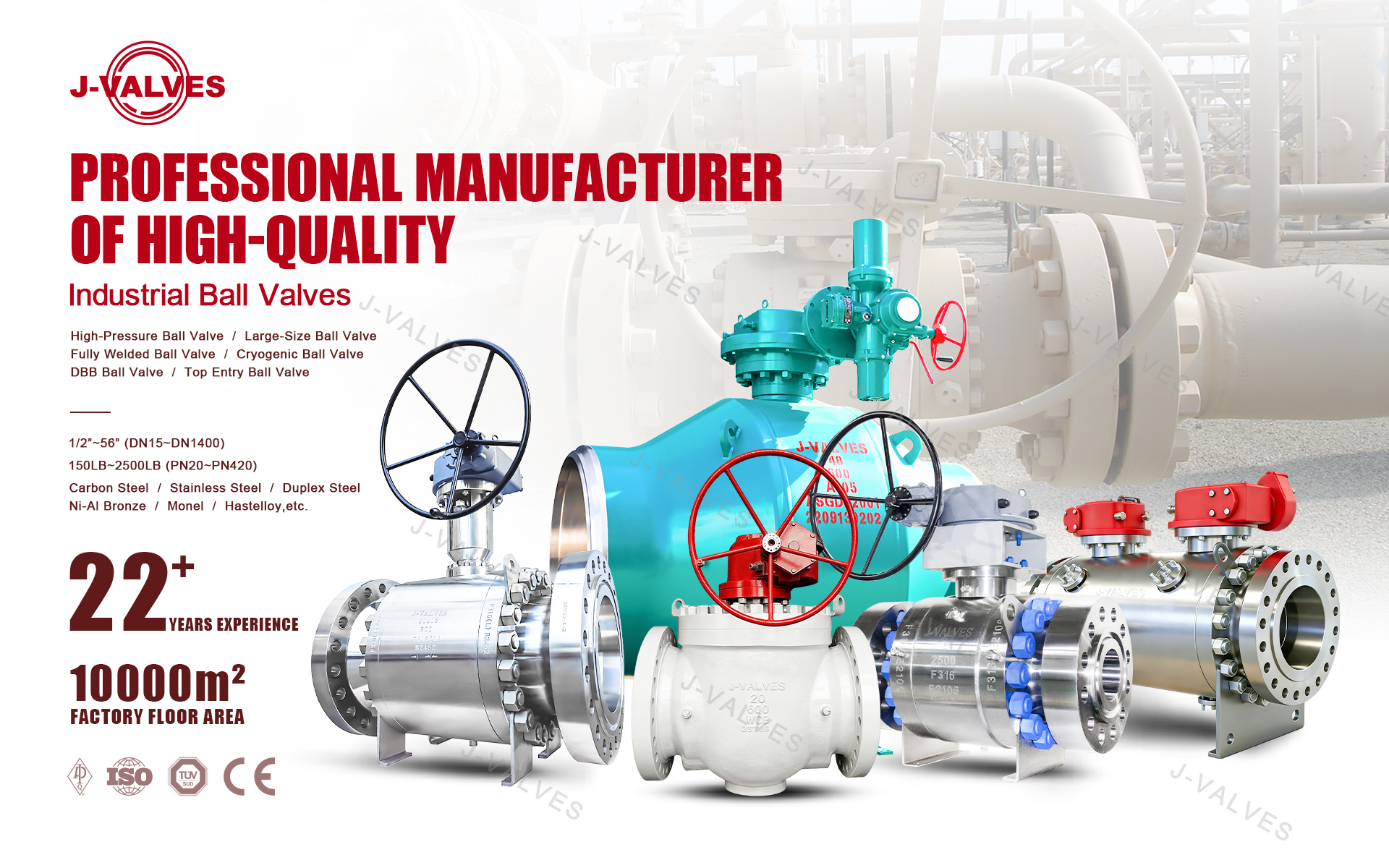
J-VALVES, a distinguished professional ball valve manufacturer rooted in China, takes pride in its extensive product portfolio. Our offerings span a wide range, including trunnion-mounted ball valves, floating ball valves, high-temperature ball valves, high-pressure ball valves, metal-sealed ball valves, ultra-low temperature ball valves, DBB ball valves, Three-way And Four-way Ball Valve, and fully welded ball valves. Each product is a testament to our commitment to precision engineering and reliable performance. Meticulously crafted, they are designed to not only meet but exceed the most stringent industrial demands, ensuring stable operation even under extreme conditions. This enables us to provide our clients with high-value services and makes our valves widely sought-after in industries.
Product Category
Contact Us


Pressure Rating: 1000 WOG (68.9 bar cold working, non-shock)
Body Type: Three piece, bolted end caps, four body bolts
Body Material: ASTM A351 CF8 (304), CF8M (316) optional
Ball: CF8, polished Ra 0.4 µm, full or reduced bore
Seat: PTFE, RPTFE, PPL, or Stellite faced metal
Body Gasket: PTFE to 180°C, graphite above
Packing: PTFE V-ring to 200°C, graphite above
End Connection: NPT, BSP, socket weld B16.11, butt weld B16.25, flanged RF
Actuator Mounting: ISO 5211 F05 / F07 pad
Air Supply: 0.4 to 0.7 MPa clean dry air
Service Temperature: -29°C to +260°C, seat dependent
Design Reference: MSS SP-110 general purpose, ASME B16.34 body wall
Test Standard: API 598, ISO 5208
-
Q681F
-
J-VALVES
A three piece pneumatic ball valve in 1-1/2 inch (DN40) 1000 WOG is a quarter-turn isolation valve built from a centre body and two bolted end caps, so that the centre section carrying ball, seats and stem can be lifted out between the pipe ends without cutting or springing the line. The body is ASTM A351 CF8 stainless, the cold working pressure is 1000 psi (68.9 bar) non-shock, and a pneumatic actuator on an ISO 5211 pad turns it. The three-piece construction is chosen for one reason that survives scrutiny: the valve can be rebuilt in place, on a line that cannot be shut down for long.
J-VALVES builds this valve in CF8 and CF8M, with PTFE, RPTFE or PPL seats, threaded, socket weld, butt weld or flanged ends, and double-acting or spring-return actuators with solenoid valves, limit switches and positioners. The buyers are skid builders, CIP and steam system engineers, and maintenance teams who have already paid the price of a two-piece valve that had to be cut out of a welded line. This page sets out what 1000 WOG really means and how it derates, the arithmetic behind actuator sizing at this bore, the ends that suit a three-piece body, and the body joint details that decide whether the valve stays tight after its first rebuild.

What the Three Pieces Buy You
One-piece, two-piece and three-piece bodies seal the same way and flow the same way. The difference is entirely about what happens on the day a seat has to be replaced.
Body type | How it comes apart | Pipe work needed | Rebuild time on a DN40 line |
|---|---|---|---|
One piece | Not serviceable in line. Ball and seats go in from one end before the end is welded or threaded | Valve must be cut out | Half a shift plus welding or re-threading |
Two piece | One screwed or bolted joint. The whole valve unscrews from the pipe, or the end cap comes off if the piping allows | Upstream or downstream joint must be broken | 1 to 2 hours |
Three piece | Four body bolts out, centre section lifts out, end caps stay on the pipe | None, if the line has enough flexibility | 20 to 40 minutes |
The saving is not the 40 minutes. It is that the pipe does not have to be cut, re-welded, re-tested and re-insulated, and that a line with a hot work permit problem does not need one at all. That is why three-piece valves appear on CIP headers, steam distribution manifolds and anything where the piping is welded and the valve is the wearing part.
It is also honest to say what the three-piece body costs. It has four more joints than a one-piece body: the body gasket is a single seal, but it is a large seal, it is loaded by four bolts, and it is the first thing to weep after a rebuild if the bolts are not torqued in the right sequence. A three-piece valve that has been rebuilt badly is a worse valve than the one-piece it replaced.
1000 WOG Is Not an ASME Class
This is the single most misread number on the page, and it is worth being blunt about it. WOG stands for water, oil and gas. 1000 WOG means the valve is rated for 1000 psi cold working pressure, non-shock, in those three service categories. It is a general purpose rating, and it is not an ASME pressure class.
ASME classes are defined in B16.34 with a material group and a temperature table, and they are what flanges, wall thickness and test pressures are built around. 1000 psi is 68.9 bar. For a group 2.2 stainless body, Class 600 is 102.1 bar at 38°C and Class 300 is 51.1 bar. So a 1000 WOG valve sits between Class 300 and Class 600, closer to Class 600 but strictly below it. Describing it as "Class 600 equivalent" is generous by about a third and it will not survive a design review on a project that specifies classes.
Rating | Pressure at 38°C | Basis | What it is good for |
|---|---|---|---|
1000 WOG | 68.9 bar / 1000 psi | Manufacturer rating to MSS SP-110 practice, non-shock | General purpose water, oil, gas and air up to 68.9 bar cold |
Class 300 | 51.1 bar | ASME B16.34 group 2.2 | Class-rated piping, flanged to B16.5 |
Class 600 | 102.1 bar | ASME B16.34 group 2.2 | Class-rated piping, higher temperature table |
Class 800 | Class 800 is a bolting/forging class, not a valve class in B16.34 | ASME B16.11 for fittings | Not applicable to valve bodies |
The practical consequence is that a 1000 WOG valve is a legitimate product with a legitimate rating, but it must not be substituted for a Class 600 valve on a line where the class was chosen for a reason. Where the piping is Class 600 and the valve is 1000 WOG with threaded ends, the valve is the weak point, and the fact that both are described in "psi" somewhere on a datasheet does not make them the same.
How 1000 WOG Derates with Temperature
A WOG rating carries no temperature table, and that is its other weakness. The 1000 psi figure applies cold, and it falls as the seat material softens. The body may be good for far more, but the seat sets the limit, and the limit has to be taken from the seat manufacturer's curve rather than from the valve label.
Temperature | PTFE seat, typical allowable | PPL seat, typical allowable | What limits it |
|---|---|---|---|
-29 to 38°C | 68.9 bar | 68.9 bar | Cold working pressure, full rating |
100°C | About 55 bar | 68.9 bar | PTFE softening and creep |
150°C | About 42 bar | About 62 bar | PTFE approaching its practical ceiling |
180°C | About 30 bar | About 55 bar | PTFE at the edge; PPL still stable |
200 to 260°C | Not recommended | About 45 bar | Only PPL or metal seat survives here |
These are typical published values and every seat supplier's curve is slightly different, but the shape is universal: a valve sold as 1000 WOG is a 500 to 600 psi valve at 180°C, and a buyer who reads only the headline number will over-pressure it on a hot line. Where the process runs above 150°C, specify the pressure at temperature instead of the cold rating, and let the supplier confirm which seat is in the valve.
Thrust and Torque at DN40
Actuator sizing at this bore is not a trivial step, because the numbers are an order of magnitude larger than on a 1 inch valve. The bore is 40 mm, the projected area is 1,257 mm², and at 68.9 bar the thrust on the ball is 8.7 kN. That is roughly nine times the thrust on a 1 inch Class 150 valve, and it has to be carried by a stem of about 19 to 22 mm, sealed by packing, and turned by an actuator.
Condition | Break-to-open torque | Note |
|---|---|---|
New, ambient, PTFE seat, dry | 35 to 45 N·m | Baseline at full differential |
New, ambient, PPL seat | 50 to 60 N·m | Harder seat, higher squeeze |
After thermal cycling to 180°C | Add 30 to 50% | Seat set plus differential contraction |
With crystallised or scaled product | Add 50 to 100% | The most common field failure cause |
Spring return at 0.4 MPa air | Multiply by 1.4 | Spring has to be compressed by the same air |
A double-acting actuator for this valve normally lands in the 80 to 100 mm cylinder bore range, and a spring-return unit one or two sizes above that. The torque must be checked at 0.4 MPa rather than at 0.6 MPa, because a skid running on a small compressor will see 0.4 MPa on its worst day, and that is the day the valve has to stroke.
End Connections and the Weld-In Spool
End | Standard | Fit with a three-piece body |
|---|---|---|
Threaded NPT / BSP | ASME B1.20.1 / ISO 7-1 | Best match: the end caps can be unscrewed and the centre lifted out with the pipe untouched |
Socket weld | ASME B16.11 | Good, and the usual choice for permanent small bore lines; end caps stay welded in place |
Butt weld | ASME B16.25 | Used where radiography is required; the body must be purged during welding |
Flanged RF | ASME B16.5 Class 150 / 300 | Possible but it defeats the purpose: a flanged three-piece body costs more than a flanged two-piece and adds joints without adding access |
The three-piece body with socket weld or butt weld ends is often built as a spool: the valve is welded into a short length of pipe in the workshop, tested as an assembly, and the whole spool is dropped into the line. That is the configuration that makes the design pay, because the workshop weld is controlled and the field work is two pipe joints rather than a valve installation.
During welding, the centre section is normally removed and a dummy spool fitted, so the seats and body gasket never see the welding heat. Where that is not done, the seat is destroyed and the failure appears as a leak on the first pressure test, which is at least an honest failure.
Steam Service with a PPL Seat
Three-piece stainless valves end up on steam more often than on anything else, and steam is where the specification usually goes wrong. Saturated steam at 10 bar is 184°C. At that temperature a PTFE seat is at the edge of its life and a PPL seat is comfortable. The packing matters as much: PTFE V-ring packing at 184°C will extrude past the gland follower within a few hundred cycles, and the leak that follows is not recoverable by tightening.
The combination that works to about 220°C is a PPL seat, graphite packing, and a body gasket in graphite rather than PTFE. Above 260°C the seat has to become metal, Stellite faced, and the valve stops being bubble tight — the leak rate moves to ISO 5208 rate D or worse, and that has to be acceptable to the process rather than discovered at commissioning.
Steam also brings water hammer and differential contraction. A three-piece body has a large gasket face at each end cap, and thermal cycling works those joints. The bolts are checked and re-torqued after the first heat cycle, not because they were wrong, but because the gasket takes a set.
The Body Joint and Bolt Torque
The body gasket on a three-piece valve is either PTFE or graphite, and the choice follows the temperature, not the price. PTFE seals at lower bolt load and is more forgiving of a scratched face; graphite survives the temperature but needs a higher and more even load to seal. Four bolts hold it, and four bolts is few enough that sequence matters.
The sequence is diagonal, in three passes, to about 60% then 80% then 100% of the specified torque, with the valve half open so the ball is not loaded against a seat while the body is being pulled together. Over-torquing one bolt to stop a weep distorts the end cap and creates a leak on the opposite side, which is the classic three-piece failure and the reason some maintenance teams distrust the design.

Testing and Documentation
Each valve gets a shell test at 1.5 times the cold rating and a seat test at 1.1 times, to API 598 with leakage judged to ISO 5208. For a 1000 WOG general purpose valve the manufacturer's rating is the reference, since there is no class table to appeal to. The test medium is water for the shell and air or nitrogen for the seat.
Documentation includes an EN 10204 3.1 certificate for the body casting, a dimensional and material report, the shell and seat records against the serial number, and the actuator datasheet with its air consumption and torque curve. Where the valve goes into a food or pharmaceutical line, internal surface finish and elastomer compliance certificates are added.

Where This Valve Is Used
Duty | Configuration | Why |
|---|---|---|
CIP and SIP headers | CF8, PTFE, full bore, clamp or weld ends | Rebuild without breaking a hygienic weld |
Steam distribution | CF8, PPL seat, graphite packing, spring return closed | 184 to 220°C steam destroys PTFE; spring closes on air loss |
Cooling water and chilled water | CF8, PTFE, double acting | Clean fluid, high cycle count, low torque |
Chemical dosing | CF8M, PTFE, positioner | Chloride duty needs molybdenum; dosing needs modulation |
Compressed air and nitrogen | CF8, PTFE, 24 V DC solenoid | Dry gas, frequent operation, low torque |
Skid isolation | CF8, PPL, socket weld into a tested spool | Workshop weld quality, field work limited to two pipe joints |
What to Put on the Enquiry
Size in inch or DN, pressure rating as 1000 WOG or as an ASME class, body material, seat material, design temperature and pressure at that temperature, fluid, end connection with thread standard, actuator type and fail action, air supply pressure, solenoid voltage, limit switch type, ingress protection, whether a positioner is needed, test standard, and quantity.
Lead time is 3 to 5 weeks for CF8 with a PTFE seat and a standard aluminium actuator. Where the valve is built into a tested spool with socket weld ends, allow 5 to 7 weeks, because the spool is welded, radiographed where required, and pressure tested as an assembly before it ships.
Three Piece Ball Valve FAQ
What does 1000 WOG mean on a ball valve?
It means 1000 psi cold working pressure, non-shock, for water, oil and gas service. It is a general purpose manufacturer rating, not an ASME pressure class. 1000 psi is 68.9 bar, which is between Class 300 at 51.1 bar and Class 600 at 102.1 bar, so it is closer to Class 600 but strictly below it.
Why choose a three piece valve instead of a two piece?
Because the centre section comes out between the end caps, so ball and seats can be replaced without disturbing the pipe. On a welded line that saves cutting, re-welding, re-testing and re-insulating, and it avoids a hot work permit. On a threaded line the advantage is smaller, because a two-piece valve also comes apart.
How does 1000 WOG derate with temperature?
A WOG rating has no temperature table, so the seat sets the limit. A PTFE seat holds 68.9 bar cold, about 42 bar at 150°C and about 30 bar at 180°C. A PPL seat holds close to the full rating to 200°C and about 45 bar at 260°C. Above those temperatures the seat has to be metal.
What actuator size does a DN40 1000 WOG valve need?
The thrust on the ball at full rating is about 8.7 kN, and the break-to-open torque is roughly 35 to 45 N·m with a PTFE seat and 50 to 60 N·m with PPL. A double-acting actuator in the 80 to 100 mm cylinder bore range covers it, sized at 1.3 to 1.5 times the worst-case torque measured at 0.4 MPa air, and a spring-return unit needs one or two sizes more.
Can a three piece valve be used for steam?
Yes, to about 220°C with a PPL seat and graphite packing and a graphite body gasket. PTFE seat and PTFE packing will not survive 184°C saturated steam. Above 260°C the seat becomes metal and the valve is no longer bubble tight, so the acceptable leak rate has to be agreed in advance.
Why does the body joint leak after a rebuild?
Usually because the four bolts were tightened in the wrong order or one bolt was over-tightened to chase a weep. That distorts the end cap and opens a gap on the opposite side. The correct method is diagonal, three passes at 60, 80 and 100% of the specified torque, with the valve half open.
Hot Products


News
Ball Valves in A Kraft Pulp Mill: Black Liquor, Green Liquor And The Cost of Choosing The Alloy by Habit
White liquor at pH 14 cracks carbon steel welds, black liquor sets solid below 100 C, green liquor dregs grind seats: alloy choice and torque in a kraft mill.
Read More
Slug Flow And Ball Valves: What Actually Arrives At The Seat
A slug is liquid mass with momentum, not a pressure spike. What changes at the seat, in the cavity and at the actuator when liquid reaches a ball valve.
Read More
Ball Valves in Direct Lithium Extraction: PH 1 Eluate, Gypsum Scale And 438,000 Cycles in Twenty-Five Years
Direct lithium extraction swings valves from pH 1 eluate to pH 12 caustic, 48 column switches a day and gypsum scale. Materials, seats and torque.
Read More
Ball Valves in Geothermal Brine: Silica Scale, Chloride Cracking And The Cooling Trap
Why geothermal brine destroys ball valves: retrograde silica scale, calcite at the flash point, chloride cracking above 60 C and the 250 C seat limit.
Read More