CHINA J-VALVES Offers Various High-quality I ndustrial Ball Valves
J-VALVES, a distinguished professional ball valve manufacturer rooted in China, takes pride in its extensive product portfolio. Our offerings span a wide range, including trunnion-mounted ball valves, floating ball valves, high-temperature ball valves, high-pressure ball valves, metal-sealed ball valves, ultra-low temperature ball valves, DBB ball valves, Three-way And Four-way Ball Valve, and fully welded ball valves. Each product is a testament to our commitment to precision engineering and reliable performance. Meticulously crafted, they are designed to not only meet but exceed the most stringent industrial demands, ensuring stable operation even under extreme conditions. This enables us to provide our clients with high-value services and makes our valves widely sought-after in industries.
Product Category
Contact Us


Pressure Class: ASME Class 150 to 2500 / PN20 to PN420
Body Material: WCB, LCB, CF8, CF8M, CF3M, duplex, alloy steel
Ball: Stainless with hard chrome, ENP, Stellite or tungsten carbide overlay
Seat: PTFE, RPTFE, PPL, or metal Stellite faced
Seat Arrangement: SPE, DPE (DIB-1), or combination (DIB-2)
Packing: Live loaded graphite, ISO 15848-1 qualified
Fire Test: API 607, also API 6FA and ISO 10497
Fugitive Emission: ISO 15848-1 class B or A, with temperature and cycle class stated
Face to Face: ASME B16.10 short or long pattern
End Connection: Flanged RF / RTJ to B16.5 and B16.47, butt weld to B16.25
Features: Double block and bleed, sealant injection, anti-static, anti-blowout stem
Design Standard: API 6D, API 608, ASME B16.34, ISO 14313
Operation: Lever, gear, pneumatic, electric, hydraulic, gas over oil
Sour Service: NACE MR0175 available
-
Q347F
-
J-VALVES
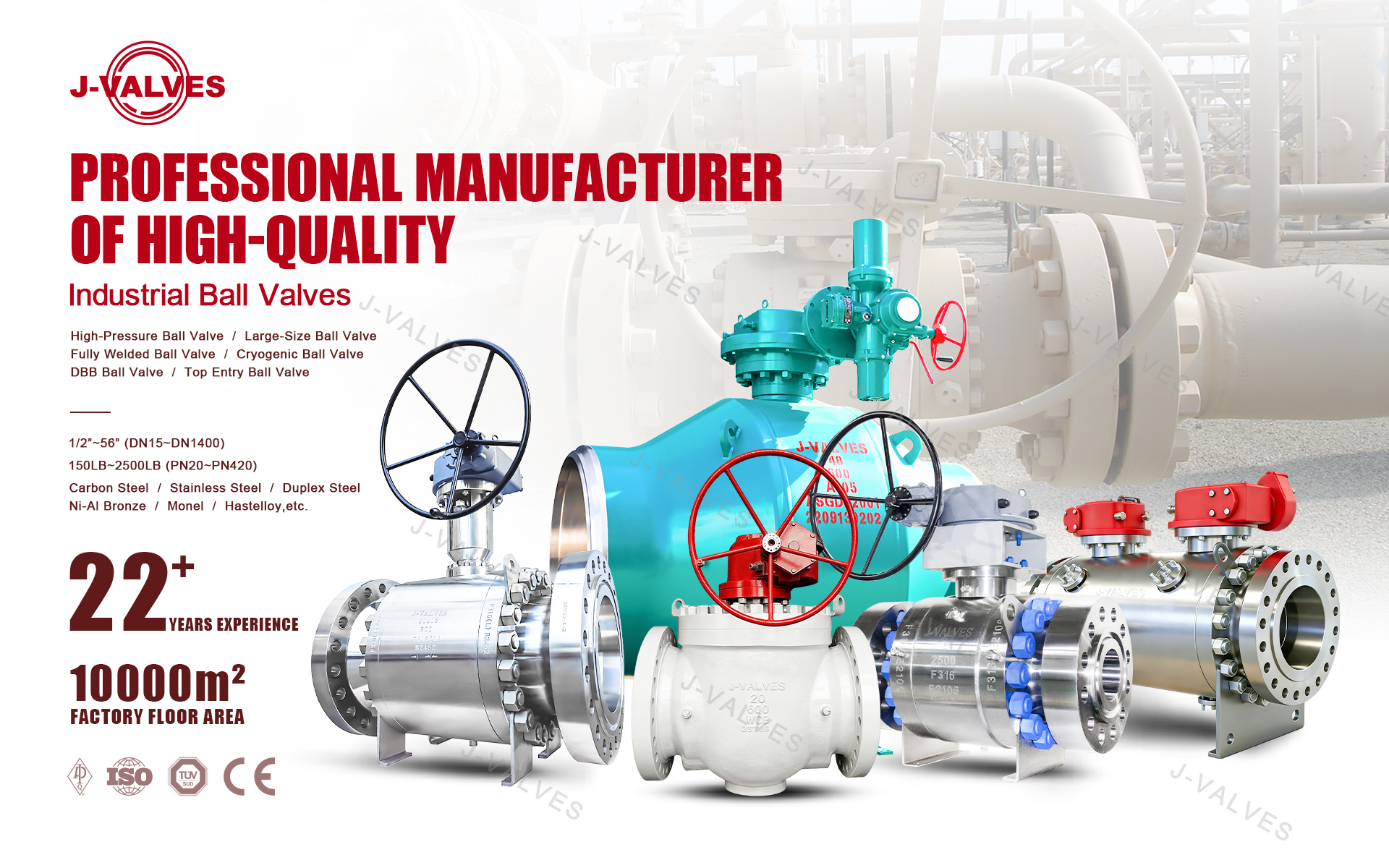
An API 607 fire safe trunnion ball valve is a quarter-turn isolation valve in which the ball is fixed on bearings at top and bottom rather than floating, the seats are spring loaded towards the ball, and the whole assembly has been proved by the API 607 fire test: closed, burned for 30 minutes, cooled, and then pressure tested to show that it still isolates. A low emission version adds a live-loaded graphite stem seal qualified to ISO 15848-1, and a short pattern version is built to the short face-to-face dimensions of ASME B16.10 so it drops into an existing valve space.
J-VALVES builds this valve from 2 to 56 inch in Class 150 to 2500, in WCB, LCB, CF8, CF8M, CF3M, duplex and alloy steel, with PTFE, RPTFE, PPL or metal seats, double block and bleed, sealant injection and double piston effect seats. The buyers are pipeline operators, refinery and petrochemical EPC contractors, and gas processing engineers who have to show a fire survival case and an emission number in the same datasheet. This page covers what API 607 actually does to the valve, what ISO 15848-1 classes mean in ppm, why fire safety is a system property rather than a valve property, and where the trunnion design earns its cost.

What API 607 Actually Does to the Valve
API 607 is a fire test, not a design standard. It does not prescribe a construction; it prescribes an experiment, and the valve either passes or it does not. Understanding the experiment is the only way to judge whether a supplier's claim means anything.
Stage | What happens | What the valve has to survive |
|---|---|---|
1. Stabilise | Valve filled with water, closed, at the rated pressure, and the actuator is left in place | No leakage before the fire, or the test is void |
2. Burn | Flame at 760 to 980°C for 30 minutes, with the body reaching at least 593°C and often 700°C | Soft seat, packing, body gasket and seals are destroyed or degraded |
3. Cool | Flame removed, valve allowed to cool to below about 100°C without being disturbed | Thermal contraction, distortion, and whatever is left of the seals |
4. Low pressure test | Pressurised to about 2 bar with the valve closed | Seat sealing at low differential, which is the hardest case for a metal seat |
5. Rated test | Pressurised to 80% of the 38°C rating | Seat and body integrity at pressure, leak measured as a rate in cm³/min |
The pass criterion is not "no leak". It is a rate. External leakage past the body and past the seat is collected and measured, and the valve passes if the rate stays under the limit in the standard for its size. That is why a fire safe valve is described as having a defined leakage after fire, not as being tight after fire. Any supplier claiming zero leakage after an API 607 burn is either misreading the standard or hoping the buyer will not read it.
The mechanism that makes it pass is worth knowing, because it explains why the valve looks the way it does. The PTFE or PPL seat burns away, and the metal seat ring — a stainless or Stellite-faced carrier that was behind the soft insert — is pushed forward by its spring until it contacts the ball directly. The joint becomes metal to metal, which is not bubble tight but is a barrier. The graphite packing expands as it is heated and, because it has been live loaded, it stays in contact with the stem as the stem grows and the gland bolts relax. The body joint gasket, if it is graphite or a metal jacketed type, survives; if it is PTFE or elastomer, the joint weeps and the valve fails the test on external leakage rather than on seat leakage.
Fire Safety Is a System Property, Not a Valve Property
A valve that passes API 607 on a test bench still fails in a real fire for reasons that have nothing to do with the valve. This is the part that project specifications often miss, and the part that a supplier who has actually been through a fire investigation will raise unprompted.
Start with the actuator. A pneumatic cylinder with nitrile seals and a polyamide housing is gone at 300°C. If the valve is spring return and the spring is inside the cylinder, the spring may survive and close the valve; if the valve is double acting, it will stay where the fire found it. A fire case that assumes the ESD valve will close has to either specify spring return, or specify a fusible link and a fire-wrapped actuator, or accept that the valve position after a fire is unknown.
Then the electrical accessories. Solenoid coils, limit switch enclosures and cable glands are the first items to fail, and a solenoid that fails open on a spring-return closed valve is a valve that does not close. Ex d enclosures survive longer than Ex e, but none of them are rated for a pool fire.
Then the installation. An insulated line holds heat against the valve body far longer than a bare line, which is why fire testing of insulated valves is a separate qualification in some specifications. A valve in a drain pit fills with burning liquid. A valve with a soft gasket at the flange is limited by the flange, not by the valve. The fire case is a property of the installation, and the API 607 certificate is one input to it.
Low Emission: What ISO 15848-1 Classes Mean
Fugitive emission performance is not a yes-or-no property either. ISO 15848-1 qualifies a stem seal by measuring helium leakage at defined temperatures through a defined number of mechanical and thermal cycles, and it reports three separate things: a tightness class, a temperature class and a cycle class. A supplier who quotes only "ISO 15848" has told you nothing.
Element | Classes | What it means in practice |
|---|---|---|
Tightness | A, B, C | Measured in ppmv helium at the stem seal. A is the tightest and is quoted in single digits; B is around the 100 ppmv order; C is in the hundreds. Most industrial ball valves qualify at B. |
Temperature | From -196°C to +400°C in bands | The qualification is only valid inside the band tested. A valve qualified at ambient is not qualified hot. |
Cycles | CO1, CO2, CO3 | Mechanical and thermal cycles in sequence. CO1 is the least onerous; CO3 the most, and it is what a real cyclic duty needs. |
The designation on a datasheet therefore looks like "ISO 15848-1 BH CO2" and each letter carries meaning. BH says tightness class B at high temperature; CO2 says it survived the second cycle class. A valve quoted as "low emission" with no designation has no verifiable claim.
Regulatory practice sits alongside the standard rather than inside it. US LDAR programmes use EPA Method 21 with a screening value, commonly 500 ppmv for valves and 100 ppmv where a site applies a tighter internal standard. The European approach under the IED and the relevant BAT conclusions pushes towards the ISO 15848 route. A valve that meets class B usually satisfies a 500 ppmv screening value with margin; a valve that meets class A is bought where the site has committed to 100 ppmv or to a leak detection and repair frequency that assumes it.
Why the Packing Is Live Loaded
Graphite packing is the only material that survives both a fire and a cryogenic duty, and it has one awkward property: it does not spring back. Once compressed, it stays compressed. In a valve that cycles between ambient and 300°C, the stem grows and shrinks by a few tenths of a millimetre, the gland bolts relax as the assembly expands, and a packing that was correctly loaded at assembly becomes loose at temperature.
Live loading solves this with a stack of Belleville washers under the gland nuts. The stack stores enough travel to follow the stem and the bolt relaxation, keeping the packing stress inside its operating window for thousands of cycles. That is what makes a class B or class A emission figure achievable in service rather than only on the first day.
The cost is that the stack has to be set, not simply tightened. Washer stacks are specified by their compressed height and their spring rate, and a maintenance team that replaces them with plain washers, or tightens them flat, has removed the feature while leaving the label on the valve. The gland bolt torque and the stack height belong on the nameplate or in the manual, not only in the supplier's file.
The Trunnion Design, and Where It Earns Its Cost
This is the structure the page is about, and it is worth setting out precisely because so much of the internet describes it loosely. In a trunnion mounted ball valve the ball is not free. It is captured between a shaft at the top and a trunnion pin at the bottom, both running in bearings fixed in the body. Line pressure pushes the ball, the bearings take the thrust, and the stem carries only torque. The seats are rings that float towards the ball, each pushed by a set of coil springs.
Feature | What it does | Where it matters |
|---|---|---|
Fixed ball on bearings | Removes the pressure thrust from the stem | Above 6 inch, and at any size above Class 600, where a floating design would need an impractical stem |
Spring loaded seats | Keeps sealing stress positive at low line pressure and through thermal movement | Low pressure shutoff, thermal cycling, and large bore where seat travel is greater |
Double block and bleed | Two seats plus a cavity vent, so isolation can be proved without disturbing the line | Pipeline and terminal isolation, custody transfer, maintenance isolation |
Sealant injection | Emergency port into each seat ring, used to restore sealing temporarily | Critical service where a shutdown to replace a seat is not acceptable |
Anti-blowout stem | Stem is retained by the body or cover so it cannot be ejected by internal pressure | All sizes; mandated by API 6D |
Anti-static device | Spring or ball contact maintaining electrical continuity from ball to body | Gas, hydrogen and any flammable service |
The seat configuration is the detail that separates a competent enquiry from a vague one. A single piston effect seat is pushed onto the ball by upstream pressure and pulled off it by downstream pressure, so the cavity relieves itself into the line — good for thermal expansion of trapped liquid, but it gives only one barrier. A double piston effect seat is pushed onto the ball by pressure from either side, which gives a double barrier and a truly bidirectional seal, but the cavity cannot self-relieve and needs an external relief device. DIB-1 is two DPE seats; DIB-2 is one of each, and it is the arrangement used where both a double barrier and cavity relief are needed in a defined flow direction.
Seat arrangement | Bidirectional sealing | Cavity self-relieving | Double barrier |
|---|---|---|---|
SPE both seats | Yes | Yes | No |
DPE both seats, DIB-1 | Yes | No, needs external relief | Yes |
Combination, DIB-2 | Yes | Yes, in the preferred direction | Yes, in the preferred direction |
Short Pattern, and What "Quick Install" Really Means
Face-to-face dimensions for flanged ball valves are tabulated in ASME B16.10 in a short pattern and a long pattern. The short pattern is roughly two thirds the length of the long pattern at the same size and class. A short pattern valve fits into the space occupied by a gate or globe valve of the same nominal size in many older line classes, and that is the real value: it replaces a valve without re-cutting the spool.
The claim that a trunnion valve is available in a wafer body is where marketing outruns physics. A wafer or lug body is a disc clamped between two flanges, and it works because the body is short and the flanges carry the bending. At 2 to 6 inch that is practicable. At 24 inch and Class 900 the flange loads and the seat spring travel make a wafer trunnion body a special item at best, and the reduction in face-to-face length also shortens the cavity, which is where the seat springs and the sealant galleries live. A buyer who needs a genuinely short trunnion valve should specify short pattern to B16.10 and confirm the dimension on the drawing, rather than accept a wafer claim on a datasheet.
The genuine installation savings come from three things: a short face-to-face that matches the existing spool, a valve that arrives with the actuator and accessories mounted and tested as one assembly, and lifting points cast into large bodies so the valve can be set without slings around the actuator. Those are worth more than the word "quick".
Materials and the Temperature Band
The old page carried a single range of -196°C to +550°C. No single valve covers that. It is a product family range, and a valve is built for one band. Saying so is more useful than repeating the number.
Band | Body | Seat | Packing | Typical duty |
|---|---|---|---|---|
-46°C to +120°C | WCB, LCB | PTFE, RPTFE | PTFE or graphite | Water, oil, gas, general process |
-29°C to +200°C | WCB, CF8, CF8M | RPTFE, PPL | Graphite, live loaded | Refinery and petrochemical, low emission duty |
+200°C to +425°C | WCB, CF8M, alloy steel | PPL, metal Stellite | Graphite, live loaded | Steam, hot oil, high temperature process |
+425°C to +550°C | WC6, WC9, CF8M | Metal only | Graphite | Power plant, superheated steam |
-50°C to -196°C | CF8M, CF3M, LF2 to -46°C | PCTFE, metal | Graphite | LNG and cryogenic, extended bonnet required |
Trims follow the same logic. A hard chrome or ENP plated ball is standard for general service; Stellite or tungsten carbide overlay is used where the fluid carries solids or where the seat is metal. Duplex and Inconel overlays are available on wetted parts and on the seat pocket where a carbon steel body meets a corrosive process. Bolting moves to A320 L7 or L7M below -29°C, and to B7 or B16 above 400°C, with the grade recorded on the certificate.

Testing, Certification and the Documents That Decide the Bid
The pressure tests follow API 6D and API 598: shell at 1.5 times the 38°C rating, seat at 1.1 times, with the leak rate judged to ISO 5208. For a fire safe valve the API 607 certificate is a type approval held by the design, not a test performed on each unit, so what ships with the valve is a certificate of conformity to the tested design plus the individual pressure test records.
The emission qualification works the same way: the ISO 15848-1 report covers the stem seal design and the packing supplier, and the individual valve carries a conformity statement. What the buyer should ask for is the report with its full designation — tightness class, temperature class and cycle class — and the date, because a qualification older than the current packing supplier's formulation is worth less than it appears.
The full document set on a project valve is: EN 10204 3.1 material certificates for body, closure, ball and stem; PMI on wetted parts; the shell and seat records; the API 607 certificate; the ISO 15848-1 report; NACE MR0175 compliance where sour; impact test records where low temperature; and the dimensional report. On a large trunnion valve the dimensional report matters as much as the rest, because the installation is designed around it.

Where This Valve Is Used
Duty | Why a fire safe trunnion valve |
|---|---|
Gas transmission and station isolation | Large bore, high pressure, DBB for proving isolation, fire case in the station design |
Refinery unit isolation | Flammable inventory, low emission requirement under LDAR, short pattern for existing spools |
LNG and gas processing | Fire safe plus cryogenic variants of the same body design, DBB at the terminal manifold |
Petrochemical storage terminals | Large bore isolation with sealant injection for critical service |
Hydrogen and SNG | Anti-static, fire safe, metal seat where permeation matters, low emission mandatory |
Power plant steam and feedwater | Metal seat, high temperature band, DBB for boiler isolation |
What to Put on the Enquiry
Size, class, body and trim material, design temperature and the specific band it sits in, fluid with H₂S and CO₂ content, seat arrangement (SPE, DPE, DIB-1, DIB-2), whether DBB and sealant injection are required, face-to-face as short or long pattern, end connection, actuator type and fail action, whether the actuator must survive fire or be fire wrapped, emission class required, fire test standard, sour service requirement, and quantity.
Lead time is 6 to 9 weeks for a 6 to 12 inch Class 600 valve in WCB with a PPL seat and a standard gearbox, and 12 to 16 weeks for 24 inch and above in CF8M with metal seats, DBB, sealant injection and full project documentation. Drawings go out for approval before casting, and a large trunnion valve is not a stock item — the schedule starts at drawing approval, not at purchase order.
Fire Safe Trunnion Ball Valve FAQ
What does API 607 actually test?
The valve is filled, closed and pressurised, then burned in a flame of 760 to 980°C for 30 minutes until the body reaches at least 593°C. It is cooled to below 100°C, then pressure tested first at about 2 bar and then at 80% of its 38°C rating. It passes if external and seat leakage stay under the rate limits in the standard. It does not have to be bubble tight.
How does a ball valve stay sealed after the seat has burned away?
The soft seat insert burns, and the metal seat carrier behind it is pushed forward by its spring until it contacts the ball directly, forming a metal-to-metal barrier. The graphite packing expands with heat and, because it is live loaded, stays in contact with the stem. A PTFE or elastomer body gasket would fail this stage, which is why fire safe valves use graphite or metal jacketed body joints.
What is the difference between tightness class A, B and C in ISO 15848-1?
They are measured helium leak rates at the stem seal in ppmv. Class A is the tightest and is quoted in single digits, class B is around the 100 ppmv order, class C in the hundreds. The designation also carries a temperature class and a cycle class, so "ISO 15848 class B" alone is an incomplete claim.
Why does low emission packing need live loading?
Because graphite packing does not spring back once compressed. As the stem grows with temperature and the gland bolts relax, an unloaded packing loses stress and starts to leak. A Belleville washer stack stores enough travel to keep the packing stress inside its window across thousands of cycles, which is what makes the emission class achievable in service.
Is a wafer body available on a large trunnion ball valve?
Not in any practical sense. A wafer body relies on the two flange sets to carry the load, and above about 6 inch the flange loads and the seat spring travel make it a special item. What most suppliers mean is a short pattern body to ASME B16.10, which is a real dimension and should be confirmed on the drawing.
What is the difference between DIB-1 and DIB-2 seat arrangements?
DIB-1 has two double piston effect seats, so both seats seal against pressure from either side and the cavity needs an external relief device. DIB-2 combines one DPE seat and one SPE seat, so the valve gives a double barrier in the preferred flow direction while the cavity still self-relieves into the line on the other side.
Can a fire safe valve be used in sour service?
Yes, with NACE MR0175 compliance on body, ball, stem and bolting, and hardness verification. Sour service does not conflict with fire safety, but it does restrict which trim hardness and which bolting grades are acceptable, and the two requirements have to be specified together rather than one after the other.
Hot Products


News
Ball Valves in A Kraft Pulp Mill: Black Liquor, Green Liquor And The Cost of Choosing The Alloy by Habit
White liquor at pH 14 cracks carbon steel welds, black liquor sets solid below 100 C, green liquor dregs grind seats: alloy choice and torque in a kraft mill.
Read More
Slug Flow And Ball Valves: What Actually Arrives At The Seat
A slug is liquid mass with momentum, not a pressure spike. What changes at the seat, in the cavity and at the actuator when liquid reaches a ball valve.
Read More
Ball Valves in Direct Lithium Extraction: PH 1 Eluate, Gypsum Scale And 438,000 Cycles in Twenty-Five Years
Direct lithium extraction swings valves from pH 1 eluate to pH 12 caustic, 48 column switches a day and gypsum scale. Materials, seats and torque.
Read More
Ball Valves in Geothermal Brine: Silica Scale, Chloride Cracking And The Cooling Trap
Why geothermal brine destroys ball valves: retrograde silica scale, calcite at the flash point, chloride cracking above 60 C and the 250 C seat limit.
Read More