


1. Why alloy choice decides seawater valve life
Seawater is one of the most aggressive fluids a ball valve has to handle. Chloride content, dissolved oxygen and flow velocity combine to attack both the passive film on stainless steel and the protective oxide on copper alloys, and the failure usually appears as localised pitting rather than uniform wall loss. In practice, the alloy selected decides whether the valve lasts years or months, because no coating or bolt-on protection can rescue a body material that is not suited to the service. A valve that passes its hydrostatic test on day one can still show pitting initiation within two years if the alloy is wrong. Chloride pitting is a localised attack, so a valve can lose only a few grams of metal and still leak at a single pit, which is why a weight-loss corrosion allowance does not protect a seawater valve.
2. Alloy comparison
The common seawater valve alloys fall into three families: duplex stainless steel, super duplex stainless steel and nickel aluminium bronze. Resistance to chloride pitting is ranked by the pitting resistance equivalent number, or PREN, which is calculated from chromium, molybdenum and nitrogen content. A higher PREN generally means better resistance to localised attack, though velocity and temperature shift the real limit. The table compares typical figures for the three families.
| Alloy | PREN | Temperature limit | Main failure risk | Cost |
|---|---|---|---|---|
| F51, 2205 duplex | about 34 | typically to 250 C | Crevice and pitting corrosion | Moderate |
| F55, 2507 super duplex | above 40 | typically to 250 C in chloride service | Crevice corrosion in stagnant water | High |
| C95800 nickel aluminium bronze | not applicable | limit set by velocity, not temperature | Erosion-corrosion above about 3 m/s | Moderate |
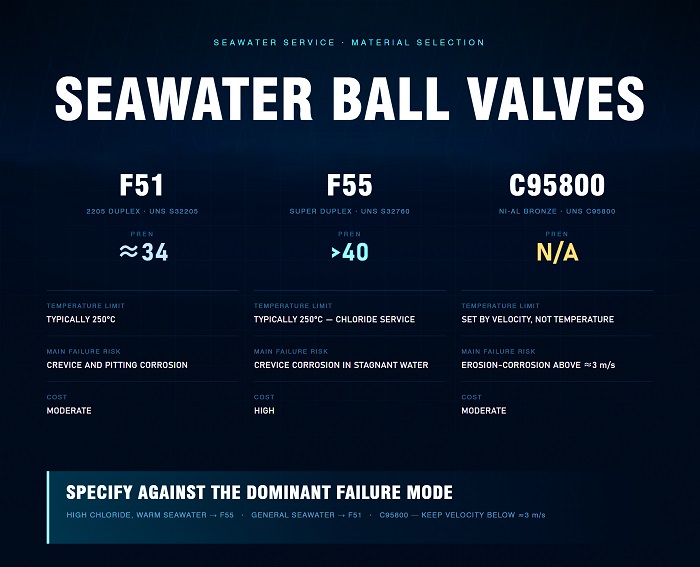
PREN is meaningful only for stainless steels, so the bronze row is judged on film stability and flow limits instead.
3. Failure mechanisms: crevice corrosion versus erosion-corrosion
Two mechanisms account for most seawater valve failures, and they need different answers. Crevice corrosion starts in shielded areas where the passive film cannot rebuild, under gaskets, around bolting, in seat pockets and beneath deposits on the ball; it is a stainless steel problem and it is worst in stagnant, low-flow water. Erosion-corrosion is a copper alloy problem: the protective oxide on bronze is stripped by fast water and the metal beneath is removed faster than the film can reform. Duplex grades tolerate stagnant seawater better, while bronze handles moderate flow but fails where velocity exceeds about 3 m/s.
4. Galvanic and cathodic protection issues
When different alloys meet in seawater, the more active metal becomes the anode and corrodes to protect the more noble one. The galvanic gap is small between duplex and super duplex but large between bronze and steel, so a bronze valve bolted to a carbon steel structure can accelerate corrosion of that structure unless the joint is isolated or the steel is protected. Impressed current and sacrificial anode systems protect submerged steel, but they can over-protect stainless components if the potential is driven more negative than about minus 0.8 V against a silver/silver chloride reference. In most specifications, duplex valves in seawater are left uncoated and isolated from the protection system, while the steel is protected separately.
5. Selection rules for offshore systems
For a fire-water or seawater lift service with long stagnant periods, super duplex is common because it tolerates chlorides without a coating. For a high-velocity cooling line, velocity matters as much as chemistry, and a nickel aluminium bronze body with a duplex or bronze trim is adequate below about 3 m/s. Where traces of H2S appear, the alloy must also satisfy NACE MR0175 / ISO 15156, which caps hardness and limits chemistry for each grade. The documentation has to match the alloy: EN 10204 3.1 or 3.2 certificates for steel bodies, and ASTM B148 or B62 for bronze castings. Where weight is critical, as on a topside module, the higher strength of duplex also allows a thinner wall for the same pressure rating, which partly offsets the higher alloy cost.
6. Frequently Asked Questions
Is 2205 duplex suitable for seawater?
Yes, in most cases. F51 duplex with a PREN of about 34 resists seawater well when flow keeps the surface oxygenated and when crevices are minimised by careful design. It is less suited to stagnant, shielded areas, where crevice corrosion can start. For cold seawater with low flow or heavy marine growth, super duplex such as F55 is the safer choice.
Why do ships use bronze instead of duplex?
Nickel aluminium bronze is chosen because it has a long record in marine use, machines easily, and tolerates moderate seawater velocity without a coating. It is also less costly than super duplex. Its weakness is erosion-corrosion at high flow, so bronze is normally limited to lines where velocity stays below roughly 3 m/s. Duplex is preferred for stagnant or high-chloride duty.
What limits super duplex temperature?
Super duplex grades such as F55 are typically limited to about 250 C in chloride service, because higher temperatures raise the risk of chloride stress corrosion cracking and of sigma phase forming in the microstructure. Above the limit the alloy loses corrosion resistance. In seawater the practical limit is usually set by the water temperature itself and by dissolved oxygen, not by the metal.


