


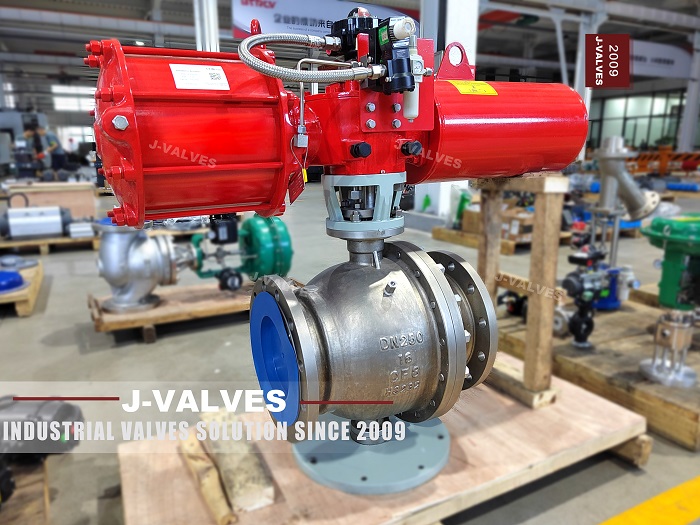
1. Start from torque, not from the actuator
Actuator sizing starts with a torque figure, not with a cylinder diameter. Every ball valve resists rotation with a torque that changes with pressure, seat material, temperature and time in service, and the actuator has to beat the highest figure across the whole quarter turn. The governing value is the break-to-open torque measured at the rated differential pressure and at the coldest or hottest temperature in the datasheet. A valve covering ASME Class 150 to 2500 can show break torque spreading across a factor of five or more between the two ends of that band. Selection therefore runs outward: torque first, actuator second, air circuit third, accessories last.
2. The four torque components
Break torque is not one number but a sum of four terms. Seating torque comes from the interference between ball and seat, and it dominates in soft-seated valves. Bearing friction, at the stem and trunnion, rises with pressure and is the main term on large trunnion-mounted valves. Packing friction is small but constant, and it grows if the stem is over-tightened. The pressure-induced term appears only when the upstream seat seals against the ball and line pressure pushes the ball into the downstream seat. In most specifications the four are added and then multiplied by a service factor of 1.25 to 1.5 to cover aged seals and dry gas. A typical 6 inch ASME Class 300 trunnion valve may show break torque near 300 Nm while running torque falls below 150 Nm.
3. Air supply, consumption and cycle time
Double-acting actuators need air to open and air to close, so the air circuit has to be sized for the worst case of a full stroke against the highest torque. The controlling variables are available supply pressure, usually 4 to 7 bar in plant air systems, and cylinder volume. Air consumption for a double-acting cylinder scales with cylinder volume and supply pressure, while a spring-return unit consumes less on the spring side. Cycle time is set mainly by the flow capacity of the solenoid, the fittings and the tubing, not by the actuator alone. A stroke that the actuator could complete in under one second may take two to three seconds if the solenoid and tubing are undersized for the cylinder.
4. Accessory selection matrix
Accessories turn a working actuator into a controlled one, and each item answers a specific failure question. A typical on-off automated valve carries at least two accessories, while a modulating valve usually carries four. The matrix below lists the common items and the condition that justifies each one.
| Accessory | Function | When required |
|---|---|---|
| Solenoid valve | Directs air to open or close the actuator | Any remote or automated operation |
| Limit switch box | Reports open and closed position to the control system | When the DCS or PLC needs feedback |
| Positioner | Modulates the valve to a control set point | Control duty rather than on and off duty |
| Air filter regulator | Cleans and stabilises the supply pressure | When plant air varies or carries moisture |
| Quick exhaust valve | Vents cylinder air to speed the stroke | When cycle time is critical |
| Manual override | Allows hand operation during air loss | Maintenance and commissioning access |
| Standard mounting interface | Standardises accessory ports and mounting | When accessories are added on site |
Every accessory adds a seal, a port and a possible leak path, so the list should be the shortest one that still satisfies the control philosophy.
5. A worked sizing example
Consider a 6 inch, ASME Class 300, trunnion-mounted ball valve in dry gas service. The datasheet quotes break-to-open torque of 300 Nm at full differential pressure and running torque of 150 Nm. Applying a 1.5 service factor gives a required actuator output of 450 Nm. A double-acting actuator is then chosen so that its output at the minimum supply pressure, not the nominal pressure, exceeds 450 Nm. Air consumption is read from the cylinder volume at that pressure, and the solenoid is sized so the stroke completes inside the specified cycle time. If the same valve must fail closed on air loss, a spring-return actuator is substituted and must satisfy the larger of open and close torque with spring force alone.
6. Frequently Asked Questions
Double acting or spring return?
Double acting is the default for on-off duty where air is always available, because it gives equal torque in both directions and wastes no spring energy. Choose spring return when the valve must move to a defined position on air or power loss, such as fail closed on a fuel line. Spring return costs more air and reduces the torque available in the direction that compresses the spring.
What safety factor should be added to break torque?
A service factor of 1.25 to 1.5 is typical on top of the calculated break torque. Use the lower figure for clean, lubricated soft-seated valves and the higher figure for dry gas, aged seals, high temperature or metal seating, where torque rises with time. Always compare actuator output at the minimum supply pressure, not at nominal pressure.
How do I make a valve fail closed?
Specify a spring-return actuator whose spring is arranged to close the valve when supply pressure is lost. Confirm that the spring-alone torque exceeds the closing and break-to-open torque of the valve once the service factor is applied. A single-acting spring-return actuator, combined with a solenoid that vents on power failure, gives predictable fail-closed behaviour.


