

CHINA J-VALVES Offers Various High-quality I ndustrial Ball Valves
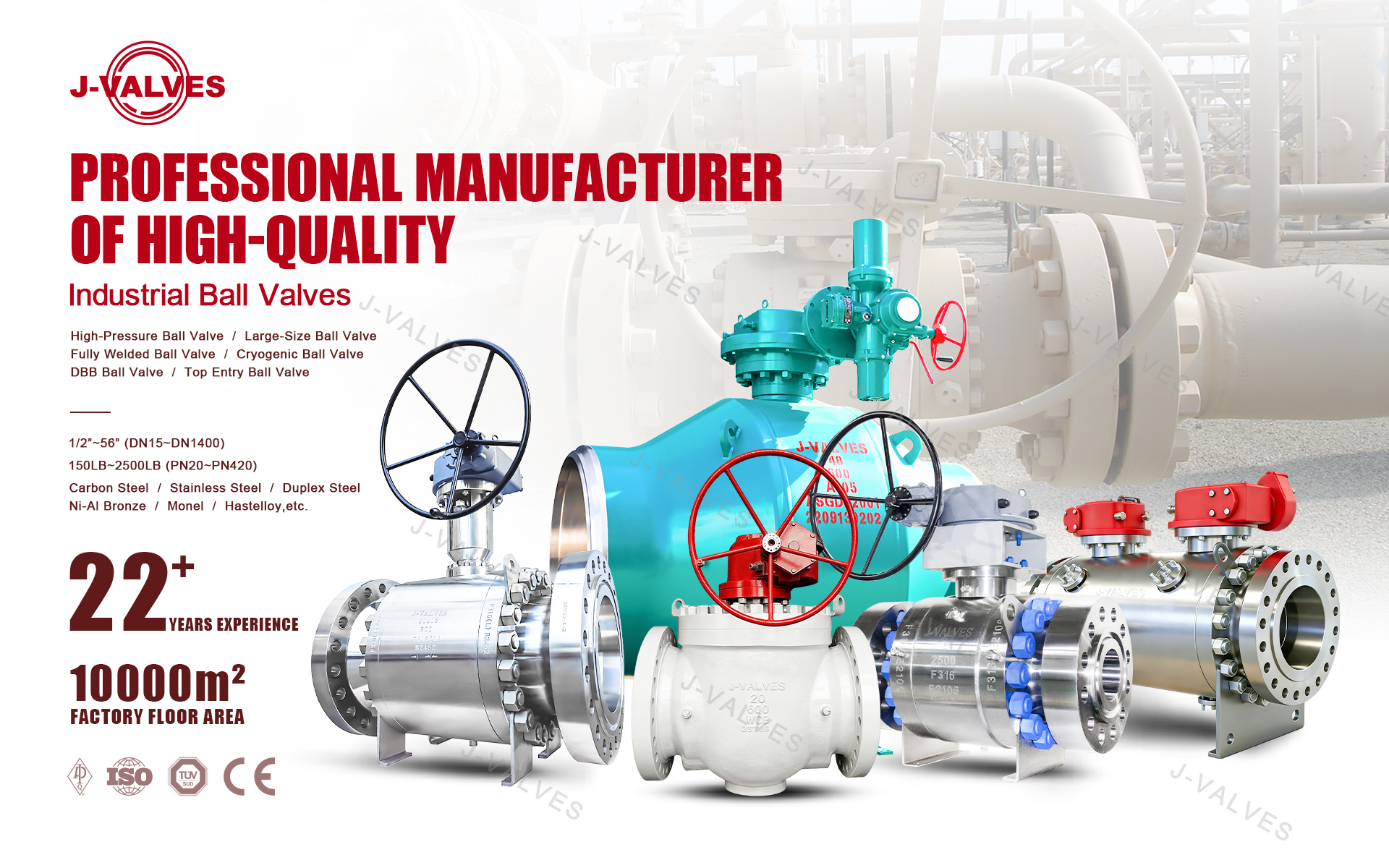
J-VALVES, a distinguished professional ball valve manufacturer rooted in China, takes pride in its extensive product portfolio. Our offerings span a wide range, including trunnion-mounted ball valves, floating ball valves, high-temperature ball valves, high-pressure ball valves, metal-sealed ball valves, ultra-low temperature ball valves, DBB ball valves, Three-way And Four-way Ball Valve, and fully welded ball valves. Each product is a testament to our commitment to precision engineering and reliable performance. Meticulously crafted, they are designed to not only meet but exceed the most stringent industrial demands, ensuring stable operation even under extreme conditions. This enables us to provide our clients with high-value services and makes our valves widely sought-after in industries.
Product Category
Contact Us


Pressure Class: ASME Class 150 / 300
Body Material: ASTM A351 CF8 (304), CF8M (316) on request
Ball: Solid SS304 / SS316, hard chrome or ENP
Seat: RPTFE standard, PTFE or PPL on request
Packing :Flexible graphite, fire safe
Body Gasket: Graphite laminated / spiral wound
End Connection: Flanged RF to ASME B16.5, FF on request
Face to Face: ASME B16.10
Design Standard: API 608, API 6D, ASME B16.34
Fire Test: API 607
Test Standard: API 598
Temperature Range: -29°C to 200°C (RPTFE seat)
Operation: Lockable lever, gear, ISO 5211 pad
-
Q41F
-
J-VALVES
A 304 fire safe floating ball valve is a two-piece flanged isolation valve with an ASTM A351 CF8 body, a solid ball, an RPTFE seat and a graphite secondary sealing path, proved to API 607 and rated Class 150 or 300. It is the default choice for water, air, oil and mildly aggressive chemical service up to about 200°C, where a 316 body would add cost without adding service life.
J-VALVES casts, machines and tests this valve at its works in Wenzhou, Zhejiang, from 1/2 to 8 inch in Class 150 and 300, with flange drilling to ASME B16.5 and face-to-face to ASME B16.10. Every va
lve leaves with a shell and seat record, and a 3.1 certificate with the heat numbers of the body casting and the ball.

What the Fire Safe Designation Commits the Manufacturer To
Fire safe is not a coating, a colour or an extra label on the nameplate. It is a statement that the valve, after being burned, still holds pressure at the seat and at the stem, using only what is left of the metal after the polymer has gone. Three details decide whether that statement is true.
The first is the secondary seat. The soft seat burns away in the first minutes of a fire, so the ball has to land on a metal surface that was machined before the valve was assembled. On a 304 floating valve that surface is the stainless seat carrier or the body itself, lapped to a finish that will seal against a chrome-plated ball with only line pressure to push them together.
The second is the body joint gasket. A PTFE gasket disappears at about 400°C and the two-piece joint opens. Flexible graphite is used instead because it oxidises slowly rather than melting, and it keeps sealing stress on the flange faces while the bolting cools unevenly.
The third is the stem seal. The packing burns, and what remains has to be a graphite collar that the gland can still compress, plus a stem that is bottom-loaded so it cannot be pushed out by the pressure that is now acting on a hot, softened assembly.
A valve can carry the words fire safe and fail all three of these on the test stand. The test is the only evidence, which is why the API 607 report should be read before the certificate is accepted.

API 607: What the Burn Test Proves, and What It Does Not
API 607 burns a valve that has already passed a seat test, then re-tests it hot and again after cooling. The sequence is short, and each step exists because a different failure mode shows up there.
| Step | What happens | What it exposes |
|---|---|---|
| 1 | Baseline seat and shell test at ambient | A valve with a poor seat never reaches the burn |
| 2 | Valve filled with water, pressurised, then burned for 30 minutes at 760 to 980°C | Gasket extrusion, packing consumption, seat destruction |
| 3 | Cooling in still air, no forced draught | Thermal shock and differential contraction of body and ball |
| 4 | Seat leakage test at pressure, both directions | Whether the metal backup actually seals |
| 5 | External and stem leakage check | Whether the graphite packing still has compression |
The test is a pass or fail against a defined leakage allowance, not a rating. It does not tell a buyer how the valve behaves at 300°C in continuous service, it does not cover the actuator, and it does not cover a valve that is only partly open when the fire starts. What it does prove is that the design has a metal path to the seat and a graphite path to the stem, and that those paths were exercised once under conditions no polymer survives.
J-VALVES tests the 304 fire safe valve to API 607 on a witness basis, and the report is issued with the serial number of the valve tested rather than as a generic design certificate.
304 or 316: The Chloride Question
CF8 is the cast equivalent of 304, with about 18 percent chromium and 8 percent nickel. CF8M is the cast equivalent of 316, with 2 to 3 percent molybdenum added. The molybdenum is what resists pitting in chloride, and that single difference decides most of the material arguments on a water line.
| Service | 304 / CF8 | 316 / CF8M | Note |
|---|---|---|---|
| Potable and process water, chlorides under 200 mg/L | Suitable | Suitable, over-specified | Most building and utility water sits here |
| Cooling tower water, chlorides 200 to 500 mg/L | Risk of pitting at stagnant zones | Recommended | Biofouling under a closed ball is the usual start point |
| Seawater, brackish water, de-icing salt | Not suitable | Marginal, duplex preferred | Neither grade is a seawater valve |
| Air, nitrogen, dry gas | Suitable | Suitable | Dry service is the easiest case for both |
| Dilute acids, food and beverage, CIP cleaning | Case by case | Preferred | 316 also tolerates more frequent caustic washes |
| Steam above 200°C | Body is fine, seat is not | Same limit | The seat sets the ceiling, not the body grade |
The practical rule is that 304 is correct wherever the water is potable, the line runs regularly, and the valve is not the low point of the system. It is wrong where chlorides concentrate: a dead leg, a closed ball that traps a slug of water for months, a cooling circuit that is dosed and then left idle. In those places the pitting starts under the seat and the first sign is a weep at the body joint that no amount of gland tightening will stop.
Two Piece Body: What the Split Buys, and What It Costs
A two-piece body splits once, at the downstream flange, and the ball, seats and stem go in through that opening. Compared with a one-piece body it allows the seat and ball to be replaced without cutting the line. Compared with three-piece it is shorter, has one joint instead of two, and costs less to cast and machine, which is why it dominates flanged sizes from 1/2 to 8 inch.
The cost is that the body joint carries the full pressure load and is the first place a fire, a thermal cycle or a bad gasket shows up. Four 304 or 316 bolts hold it, usually B8 or B8M to ASTM A193 with A194 8 nuts. Those bolts are in the load path, so their grade matters more than buyers expect: B8 at ambient is fine, but A2-70 commercial bolts with no traceability are a common cause of a weeping joint six months after commissioning.
The split also fixes the orientation of the valve. The end cap faces downstream, so the valve is not symmetrical, and on a line that reverses flow the installation should be reviewed rather than assumed. A bidirectional seat design seals either way, but the mechanical load on the joint is not the same in both directions.
Rating, Derating and the Real Pressure Ceiling
Class 150 and 300 are ratings at a reference temperature, not working pressures at any temperature. For CF8 in ASME B16.34 group 2.2 the room temperature figures are about 19.6 bar at Class 150 and 51.1 bar at Class 300, and they fall slowly as the temperature rises.
| Temperature | Class 150 allowable | Class 300 allowable | What changes |
|---|---|---|---|
| -29 to 38°C | 19.6 bar | 51.1 bar | Reference band, full rating |
| 100°C | 17.7 bar | 46.6 bar | Minor derating from the material curve |
| 150°C | 15.8 bar | 45.1 bar | Seat creep begins to matter more than the shell |
| 200°C | 13.8 bar | 43.8 bar | Practical ceiling for an RPTFE seat |
| 250°C | 12.5 bar | 41.9 bar | Requires PPL or metal seat, see S12 |
Two things in that table are more useful than the numbers. First, the shell is almost never the limit on a Class 150 stainless valve; at 200°C there is still 13.8 bar available when the process usually runs at 6. Second, the seat reaches its limit earlier than the body, so the honest rating of the valve is the seat rating, and the pressure class only tells a buyer which flange will bolt to the pipe.

Seat and Packing: Where the Ceiling Comes From
The soft seat is the component that decides temperature, torque and service life together, and the choice is narrower than the catalogue suggests.
| Component | Material | Practical range | Behaviour |
|---|---|---|---|
| Seat | PTFE, virgin | -29 to 180°C | Lowest torque, highest creep, not for cycling steam |
| Seat | RPTFE, glass or carbon filled | -29 to 200°C | Standard for this valve, less creep, slightly higher torque |
| Seat | PPL | -20 to 220°C | For hot water and low pressure steam, harder, not for strong solvents |
| Packing | PTFE V-ring | -29 to 180°C | Low friction, but consumes itself in a fire |
| Packing | Flexible graphite | -29 to 400°C | Required for fire safe, higher stem torque when cold |
| Body gasket | Graphite laminated or spiral wound | -29 to 400°C | Keeps the joint closed after the polymer is gone |
RPTFE is the standard seat and it is a compromise, not a best case. The glass or carbon filler reduces cold flow, which is what allows the seat to hold pressure at 150°C without taking a permanent set, but the filler also raises breakaway torque by 15 to 30 percent against virgin PTFE. On a hand-operated valve that is noticeable at 4 inch; on an actuated valve it changes the actuator size.
Graphite packing is the other half of the fire safe claim, and it is the reason a new valve feels stiffer than a PTFE-packed one. Graphite has no plasticiser to migrate, so it does not shrink away from the stem over a thousand cycles, but it needs a higher gland load to seal at low pressure. A valve that weeps at 2 bar and holds at 10 bar is usually under-torqued at the gland, not defective.
How to Specify This Valve Without a Second Round of Questions
Six lines on a datasheet resolve the whole configuration. Anything missing becomes a question, and a question becomes a week.
| Item | What to state | Common omission |
|---|---|---|
| Size and class | DN or inch, Class 150 or 300, full or reduced port | Port type, which changes Cv and cost |
| Body material | CF8 for 304, CF8M for 316, and the casting standard A351 | Whether 304 is acceptable at all |
| Trim | Ball grade, seat material, packing material | Seat temperature, so RPTFE gets offered for 250°C |
| Ends | Flange drilling, face type RF or FF, face-to-face standard | FF for cast iron mating flanges |
| Operation | Lever, gear, or ISO 5211 size if actuated later | Pad size, which is not interchangeable after the fact |
| Documents | EN 10204 3.1, API 607 report, API 598 test record | Whether the fire report is per valve or per design |
Torque belongs on the datasheet too, even for a lever valve, because it is the number that decides whether the valve can be actuated later without changing it. For a lubricated clean-water duty a 2 inch Class 150 floating valve breaks away at roughly 25 to 35 Nm; add 50 percent for dry service and double it for a slurry. The ISO 5211 pad on this valve is a low pad, which takes a direct-mounted actuator but limits the stem square, so a buyer who plans to automate in year two should order the high pad version covered on page S06.
Testing, Records and What Should Arrive With the Valve
The routine test is API 598: a shell test at 1.5 times the 38°C rating and a seat test at 1.1 times, both with the valve half open for the shell and closed for the seat, in both directions. A 304 valve is hydrostatically tested with water unless the buyer asks for air, and the water is drained and the bore dried before packing because a trapped slug freezes in winter transit and cracks a body that passed every test.
Documentation is where a low-cost supplier and a project supplier separate. The set that clears an audit is: EN 10204 3.1 certificate naming the body heat and the ball heat, API 598 test record with the actual pressures and durations, API 607 fire report, a dimensional report for face-to-face and flange, and the anti-static continuity check. NACE MR0175 is available on request, and it changes the bolting and the ball hardness rather than the body grade.

FAQ
Is a 304 fire safe ball valve the same as a fire rated valve?
In practice yes, and the wording matters when a specification is being checked. Fire safe normally means the design has been qualified to API 607 or API 6FA by test. Fire rated is sometimes used for a valve that only has a fire safe certificate for a different size or pressure class. Ask for the report with the size and class on it.
Can a 304 valve be used in seawater?
No. 304 has no molybdenum and pits in chloride above roughly 200 mg/L, especially under a closed ball where water sits stagnant. 316 is better but still marginal in true seawater, where a duplex or super duplex body is the correct answer.
What is the maximum temperature for an RPTFE seat?
About 200°C in continuous service, and less if the valve cycles. Above that the seat creeps under load and the valve loses preload, so the leak appears after a few thermal cycles rather than at once. PPL reaches about 220°C and a metal seat is used above that.
Why does the body have an anti-static device, and how is it checked?
A ball rotating in a dry medium can build a charge that has no path to earth through the seat and packing. A spring between the stem and the body, or a conductive seat, provides the path. It is checked with a resistance meter between ball and body, and the usual acceptance limit is under 10 ohm.
What is the difference between a low pad and a high pad for the actuator?
Both are ISO 5211 mountings. A low pad sits close to the body and suits a direct-mounted pneumatic actuator on a lever valve. A high pad raises the mounting face to clear the pipe insulation and takes a larger stem square, which is what an electric actuator or a valve with 50 mm of insulation needs.
Hot Products


News
Ball Valves in Amine CO2 Capture: Heat Stable Salts, Rich Amine, And The Three Places The Body Thins
Rich amine at 110 C with heat stable salts is where capture plant ball valves fail. Materials, velocity limits, cavity gas and seat choice, with numbers.
Read More
Fail-Safe Ball Valve Actuators: Spring Return, Stored Air, And The Torque Nobody Checks
Spring return or stored air? The answer is a torque curve, not a datasheet box. Sizing, receiver volume, closing time and four silent failures.
Read More
Ball Valve Stem Leak: The Gland, The Backseat And The Repair That Cannot Be Done Live
A stem leak on a quarter turn valve is four different failures. What gland tightening buys you, why the backseat is usually absent, and what needs a shutdown.
Read More
Ball Valves in A Kraft Pulp Mill: Black Liquor, Green Liquor And The Cost of Choosing The Alloy by Habit
White liquor at pH 14 cracks carbon steel welds, black liquor sets solid below 100 C, green liquor dregs grind seats: alloy choice and torque in a kraft mill.
Read More