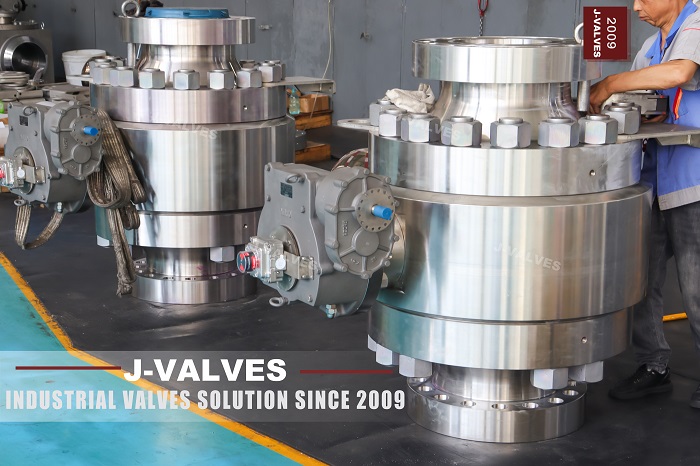
A large valve is not a small valve with bigger numbers
Every dimension of a ball valve grows with nominal size, but four things grow faster than the size does: the mass of the ball, the torque needed to turn it, the difficulty of machining and assembling the body, and the size of the equipment needed to prove the valve holds. Those four are the reason a large diameter ball valve is not a scaled drawing of a small one. It is a different set of decisions, and the vocabulary changes with it: trunnion instead of floating, gear instead of lever, split body instead of one piece, and a test bench instead of a test rig.
None of those changes is a preference or a marketing feature. Each one is forced by a limit that arrives at a particular size, and the four limits do not arrive together. That last point is the useful one for a buyer, because it explains why no catalogue can give a single size at which "large" begins, and why a specification that names a size instead of a requirement usually ends up arguing about the wrong thing.
Limit one: the ball's own weight starts to load the seat
In a floating design the ball is held only by the two seats. Line pressure pushes it into the downstream seat, which is what produces the seal, and the seats carry the ball. That arrangement works because the ball is small enough that its mass is negligible next to the pressure force. As the ball grows, its mass grows with the cube of the diameter while the seat contact area grows only with the square, so the share of the seat load that comes from the ball itself keeps rising. In a horizontal line the weight does not act along the seat axis at all; it acts downward, and it tends to let the ball settle slightly off centre and move the contact band away from where it was lapped.
There are two ways out, and they fail differently. The first is to carry the ball on trunnions so that its weight goes into the body through the trunnion and its bearing instead of into the seats. That is what a trunnion mounted ball valve is for, and it is why the design appears at large size rather than by fashion; the structural difference between the two designs is set out in floating versus trunnion mounted ball valves. The second is to make the ball lighter, which in practice means a hollow ball rather than a solid one. That solves the load and creates two new questions: the shell has to be closed by welding, so the weld becomes a pressure boundary that has to be sound and inspectable, and the sphere has to stay round under seat squeeze, which is a stiffness question rather than a weight question.
So the honest version of the usual question is not which design is better. It is where the weight goes, and whether the answer was written into the drawing or left to the supplier's default.
Limit two: the operator stops being a lever
Torque rises with size for reasons that do not change: a larger seat contact runs at a larger radius, the ball surface area under seat load grows, and the stem has more bearing and packing friction to overcome. A lever converts a fixed force applied by a person into a torque through a fixed arm. Both halves of that are bounded, so at some point the lever stops being a design option and a gear operated ball valve takes its place, with an actuator as the next step after that.
What the buyer should notice is not the gear itself but what it does to the valve. The top works change: the stem has to be long enough to clear the gear housing, the mounting pad has to be machined to the ISO 5211 interface that the operator will use, and an adapter has to be made to sit between them. A gear also turns a quarter turn into many handwheel turns, so operating time stops being instantaneous and becomes something the operating procedure has to state. And the torque figure the valve actually needs has to reach whoever selects the operator, because a gear chosen on a guess will either be too weak in the seat region or too strong for the stem. How the three torque figures travel from the valve to the operator is covered in actuator sizing and the torque chain.
Limit three: the body stops being one piece
A one-piece body is assembled by putting the ball in through the bore and then fitting the seats behind it. At small sizes that is a sequence; at large sizes it becomes a geometry problem, because the ball is nearly as large as the bore it has to pass and the seat rings have to reach their pockets behind it. The result is that a large diameter ball valve body is normally split into two or three pieces, or built as a top entry body where the ball and the seats come out through the top.
The machining reason arrives at roughly the same place. The seat pockets at both ends have to be bored concentric with each other, and a single-piece body of that size cannot be reached from both ends by the machine that has to hold it. So the ball valve body split is a manufacturing necessity before it is a maintenance feature, and the maintenance benefit is a by-product that happens to be very useful.
What the split costs is a joint, and a joint is a pressure boundary that did not exist before. A bolted body joint needs a gasket, correctly tensioned bolting, and on the better designs a captive arrangement so the gasket cannot be displaced during assembly or during a thermal cycle. A welded body joint removes the gasket and removes the possibility of opening the valve at all, which turns the valve into a sealed unit for life. Neither is wrong; they answer different questions, and the question should be asked before the order rather than after the first seat replacement.
The split also has a handling consequence. Each half has its own mass and its own lifting points, and the assembly sequence at site has to be planned by someone who knows which half carries the seats.
Limit four: the test bench and the crate
A ball valve is proved by a shell test at 1.5 times its rated pressure, and a seat test at 1.1 times. Those multipliers are fixed by API 598 and do not relax with size, so the absolute test pressure rises with the class and the force on the end closures rises with the square of the bore. A ball valve test bench therefore has to provide the right flange size, end closures that can take the thrust, enough water to fill the body, and a pit or a frame that lets the valve be examined while it is under pressure. A large bore ball valve has to be proved on that equipment, so the bench becomes part of the product specification whether or not it appears on the drawing, and on the largest sizes it is the bench rather than the machine shop that decides the delivery date: a factory that cannot test a valve cannot ship it, however well it machines it.
Then the valve has to travel. Large ball valve shipping is a discipline of its own: lifting points on the body rather than slings around the bore, blind ends so the machined faces and the seat area are not damaged, a case designed for the mass and the centre of gravity, and a decision about whether the unit travels in a container or needs a flat rack. A DN1400 ball valve is not a parcel. Most transport damage on large valves is not a manufacturing defect at all but a lifting or packing decision made by someone who was not told what the valve weighs or where it may be lifted.
What does not change at any size
The sealing principle does not scale away. The valve still turns through 90 degrees, the seat still has to be squeezed against a lapped ball, the seat test is still at 1.1 times rated pressure, the leakage acceptance is still expressed against ISO 5208 rates, and the seat material still sets the temperature ceiling of the whole valve: PTFE seats to about 180 °C, PPL to about 280 °C, PEEK to about 260 °C, with metal seats and their thermal clearance for anything above that. A certificate is still a certificate, and EN 10204 3.1 is still issued by the manufacturer's inspection department rather than by the sales office.
This matters because large valves sometimes get relaxed "because they are large". There is nothing in API 598, API 6D or ISO 5208 that relaxes with size. What changes with size is the difficulty of achieving the same result, which is a reason to ask more questions, not fewer.
Why there is no single size where this begins
The four limits do not cross at one diameter, and each crossing moves with other variables. Class moves the first one: a small bore in a high class can need a trunnion before a much larger bore in a low class does, because the pressure load on the seats arrives earlier than the ball's own weight. The medium moves it too: a gas duty and a liquid duty do not need the same seat load to seal, so the same valve can be marginal on one and comfortable on the other. Material moves the ball's mass, the installation moves whether weight acts along the seat axis at all, and whether the valve is manual or actuated moves the operator limit by a long way. The factory's bench and crane move the fourth limit, and they are not part of the valve at all.
That is why a specification that says "trunnion mounted above a certain size" is weaker than one that says "trunnion mounted", and why a supplier cannot answer "at what size" honestly without knowing the class, the medium and the orientation. The requirement can be written; the threshold cannot.
The four limits against the enquiry

Five lines to add to the enquiry for a large valve
First, the orientation: horizontal or vertical, and whether the stem is up, because it decides whether the ball's weight acts along the seat axis. Second, the operator: bare stem, gear operated ball valve or actuator, with the ISO 5211 interface named and the torque figure attributed to a party rather than left open. Third, the body style and the joint: two piece, three piece, top entry or welded, and whether the joint gasket must be captive. Fourth, the proof: which standard governs the shell and seat tests, whether the test is witnessed, and at which hold points. Fifth, the movement: lifting points on the body, packing specification, and the delivery term.
None of the five adds cost by itself. What they remove is the space in which a supplier has to guess, and on a large valve a guess is expensive in both directions: guessed light and the valve does not hold, guessed heavy and the buyer pays for metal and handling that the duty never needed.
J-VALVES builds floating and large bore trunnion mounted ball valves across the ball valve size range from 1/2 inch to 56 inch (DN15 to DN1400) in ASME Class 150 to 2500, with two and three piece bodies, top entry bodies and welded bodies, gear and actuator mounting to ISO 5211, shell tests at 1.5 times and seat tests at 1.1 times rated pressure, and EN 10204 3.1 certificates for the pressure-containing parts.
Frequently Asked Questions
At what size does a ball valve need to be trunnion mounted? There is no single size. The choice is decided by whether the ball's weight and the pressure load can be carried by the seats without moving the contact band, and that depends on the pressure class, the medium, the ball construction and the mounting orientation. A small valve in a high class can need a trunnion before a much larger valve in a low class does, so the enquiry should state the requirement rather than a threshold.
Why is a large diameter ball valve body split into pieces? Because at large size the ball and the seat rings cannot be assembled through a one-piece body, and the seat pockets at both ends cannot be machined concentrically from one side. The split is a manufacturing necessity first; the ability to open the valve for maintenance is a consequence of it, and it introduces a body joint that has to seal.
Does a hollow ball make a large ball valve weaker? Not by definition, but it moves the engineering. The shell has to be closed by a weld that is a pressure boundary, and the sphere has to remain round under seat squeeze. A hollow ball is normally chosen to reduce mass and the load it puts on the seats and trunnions, not to save material for its own sake.
Can a large ball valve be repaired in line? It depends on the body style rather than the size. A top entry body allows the ball and seats to be reached from above with the valve in place; a welded body does not open at all; a bolted two or three piece body can be opened but needs the line supported and the joint resealed to the original specification. The body style should be chosen with that possibility in mind at the enquiry stage.
Does the pressure test change for a large valve? The criteria do not. The shell test is still at 1.5 times the rated pressure and the seat test at 1.1 times, to the durations and acceptance criteria of the referenced standard. What changes is the equipment needed to apply it and the time the valve occupies the bench, which is often what actually decides the delivery date on a large order.