Two different failures, one lever
A ball valve that will not turn is asked the same question in two completely different situations. The first is a valve that has never worked properly: it came out of the crate stiff, or it seized within its first few cycles, and the cause is in the build, at a surface where two similar metals welded together. The second is a valve that worked for two years and then began to tighten, month by month, until the lever needed two hands. The first is a materials and assembly problem. The second is a service problem, and it is the one this article is about.
The two are worth separating before anything is dismantled, because they lead to opposite actions. A valve that galls needs parts replaced and a specification changed. A valve whose ball valve operating torque has climbed in service usually needs a diagnosis of the process, the seat, the stem or the alignment, and replacing parts without that diagnosis buys one more interval of the same failure. The good news is that the second case can be diagnosed without taking the valve out of the line, using one measurement that most sites never take.
The measurement nobody takes
Torque is the only signal a ball valve produces continuously, and it is almost never recorded. A valve is commissioned with a lever that moves easily, the fact is noted as satisfactory, and nothing is written down. Two years later, the same valve is stiff and there is no baseline to compare against, so the discussion moves to opinions: it was always like that, it got worse after the shutdown, the medium is aggressive, the seat must be swollen. None of those statements can be tested, because there is no starting number.
What should be recorded at handover is small and takes a few minutes per valve. The turning effort at the open stop and at the closed stop, measured with the line at pressure and again with the line isolated and vented, and both repeated with the line at operating temperature if the valve can be reached safely at that condition. Four numbers, a date and the name of the person who took them. With those four numbers, every later complaint becomes a comparison; without them, the first useful reading is the one taken on the day the valve fails, which is the day the reading is least useful.
The instrument does not need to be elaborate. A torque wrench on the stem square, or a spring balance on the lever at a measured distance, gives a number that is consistent enough to show a trend. What matters is that the same method, the same direction and the same person are used each time, because the variation between methods is larger than the change being looked for. Sites that already collect other condition data will recognise the same logic in ball valve condition monitoring; the difference is that this signal needs nothing beyond a wrench and a record sheet.
The test: pressure on, pressure off
The single most useful diagnostic in this subject is a comparison of two readings taken at the same temperature, in the same direction, on the same valve: one with the line pressurised, one with the valve isolated and the downstream side vented so that no differential pressure remains across the seat. The difference between the two readings splits the causes into two groups.
If the effort collapses when the differential is removed, the resistance was coming from the seat, because the seat is the only part of a ball valve whose load is set by line pressure. If the effort is unchanged, the resistance is mechanical: deposits, the stem, the packing, a bearing, or a body that is being held out of shape. Nothing else in the valve responds to pressure in that way, which is why the test is so decisive. It can be run with the valve in the line, with the line isolated and locked out, and it needs no parts.
A second reading completes the picture: stroke the valve a few times and measure again. A deposit is altered by movement, so its resistance changes, often improving for a while and then returning. A welded or seized surface does not change at all. A packing that has taken a compression set does not change either. Between the pressure test and the stroke test, four of the five causes below can be identified on site, without dismantling anything.
Temperature has to be controlled or at least recorded, because every clearance and every polymer property in the valve changes with it. A valve measured cold and compared with a valve measured hot will show a difference that has nothing to do with wear, and a valve that stiffens only when hot is telling you something about the seat, the clearance or the alignment rather than about deposits.
Cause one: differential pressure on the seat
The first cause is not a fault. In a floating ball valve the line pressure pushes the ball into the downstream seat, so the ball valve seat load, and therefore the friction between seat and ball, rises with the differential across the valve. Close the valve against a high differential and the effort needed to reopen it is the highest the valve will ever demand. A trunnion mounted valve behaves less steeply because the ball is supported and the seat is loaded by its own spring and by pressure on a smaller annular area, but the trunnion ball valve torque still rises with differential, and the same test applies.
The signature is unmistakable once the test is run: heavy when pressurised, free when vented, and identical from the first day of service. The answer is not a repair. It is an operator sized for the worst condition, or a bypass that equalises the pressure before the valve is opened. The mechanics of that load are set out in floating ball valve torque and seat loading, and the practical point here is that a valve in this condition is working exactly as designed, and any attempt to fix it by changing parts will produce a new valve with the same behaviour.
Cause two: deposits on the ball and in the seat pocket
Ball valve deposits are the most common cause of a genuine rise in service, and the easiest to confirm. A ball valve torque increase that appears over months, rather than from the first stroke, is usually this. Material builds on the ball surface, in the seat pocket, around the seat spring and in the body cavity. The ball then has to force its way through a layer that was not there when the valve was set up, and the effort rises with the thickness of the layer rather than with the pressure.
The signature has three parts. The effort is independent of line pressure, so venting the line changes little. It is uneven and often gritty, sometimes with a crunch at one point in the stroke. And it changes with movement: after a few strokes the high spots are wiped away, the valve turns more easily, and then the deposit rebuilds over the following days. It is usually worse after a shutdown or a cold night, because that is when the material came out of solution or stopped flowing.
Two further observations help. The effort is often different in the two directions, because the deposit is laid down on the side the flow reaches. And on valves that are left in one position for long periods, the deposit forms a ring on the ball at the seat contact line, so the valve is stiff at the start of the stroke and free once the ring has been passed.
The mechanism by which such layers form is medium-specific, and it belongs to the process rather than to the valve. What matters for diagnosis is that the valve is reporting a process condition. Cleaning the ball and re-seating the valve without changing anything upstream will reproduce the same deposit on the same schedule, and the second failure usually arrives faster than the first because the line now has a proven tendency.
Cause three: the stem, the packing and the stem bore
The third cause sits above the ball and is completely independent of line pressure, which makes it the easiest to identify once the pressure test has been run. Three things happen in the stem area at the same time. The packing takes a compression set under the gland load and, after months without movement, consolidates into a harder ring that grips the stem more tightly than it did when it was installed. The lubricant applied at assembly dries, oxidises or is washed out, leaving the stem surface in the bore with nothing between the metals. And in corrosive or wet service, the stem surface itself can carry corrosion products that increase friction and, in the worst case, damage the packing as it moves.
The signature is a valve that is heavy in both directions, heavy whether or not the line is pressurised, unchanged by stroking, and often noticeably heavier after a long idle than after a period of regular use. The stem may show a matte band where the packing has been sitting, and the bore may show a dry, stained or slightly pitted surface. Ball valve stem friction of this kind is often the real content of a complaint that is described as a stiff ball.
The instinct at this point is to tighten the gland, and it is the wrong instinct. Tightening compresses the packing further and adds friction on the same stem, so the valve becomes harder to turn in exchange for a leak that may not have been the problem. The correct actions are to slacken the gland to its specified condition, to check whether the packing is live loaded, and to lubricate or replace the stem surface if it is no longer smooth. Gland load, packing condition and leakage form a separate subject; what matters here is that the same load produces both the seal and the ball valve packing friction, and that adding load to cure one makes the other worse.
Cause four: the trunnion bearings and the seat pocket faces
On a trunnion mounted valve the ball does not rest on the seats; it is carried by a stem at the top and a trunnion at the bottom, each running in a bearing or a bushing. Those bearings carry the weight of the ball and the side load from the flow, and they have to move under a load that line pressure does nothing to relieve. Contamination reaching them, water standing in the cavity, or a bearing that has brinelled under vibration while the valve stood still all raise the effort in a way that has nothing to do with the seat and nothing to do with the medium's chemistry.
The signature is specific. The effort is high from the first degree of travel rather than rising through the stroke, and in a brinelled bearing it often shows as a notch at the same angle every time, because the rolling elements or the bushing have dented the race at the position where the valve sat. Ball valve bearing friction of this kind also tends to be worse after the valve has been left in one position for a long period, and it does not respond to line pressure at all.
Water in the cavity is the most common route in. A valve in a wet or buried location, a cavity that has been collecting condensate, or a stem seal that has been passing slightly for a year will all put moisture where the bearing sits. The relevant question is not only what the bearing is made of but whether the cavity can drain and whether the valve is installed in an orientation that lets it. What the bearings carry, and how they fail when they are starved or contaminated, is a subject in its own right; for the diagnosis here the point is that their friction belongs to the mechanical group and not to the seat.
Cause five: a body that is being held out of shape
The fifth cause is the one that appears after the valve has been installed, and it is the one most often blamed on the valve. A body that is bolted between two flanges which are not parallel, or which have been pulled together to close a gap, is bent by the bolting. The seat pockets are no longer coaxial with the ball, the ball is pinched between two seats that are no longer square to each other, and the effort rises. The same thing happens when a line goes hot and the pipe expands against a valve that is anchored between two rigid supports.
The signature is a valve that was free before installation and heavy afterwards, heavy at every angle of travel rather than only at the ends, and unchanged by venting the line. It may also leak slightly, and the leak may change with temperature. A useful confirmation, if the line can be safely isolated and vented, is that the effort falls when the flange bolting is slackened; that is a diagnostic, not a repair, and it must never be attempted on a live line.
The cure is at the piping, not at the valve: bring the flanges parallel, support the spool, and do not use the valve as a pipe clamp. A valve that has been distorted for long enough may also have taken a permanent set in the seat or the body, in which case correcting the piping will reduce the effort but not restore the original figure.
What not to do: a bigger actuator
The common response to a stiff valve is a larger actuator, a longer lever or a higher air pressure. It works, in the sense that the valve moves, and it converts a diagnosable problem into an undiagnosed one. The additional force goes through the same stem, the same drive and the same stop, so the next failure is a twisted stem, a sheared drive or a cracked stop rather than a stiff lever. On an automated valve it also removes the only signal the site had, because the actuator no longer labours and nobody notices the next increase.
Ball valve actuator overload is a real failure mode in its own right, and it usually begins with an actuator chosen on the catalogue figure rather than on the measured one. If the valve genuinely needs more torque than the operator can supply, the reason has to be established first, and the sizing then follows the measured condition at the worst temperature and the worst differential. The method is set out in actuator sizing and the torque chain; the discipline is to size after the diagnosis, not instead of it.
Matching the cause to the signature
The table below is the working summary. Read it with the valve in the line, after the pressure test and the stroke test have been run, and before any part is ordered.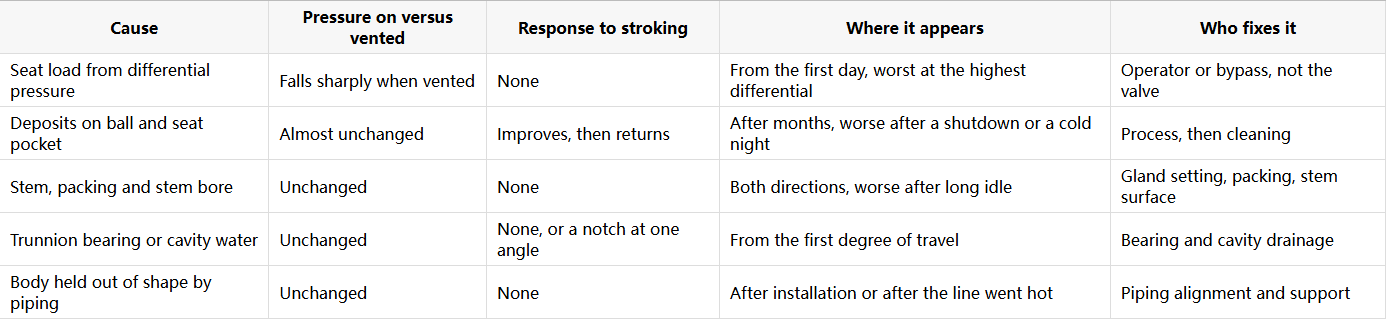
Two combinations are worth recognising because they are common and misleading. A valve that is stiff only when hot, and only when pressurised, has a seat that is losing clearance as it grows, and the answer is in the seat and clearance design rather than in the medium. A valve that is stiff at one angle only, in both directions, with the line vented, has a mechanical obstruction or a brinelled bearing, and no amount of cleaning the seat will change it.
What to record, and what to write into the order
Three things on the purchase order make this diagnosis possible later. State the operating torque figure with the conditions it applies to, because a number without a condition is not a specification; a figure quoted at ambient with no differential says nothing about the valve in service. State the seat material and the temperature it is rated for, so that a later swell or a later loss of clearance can be attributed rather than guessed. And state whether the valve is expected to be operated frequently or to stand in one position, because that changes what the packing, the bearings and the seat should be.
On site, the handover record described earlier is the other half. Four numbers, a date and a name convert every later complaint into a comparison, and they make the difference between a valve that is repaired and a valve that is replaced by guesswork. A maintenance team that has the baseline can run the pressure test, read the table and order the right part on the first attempt; a team without it will do all of those things in the wrong order, starting with the seat.
J-VALVES builds floating, trunnion mounted, top entry and fully welded ball valves from 1/2 inch to 56 inch (DN15 to DN1400) in ASME Class 150 to 2500, with seat and stem materials named on the drawing, ISO 5211 mounting pads for actuation, shell tests at 1.5 times and seat tests at 1.1 times rated pressure to API 598 or API 6D, and EN 10204 3.1 certificates for the pressure-containing parts. Where a duty involves frequent operation or a high differential, the seat and operator are selected for the measured condition rather than for the catalogue figure.
Frequently Asked Questions
Why is my ball valve hard to turn only when the line is pressurised? Because the seat load is set by the differential across the valve. In a floating design the line pressure pushes the ball into the downstream seat, and the friction between seat and ball rises with that pressure. If the effort falls away when the line is isolated and vented, nothing is worn out; the valve needs an operator sized for the worst differential, or a bypass to equalise pressure before it is opened.
Can a stiff ball valve be freed by working it back and forth? Sometimes, and the result tells you what the cause was. If the effort improves after a few strokes and then returns over the following days, the resistance is a deposit being wiped and rebuilt. If nothing changes at all, the cause is mechanical: the stem, the packing, a bearing or a distorted body, and stroking it harder will not help.
Does tightening the packing gland make a ball valve harder to turn? Yes, and it is a common own goal. The gland load is what produces ball valve packing friction on the stem, so tightening a gland that was already at its specified condition adds effort in exchange for a leak that may not have been there. If the stem is heavy in both directions and the effort does not change with line pressure, the gland setting and the stem surface are the first things to look at.
How is ball valve torque measurement taken in the field? With a torque wrench on the stem square, or a spring balance on the lever at a measured distance, using the same method and the same person each time. Take it at both stops, with the line pressurised and again vented, and at operating temperature where that can be done safely. The absolute figure matters less than the trend, provided the method never changes.
Is it worth fitting a larger actuator to a valve that has become stiff? Only after the cause is known. A larger actuator moves the valve and hides the signal, while the extra force goes through the same stem, drive and stop, so the next failure is a broken part rather than a stiff lever. Diagnose first with the pressure test, then size the operator for the measured condition.