


Where the polymer stops
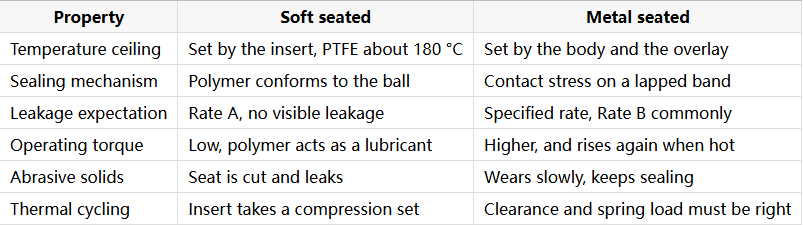
A soft-seated ball valve is a temperature-limited device, and the limit is not the body. The body can carry the full range the line asks for, but the seat insert sets a much lower ceiling: PTFE to about 180 °C, PPL to about 280 °C and PEEK to about 260 °C. Above those numbers the polymer stops behaving like a seal. It creeps under load, extrudes into the clearance gap, loses its elastic recovery, and at the top of its range begins to degrade. A valve whose body is rated for the full range but whose seat is PTFE is, in practice, a valve rated to the seat.
The metal-seated valve is the answer, and it is worth being clear about what changes. Not just the material of one part, but the sealing mechanism, the torque, the leakage expectation, and the way the seat is set at the factory.
Two hard surfaces instead of one soft one
A polymer seat seals by conforming. It flows into the microscopic profile of the ball, tolerates a scratch, and closes on a band that is wide relative to what it has to bridge. A metal seat cannot conform to anything. It seals on contact stress over a narrow band, and the whole load is carried by two hard surfaces that have to be geometrically right: the ball must be spherical to a tolerance the seat can follow, and the seat face must be lapped to that ball. There is no forgiveness in the joint, which is why the surface and roundness work that improves a soft seat becomes the entire design for a metal one.
The consequence for the buyer is that leakage becomes a rate rather than a state. A metal-seated valve is specified to a leakage class, tested, and accepted at that class. It is not bubble-tight in the sense that a PTFE seat is, and a specification that asks for both a metal seat and no visible leakage has asked for two different things at once.
Growth: the ball and the seat do not grow together
At temperature three things move at once. The ball grows in diameter. The seat ring grows in diameter. The housing around the seat grows as well. The ball grows in proportion to its own diameter, the ring in proportion to its own, and the ball usually runs hotter than the body because it sits directly in the flow. The net effect is that the running clearance between ball and seat closes as the valve heats up.
If it closes to zero the seat is being crushed against the ball. Torque rises sharply, the seat spring goes solid, the overlay begins to wear, and on cool-down the seat is left permanently deformed or the ball is scored. In the field this shows up as a valve that turns freely cold, seizes at temperature, and leaks once it is back at ambient. Preventing it is a drawing decision rather than a purchasing one: the clearance is set for the hot condition, and the seat carrier is given travel in both directions so that growth has somewhere to go.
Clearance is set on the drawing, not in the catalogue
One practical consequence: the same valve cannot be supplied for a moderate design temperature and for the top of the range with identical internal geometry. The clearance and the seat travel are worked out for a stated design temperature and recorded on the general arrangement drawing. If the design temperature changes after the order, the body material question is the easy one; the seat geometry has to be reviewed as well, and a supplier who only reissues the material certificate has not answered the question.
The other consequence concerns the stem. On a trunnion-mounted valve the stem grows axially with temperature and pushes against its bearing and its packing, so the gland has to absorb that movement without losing preload. That is why live loading is standard rather than optional on a high-temperature trunnion valve.
Keeping the seat in contact: where the load comes from
A metal seat needs a minimum contact stress at all times, and the source of that stress changes with the operating state. At high differential pressure, line pressure pushes the seat onto the ball and supplies most of the load. At low differential pressure there is almost nothing available from the process, and the load comes entirely from the springs behind the seat, preloaded at assembly.
That is why a metal-seated valve which holds at full pressure can still weep at low pressure: the seat load collapses with the differential, not because the seat is damaged. It is also why the low-pressure seat test is not a formality, and why a metal-seated valve should be tested at both ends of its pressure range rather than only at the rating.
Hardfacing: choose a pair, not two of the same
The wear surface on a metal seat is an overlay, and the choice is a pair rather than two independent decisions. Cobalt-based Stellite 6 is the usual seat overlay: it keeps its hardness at temperature, resists galling, and can be machined and lapped after deposition. Against it, the ball normally carries either a tungsten carbide HVOF coating or a different cobalt or nickel alloy, so that the two surfaces in sliding contact are not identical. Two identical cobalt overlays in dry contact under load will gall, and a galled seat leaks along the tear.
Two manufacturing points decide whether the overlay survives. It has to be thick enough to be finished after deposition, because the lapped geometry is cut into the overlay and not into the base metal beneath it. And the edge of the overlay on a thin seat lip is where cracking starts, so a cobalt layer running to a sharp edge will craze under thermal cycling and the crack becomes a leak path. Inconel 625 appears in these valves as well, but for corrosion resistance rather than wear, and it should not be substituted for a wear overlay on the strength of its corrosion data.
What leakage class to specify
ISO 5208 defines the classes, and the tabulated rates scale with nominal size. Rate A, no visible leakage, is a soft-seat claim; on a metal seat it is achievable in small sizes and unrealistic in large ones. Rate B is the usual specification for a metal-seated ball valve, with Rate C accepted for large sizes or for the most severe temperature, where the differential growth simply cannot be held closer.
API 598 is the other route and is what most oil and gas buyers write: seat test at 1.1 times rated pressure, in both directions, with the test duration set by size. Whichever is named, the order should also state the test medium, because a metal seat tested on water and a metal seat tested on gas are not the same acceptance, and a valve that passes on water can fail on nitrogen.
Where metal seats earn their price beyond temperature
Temperature is the obvious reason to buy a metal seat and it is not the only one. Abrasive solids such as sand, catalyst fines, slurry and ash cut a polymer seat in a few hundred cycles, while a hardfaced seat simply wears more slowly. High-cycle service with frequent operation favours metal because the seat does not take a compression set. And where the process fluid would swell or attack the polymer, metal is the only option left.
The cost side is real. Torque is higher because there is no polymer acting as a lubricant and because contact is metal on metal, so the operator or actuator has to be sized on the hot, high-friction condition rather than on the ambient one. That single decision accounts for most of the cost difference between a soft-seated and a metal-seated valve, and it is a question for the valve maker rather than for the actuator catalogue.
Proving the design before it goes into the line
An ambient seat test proves that the geometry was lapped correctly. It does not prove that the clearance was set correctly for the design temperature. That needs a hot test: the valve brought to design temperature, soaked until the body is uniform, and then seat tested while hot. A thermal cycling test, heating, operating, cooling and repeating before the final test, catches the seat that deforms progressively and passes only the first cycle. Not every order justifies either, but a first article for a high-temperature line should be asked for.
The same test produces the figure the actuator needs: torque measured hot, after a soak, and preferably after a few cycles, because the cold torque on a data sheet describes the condition the valve will spend least of its life in.
What to write into the purchase order
Six lines: design temperature, and the temperature at which the seat clearance is to be set; ball and seat overlay materials with their hardness and deposition method; the leakage class together with the test standard, test pressure, direction and medium; the seat spring type and its preload basis; whether a hot seat test or a thermal cycling test is required and whether it is witnessed; and the torque figures to be used for actuator sizing.
J-VALVES builds metal-seated ball valves from 1/2 to 56 inch (DN15 to DN1400) in ASME Class 150 to 2500 across the standard -29 °C to +425 °C range, with Stellite-overlaid seats, hardfaced balls, spring-loaded seat carriers set for the stated design temperature, and ISO 5208 or API 598 seat testing at 1.1 times rated pressure in both directions, supported by EN 10204 3.1 certificates for body, ball and stem.
Frequently Asked Questions
When should a metal-seated ball valve replace a soft-seated one? When the design temperature passes the polymer ceiling at the seat, or when abrasive solids, high cycle duty or an aggressive fluid would destroy a polymer insert. The body can often go higher than the seat, so the temperature question should be asked of the seat rather than of the valve as a whole.
Can a metal-seated ball valve be bubble-tight? Generally not to Rate A at large sizes. It is specified to a tabulated leakage class, usually ISO 5208 Rate B, and accepted at that rate. Rate A is a soft-seat claim, and asking for both a metal seat and no visible leakage creates a conflict the valve cannot resolve.
Why does a metal-seated valve leak at low pressure but hold at high pressure? Because seating load comes from the pressure differential. At low differential only the seat spring supplies contact stress, so a weak or coil-bound spring shows up as a weep. That is why the low-pressure seat test matters and why spring preload is a design parameter rather than an assembly detail.


