


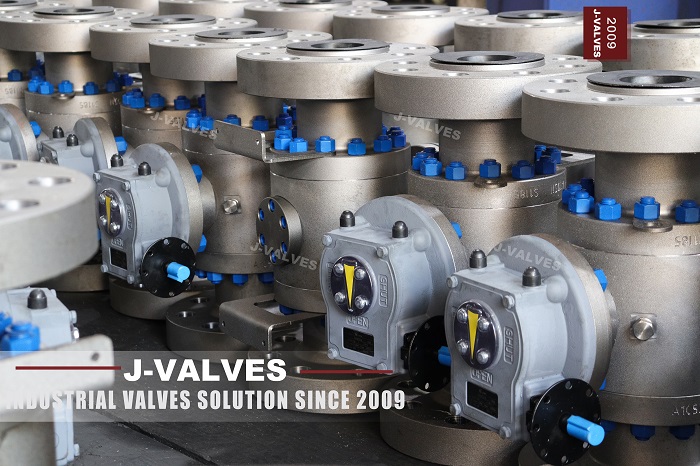
1. Holding the ball instead of pushing it
A floating ball valve lets line pressure push the ball against the downstream seat to seal, which works well in small sizes but turns against you as the bore grows. In a trunnion mounted ball valve the ball is carried on a lower trunnion bearing and an upper stem bearing, so it cannot move downstream under pressure. The seats are the moving part instead: each seat ring is pushed against the ball by a spring stack behind it, and line pressure adds to that load through the piston effect. Because the ball is fixed, the seats seal equally in both directions and the actuator only has to overcome friction at the bearings and the seat contact, not the full force of line pressure on a moving ball. That is why trunnion valves scale up cleanly to 56 inch (DN1400) and Class 2500 while a floating valve of the same size would need an impractically large operator.
2. Spring-loaded seats do the sealing
In a trunnion valve the seat rings carry the seal, so their design decides the leakage class. Each seat is a metal ring holding a soft insert or a hard facing, backed by a set of springs that push the ring onto the ball even at zero differential pressure. At low pressure the springs alone hold the contact, and as pressure rises the ring acts like a small piston: the pressure behind it drives it harder onto the ball, so the seal improves with load rather than relaxing. Two consequences follow. First, the valve can seal in both flow directions with a single seat design. Second, the seat can be made self-relieving, so a trapped cavity pressure above a set value pushes the seat back and vents into the line instead of stressing the body. Where a self-relieving seat is not wanted, an external cavity relief or a double block and bleed arrangement is specified instead.
3. Torque: small actuator, large line
The single biggest reason to choose a trunnion valve in large bore duty is operating torque. A floating ball valve seals by pressing the ball into the seat, so break torque rises steeply with size and pressure class, and the valve can seize after long static periods. A trunnion valve spreads the reaction load across the two trunnion bearings, and the seat friction is controlled by the spring force rather than by line pressure acting through a lever. The result is a flatter torque curve and a break torque that is often 60 to 70 percent lower than a floating equivalent at the same rating. Sizing still has to cover three cases: break to open after a long closure, run torque in the mid stroke, and end torque as the seat passes the port. The actuator is then sized on the highest of the three plus a safety factor, normally 1.3 to 1.5, and the mounting flange follows ISO 5211 so a quarter turn actuator drops straight on.
4. Double block and bleed in one body
Because both seats seal independently against a fixed ball, a trunnion valve can be built to the double block and bleed definitions in API 6D. In a DBB-1 configuration the valve holds pressure from both ends with each seat, and the cavity between the seats is vented and bled to prove the seats are holding. In a DIB-1 configuration the valve seals from both sides with the same seat set, while DIB-2 uses independent sealing in each direction. This matters on station isolation and meter bypass duty, where the operator must prove the valve isolates both sides before breaking the line for maintenance. The bleed connection is fitted with a small valve, and on gas service it is normally left closed and only opened to test, so a trapped cavity cannot vent freely into the atmosphere.
5. Trunnion and floating compared
The table below sets out the practical difference between the two ball support arrangements on the values that drive a selection.sd
| Feature | Floating ball valve | Trunnion mounted ball valve |
|---|---|---|
| Ball support | Seats only, ball moves with pressure | Top and bottom bearings, ball fixed |
| Seat sealing | Ball pressed into downstream seat | Spring loaded seats, pressure assisted |
| Operating torque | Rises steeply with size and class | Low, roughly constant across travel |
| Double block and bleed | Not standard | DBB-1 or DIB available |
| Typical size range | Up to about 8 inch (DN200) | 2 to 56 inch (DN50 to DN1400) |
6. Body styles and where ed
The trunnion support changes how the body is split. A bolted body or side entry valve is the workhorse for refining, pipeline and terminal duty, because the ball and seats can be removed through the side for servicing. A top entry valve lifts the bonnet and the internals out of the top, so the valve stays in the line during maintenance, which suits buried or inaccessible locations. A fully welded body removes the body joint entirely and is used for gas transmission and buried service where a leak to atmosphere is not acceptable; the trade is that internal parts can only be replaced by cutting the body open. The choice is driven by maintenance access and the leak tightness the specification demands, not by pressure rating alone, because all three styles are built across the same Class range.
7. Seat, bearing and stem details that decide service life
Three details separate a long life trunnion valve from one that dies early. The bearing surfaces at the trunnion and stem take the reaction load and must be a hard, low friction material such as a PTFE lined bushing or a metal pair, because any wear here is what ultimately drives up torque. The seat insert follows the usual polymer rules: unfilled PTFE and RPTFE for clean service, PEEK for higher pressure and temperature, and a hard facing or metal seat for solids and temperatures above the polymer limit. The stem carries anti-static continuity between ball, stem and body, and anti-blowout protection so the stem cannot be ejected under pressure. For high cycle or high temperature duty the bearing and seat materials are specified together, since a bearing that cold welds under load will seize the valve long before the seat wears out.
8. Specification checklist for a trunnion valve
Eight items settle the valve before an RFQ goes out: size and pressure class, body style, seat type and whether it is self-relieving, the DBB or DIB class required, the cavity relief arrangement, bearing and stem material, the actuator torque case and mounting flange, and the leakage class required at seat test. Confirm the flow direction requirement on the datasheet, because a self-relieving seat and a DIB seat are not interchangeable once the valve is welded in. J-VALVES builds trunnion mounted ball valves from 2 to 56 inch (DN50 to DN1400) across ASME Class 150 to 2500, in soft seated and metal seated versions from -196 C to 650 C, each shell tested at 1.5 times and seat tested at 1.1 times rated pressure, with quotes returned within three working hours.
9. Frequently Asked Questions
What is the difference between a trunnion and a floating ball valve?
In a floating ball valve the ball moves and line pressure pushes it onto the downstream seat; in a trunnion valve the ball is fixed on bearings and the seats move against it. Trunnion valves keep torque low in large sizes, seal in both directions and are the usual choice above about 8 inch or at high pressure.
Why does a trunnion ball valve need less torque to operate?
The ball rides on top and bottom bearings instead of pressing into the seats, and the seats seal by spring load plus the piston effect rather than by the operator forcing the ball down. Break torque is often 60 to 70 percent lower than a floating valve of the same size and rating.
Can a trunnion ball valve provide double block and bleed?
Yes. Because both seats seal against a fixed ball, a trunnion valve can be built to the API 6D DBB-1 or DIB configurations, with a bleed connection between the seats to vent and prove the cavity. State the required class on the datasheet, because DBB-1 and DIB-2 seal in different ways.


