

In the field of industrial fluid control, valve selection for high-pressure and large-bore pipelines directly determines the operational safety and maintenance cost of the entire system. As a professional brand dedicated to the R&D and manufacturing of industrial valves, J-VALVES has earned global customer trust with its trunnion mounted ball valve series and comprehensive fluid control solutions.
1. Structure & Materials: Tailored for High-Pressure Working Conditions
J-VALVES trunnion mounted ball valves adopt a three-piece fully forged body design. Available materials include carbon steel and alloy steel such as A105, LF2 and WCB, which can be customized according to medium properties and operating requirements.
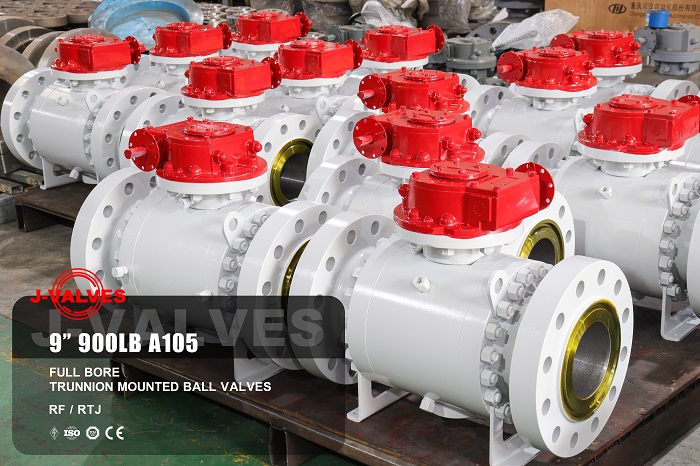
Take the 9" 900LB A105 model as an example. Forged A105 carbon steel boasts outstanding strength and toughness, maintaining stable mechanical performance under high-pressure and low-temperature conditions. It eliminates common defects of cast valve bodies like pores and sand holes, and greatly improves the valve’s overall impact resistance and fatigue resistance.
The trunnion support structure is the core technical highlight of J-VALVES trunnion mounted ball valves. The ball is fixed by upper and lower trunnions, and the thrust generated by medium pressure is borne by the bearing system. The valve seat only needs to provide preload for sealing, which effectively reduces seat wear and extends the valve service life. This design keeps low operating torque even under severe pressure differential, cutting down the procurement cost of actuators and lowering on-site maintenance frequency.
2. Sealing & Safety: Multiple Protections to Eliminate Potential Risks
Sealing performance is the core competitiveness of trunnion mounted ball valves. J-VALVES applies floating seat plus spring pre-tightening sealing structure to realize bidirectional sealing. It maintains reliable sealing performance even with fluctuating medium pressure or reverse pressure. Various seat materials including PTFE, PEEK and metal hard seal are optional to suit diverse working conditions from normal temperature to high temperature, and from clean media to particle-laden media.
In terms of safety design, J-VALVES trunnion mounted ball valves are equipped with cavity pressure relief devices. When the internal cavity pressure rises abnormally, the device will release pressure automatically to prevent valve body rupture. Meanwhile, the built-in anti-static structure and fire-safe design comply with API 607 standards. The valves can retain sealing performance under extreme conditions such as fire, delivering extra safety guarantee for the transportation of flammable and explosive media.
3. Quality & Service: Full-Process Control to Safeguard Projects
J-VALVES has established a rigorous full-range quality management system. Every procedure, from raw material incoming inspection, forging, machining to assembly and testing, undergoes strict examination. All valves pass hydrostatic and pneumatic sealing tests in accordance with API 6D standards, and key components are inspected via non-destructive testing to ensure stable and reliable product quality.
In terms of service, J-VALVES offers customized solutions. We can provide tailored products with special materials, extended bonnets, special connection types and more based on customers’ actual working conditions. Our complete after-sales service team provides installation guidance, maintenance training and technical support to solve various problems during project operation.
4. Successful Cases: Proven Strength Through Practical Applications
J-VALVES trunnion mounted ball valves have been widely applied and verified in numerous international projects. In an overseas petroleum project, J-VALVES Class 900 trunnion mounted ball valves were installed on high-pressure natural gas transmission pipelines, running continuously for 12 months with zero leakage and ensuring stable production.
In an oil and gas project in Indonesia, custom high-pressure ball valves perfectly adapted to complex on-site conditions, solved the long-standing sealing failure issues and significantly reduced operation and maintenance costs. These cases fully demonstrate the exceptional reliability and stability of J-VALVES trunnion mounted ball valves under harsh working environments.


