


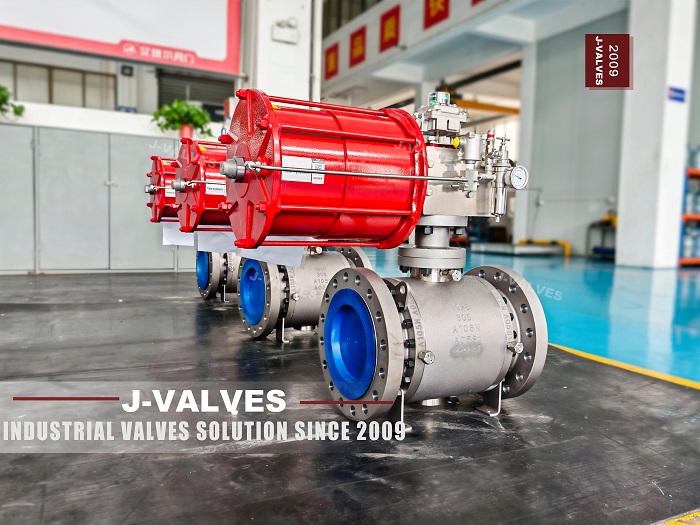
In industrial piping systems, working conditions featuring high pressure, large bore sizes and frequent opening/closing impose stringent requirements on valves in terms of sealing performance, structural stability and automation capability. Featuring a trunnion ball structure, premium forged materials and precision sealing design, the J-VALVES pneumatic trunnion ball valve stands as a benchmark product for high-pressure fluid control. Specifically, the 10x8" 300LB A105N model has proven its reliability in numerous major projects worldwide.
I. Core Values of Pneumatic Trunnion Ball Valves: Stability, Tight Sealing & High Efficiency
Integrating a trunnion ball structure, pneumatic actuation and bi-directional sealing, this automated valve effectively addresses common drawbacks of floating ball valves under high pressure: leakage, excessive operating torque and short service life.
Trunnion Ball Design: The ball is fixed by upper and lower shafts. High-pressure medium load is borne by upper and lower bearings, protecting valve seats from direct high-pressure impact. The sealing surface remains undeformed, delivering zero leakage during long-term operation.
High-Efficiency Pneumatic Actuation: Powered by compressed air, the actuator responds within 1 second with smooth opening and closing. It can be seamlessly connected to PLC and DCS systems for automated operation, cutting labor costs.
Wide Working Condition Adaptability: Pressure rating ranges from 150LB to 2500LB, and operating temperature from -46°C to 200°C. Optional materials include carbon steel, stainless steel and alloy steel, suitable for gas, liquid, steam and corrosive media.
II. In-depth Introduction to J-VALVES 10x8" 300LB A105N Model
Valve Body Material: A105N Forged Carbon Steel
A105N refers to normalized carbon steel. The forging process endows it with high strength, superior toughness, excellent fatigue resistance and low-temperature impact resistance. It resists deformation under 300LB high pressure and fits service conditions with slightly corrosive media in petroleum, chemical and other industries, offering far better cost performance than stainless steel.
Sealing System: Combined Sealing with Automatic Wear Compensation
Valve Seat: Spring preloaded design equipped with PTFE soft seal and metal hard seal for bi-directional sealing. It automatically compensates for wear on sealing surfaces and maintains zero leakage under 300LB high pressure differential.
Ball: High-precision polished surface (Ra ≤ 0.8μm) ensures perfect contact with valve seats, reducing friction and lowering operating torque.
Customized Pneumatic Actuator
Operation Type: Single-acting (spring return for fail-safe operation) / Double-acting (dual pneumatic drive for fast opening and closing).
Accessories: Solenoid valve (24V/220V), air filter regulator, limit switch and valve position transmitter, supporting remote control and status feedback.
Explosion-proof Rating: Ex d IIB T4, applicable to flammable and explosive environments such as natural gas and coal chemical industries.
III. Four Core Competitive Advantages of J-VALVES
Technical Strength
We have over 20 years of experience in the R&D, design and manufacturing of trunnion ball valves. We master core technologies including structural mechanics analysis for trunnion balls, high-pressure sealing simulation and pneumatic actuator matching. Our products comply with international standards such as API 6D and ASME B16.34, and have obtained ISO 9001 and API 607 certifications.
Superior Manufacturing Craftsmanship
Forging: The valve body is produced via die forging with dense internal structure, free of pores and inclusions, ensuring outstanding high-pressure resistance.
Machining: Valve bodies, balls and seats are processed by CNC lathes with dimensional tolerance controlled within ±0.02mm. The surface roughness of sealing faces reaches Ra ≤ 0.8μm after fine lapping.
Testing: 100% full testing is implemented, including hydrostatic test (body pressure: 450LB, sealing pressure: 330LB), pneumatic test and non-destructive testing (UT/MT) to guarantee zero leakage.
Cost Advantage: High Cost Performance & Long Service Life
Adopting A105N forged carbon steel, the product is priced lower than 304/316 stainless steel versions. Its service life spans 15 to 20 years with low maintenance frequency. The overall cost is 30% lower than that of similar imported brands.
Comprehensive Service: Global Localized Support
We operate a complete global sales and service network, providing one-stop services including technical consultation, model selection guidance, customized design, installation & commissioning and after-sales maintenance. Our response time is within 24 hours to fully resolve customers’ concerns.
IV. Success Case: Large-Scale Domestic Coal Chemical Project
A major domestic coal chemical project purchased 10x8" 300LB A105N pneumatic trunnion ball valves for high-pressure syngas service (Pressure: 300LB, Temperature: 120°C, containing trace hydrogen sulfide). The project required explosion-proof performance, zero leakage, remote control and full compliance with API 6D standards.
Challenges: Hydrogen sulfide in syngas tends to corrode sealing components; high pressure differential leads to large operating torque; tight project schedule required rapid delivery.
Solutions: We supplied A105N valve bodies against sulfide corrosion, combined metal-PTFE sealing for sulfur-containing media, and double-acting explosion-proof actuators for fast operation and remote control. All production and tests were completed within 15 days for early delivery.
Outcomes: The valves have run for 3 consecutive years with zero leakage and no malfunctions, passing the owner’s annual inspection. The client continued procurement for Phase II and Phase III projects, and we have become their core supplier.


