

Introduction
In the oil and gas industry, ensuring reliable flow control, isolation, and corrosion resistance is essential for pipeline safety and efficiency. C95800 Floating Ball Valves have emerged as a preferred solution for pipelines handling seawater, crude oil, refined products, and other corrosive fluids. Constructed from C95800 Nickel Aluminum Bronze (NAB), these valves combine high mechanical strength with superior corrosion resistance, making them ideal for long-term service in harsh environments.
J-VALVES, a specialist industrial valve manufacturer since 2009, delivers API- and ASME-compliant floating ball valves, offering unparalleled quality, performance, and reliability for oil and gas applications worldwide.
Key Features of C95800 Floating Ball Valves
1. Corrosion Resistance
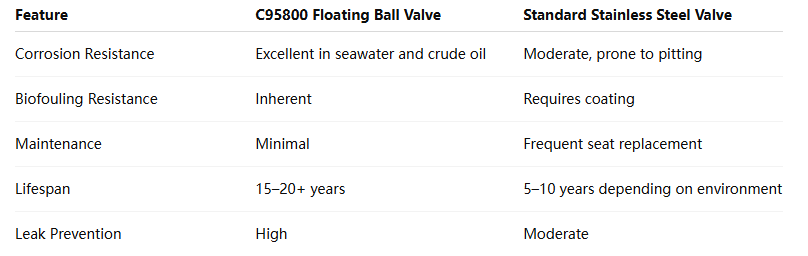
C95800 alloy provides excellent protection against chloride-induced corrosion and seawater exposure, ensuring durability in offshore and onshore pipeline applications.
2. Reliable Floating Ball Design
The ball moves slightly under pressure to create a tight seal against resilient seats. This ensures bubble-tight shut-off and bidirectional sealing under high-pressure service.
3. High Mechanical Strength
The C95800 material offers exceptional tensile strength, reducing the risk of deformation and extending service life even in high-pressure pipelines.
4. Low Maintenance
The simple design of floating ball valves minimizes operational wear and allows easy replacement of seats, significantly reducing maintenance costs.
5. API and ASME Compliance
Manufactured according to API 6D, API 608, API 598, and ASME B16.34 standards, ensuring dimensional accuracy, pressure integrity, and operational safety.
6. Versatile Applications
Suitable for oil and gas pipelines, seawater systems, offshore platforms, chemical process lines, and desalination facilities.
Advantages Over Conventional Valves
Oil & Gas Pipeline Applications
1. Seawater Injection Pipelines: Protect pumps and compressors from backflow and contamination.
2. Produced Water Systems: Handle high chloride content with minimal corrosion.
3. Refinery Pipelines: Reliable isolation in chemical and hydrocarbon services.
4. Offshore Platforms: Corrosion-resistant valves for utility, cooling, and process lines.
The floating ball mechanism allows for smooth operation under varying pressure conditions and ensures reliable shut-off even after extended service periods.
J-VALVES Expertise
Since 2009, J-VALVES has delivered high-performance C95800 floating ball valves for oil and gas pipelines worldwide. Key advantages include:
1. Precision Engineering: CNC machining ensures consistent tolerances and sealing performance.
2. Comprehensive Testing: Hydrostatic, shell, and seat leakage tests per API 598.
3. Material Traceability: Full certification and traceability of C95800 materials.
4. Customization: Pressure ratings, seat materials, and end connections tailored to client specifications.
5. Global Experience: Proven deployments in offshore, onshore, and industrial pipelines.
Successful Project Examples
1. Offshore Seawater Injection System
C95800 floating ball valves provided reliable isolation and corrosion resistance under continuous seawater exposure, reducing maintenance requirements and extending operational life.
2. Oil Refinery Hydrocarbon Lines
J-VALVES supplied valves for crude oil pipelines with high chloride content, ensuring consistent shut-off and leak-tight performance under high-pressure conditions.
3. Offshore Utility Water Systems
Floating ball valves were deployed for utility water lines on an offshore platform, improving operational safety and minimizing downtime during maintenance operations.
Conclusion
C95800 Floating Ball Valves by J-VALVES offer the oil and gas industry a robust solution for corrosion-resistant, high-performance flow control. With superior sealing, long service life, and full API/ASME compliance, these valves enhance operational safety and efficiency in demanding pipeline applications. Proven in offshore, onshore, and refinery environments, J-VALVES continues to provide reliable, high-quality solutions that meet the stringent requirements of modern oil and gas infrastructure.


