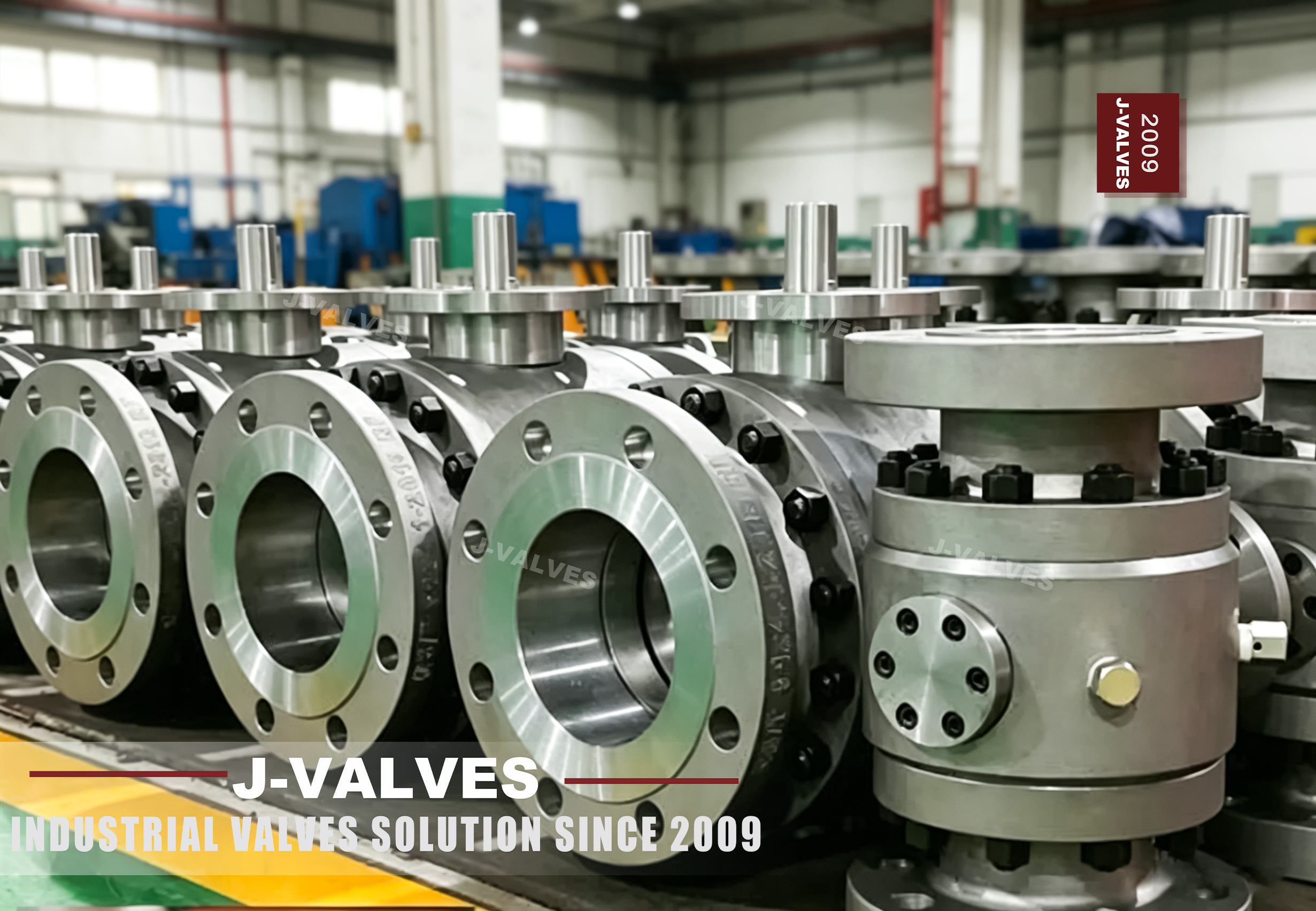
In industrial fluid control, valve performance depends not only on design concepts but also on every stage from R&D and production to delivery. J-VALVES top entry floating ball valves have become the trusted choice for numerous industrial projects, driven by three core technical advantages: precision manufacturing, inline maintenance design, and harsh environment adaptability, forming a full-chain quality assurance system from workshop to site operation.
First, precision manufacturing is the foundation of product performance. In J-VALVES’ production workshop, every top entry floating ball valve undergoes multiple precision machining processes: the ball is CNC ground to a surface roughness of Ra0.8 or less, ensuring perfect contact with the seats; the valve body adopts an integrated casting process to reduce potential leak points, with ultrasonic testing to detect internal defects and avoid casting flaws affecting service life. For example, the C95800 top entry floating ball valve requires over 10 machining steps from raw casting to finished product, with key dimensional tolerances controlled within ±0.02mm, ensuring interchangeability and consistent sealing performance across units. This extreme attention to detail has been J-VALVES’ quality philosophy for over a decade.
Second, inline maintenance design is key to reducing user costs. The top-entry structure was originally developed to address the pain points of difficult maintenance and high downtime costs in traditional ball valves. In industries such as petrochemical and long-distance pipelines, a single system shutdown can cause hundreds of thousands or even millions in economic losses. J-VALVES’ top entry floating ball valve enables inline maintenance via its top-access design: when sealing issues occur, there is no need to cut the pipeline or remove the valve. Simply open the top bonnet to access and service core components such as the ball and seats, with the entire process taking only 1/3 the time of traditional valve maintenance, significantly reducing downtime and operational costs. Some models also feature sealant injection ports for emergency temporary sealing, providing dual safety assurance.
Third, harsh environment adaptability is the core of product reliability. For complex conditions such as marine engineering, corrosive chemical media, and high-temperature/pressure applications, J-VALVES offers diverse material and configuration options: in addition to C95800 aluminum bronze, materials such as stainless steel, duplex steel, and alloys are available; sealing surfaces can be customized with PTFE, metal-to-metal, or other forms based on media characteristics. All valves undergo rigorous tests including API 607 fire-safe testing and anti-static testing to ensure safe operation under fire, static electricity, and other special conditions. For example, in a coastal chemical project, users deployed J-VALVES top entry floating ball valves to transport chloride-containing process media. The valves operated leak-free for 5 consecutive years, with corrosion resistance exceeding expectations and saving users significant equipment replacement costs.
Furthermore, J-VALVES has established a comprehensive quality traceability system. Each valve has a unique traceability code, allowing users to scan and query material reports, test records, and production batches, enabling full traceability from raw materials to finished products. A professional technical team also provides customized solutions, offering one-stop services including material selection, structural optimization, and maintenance plans to ensure perfect adaptation to user-specific working conditions.
From precision machining in the workshop to stable operation on-site, J-VALVES top entry floating ball valves deliver full-chain quality assurance through three core advantages, providing industrial users with fluid control solutions that balance reliability, economy, and convenience. Going forward, J-VALVES will continue to deepen valve technology R&D, continuously optimize product performance, and deliver efficient, reliable valve products and services for more industrial applications.