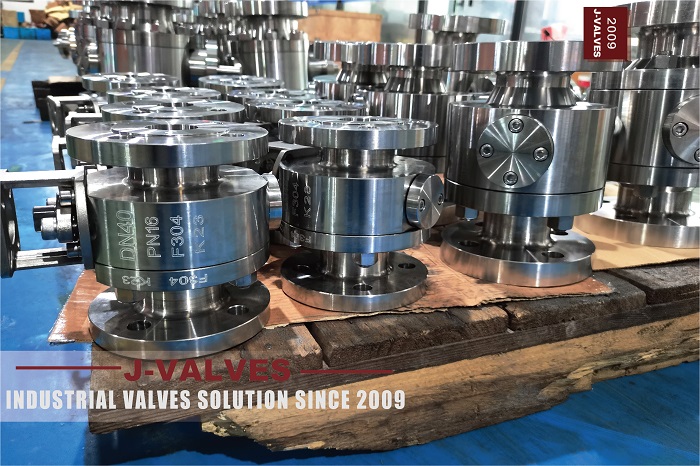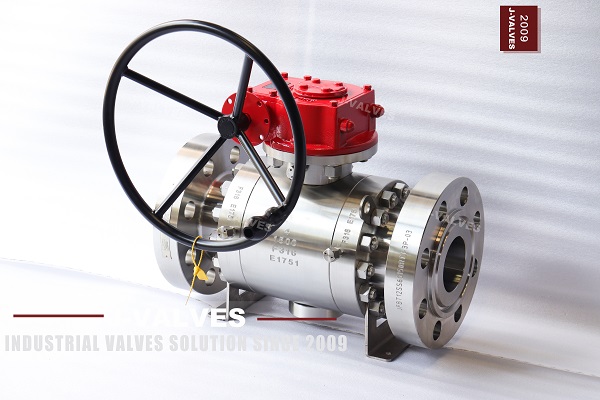


The operation of the pneumatic trunnion ball valve relies on pneumatic transmission. When compressed air enters the pneumatic actuator, it drives the internal piston or diaphragm to produce displacement, which in turn drives the valve stem to rotate. The valve stem is connected to the ball, and the ball changes its angle with the rotation of the valve stem to control the flow state of the fluid. When fully open, the through-hole of the ball is coaxial with the pipeline, allowing fluid to pass smoothly; when closed, the ball rotates until the through-hole is perpendicular to the pipeline and fits tightly with the valve seat to achieve reliable shut-off.
Structural Features
Double trunnion support structure: This is the core feature that distinguishes the pneumatic trunnion ball valve from other ball valves. The upper and lower ends of the ball are supported by trunnions, which can effectively disperse the medium pressure on the ball, prevent the ball from shifting due to excessive pressure, ensure the stability of the sealing performance, reduce the wear of the valve seat, and extend the service life of the valve.
Pneumatic actuator: It is divided into two types: single-acting and double-acting. The single-acting actuator opens or closes the valve when ventilated, and resets by spring force when the air is cut off; the double-acting actuator realizes the opening and closing of the valve through positive and negative air pressure. Its design is compact, the action is rapid, and it can quickly respond to control signals.
Sealing components: The valve seat usually uses high-performance materials, such as metal seals or reinforced polytetrafluoroethylene, combined with precise processing technology, which can achieve a good sealing effect. Even under harsh working conditions such as high pressure and high temperature, it can effectively prevent medium leakage.
Performance Highlights for Adapting to Automatic Control
Stable control capability under high-pressure working conditions
In automatic control, some industrial scenarios involve high-pressure fluid transmission, such as oil drilling, high-pressure hydraulic systems, etc. Due to the double trunnion support structure, the pneumatic trunnion ball valve can withstand extremely high medium pressure, maintain a stable working state in high-pressure environments, and will not affect the control accuracy due to pressure fluctuations. It can accurately adjust the fluid flow and ensure the safe operation of high-pressure systems.Efficient circulation in large-diameter pipelines
With the expansion of industrial production scale, the application of large-diameter pipelines is becoming increasingly widespread. The pneumatic trunnion ball valve is suitable for large-diameter pipelines. Its smooth channel design can reduce fluid resistance, ensure efficient circulation under large flow conditions, and facilitate automatic control, meeting the fluid control needs of large-scale industrial production.Durability in long-term operation
Automatic control systems often require equipment to operate continuously for a long time, which has high requirements for the durability of the equipment. The components of the pneumatic trunnion ball valve are made of high-strength and corrosion-resistant materials, and after precision processing and strict testing, they have good wear resistance and fatigue resistance. They can maintain stable performance during long-term operation, reduce the number of maintenance, and lower production costs.