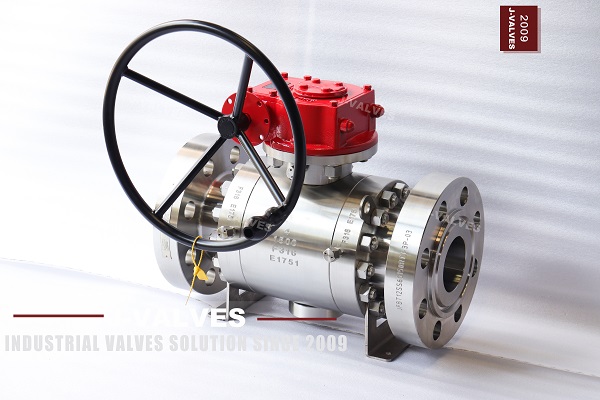


What is a high platform flanged ball valve? It is a flanged ball valve fitted with a raised or extended top mounting platform for manual or automated operation. This configuration can be considered for industrial piping that requires reliable isolation, remote control or future actuator integration. However, ISO 5211 compatibility, full-port design and pressure-temperature limits must be verified from the valve drawing, data sheet, material certificates and test documentation.
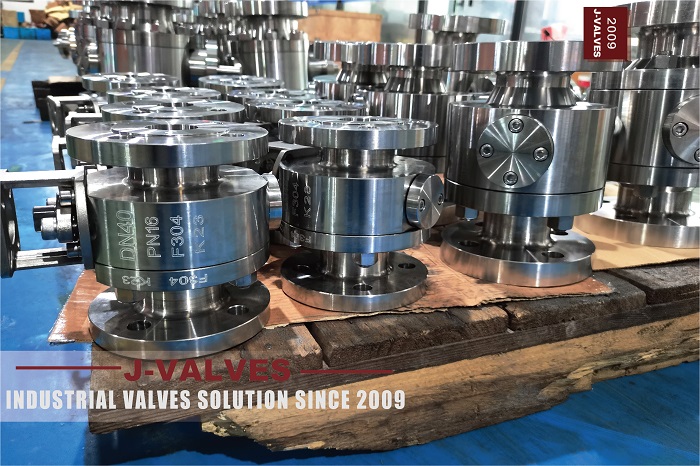
Technical boundary: The photograph shows flanged ends, ball valve bodies and top mounting platforms. An F304 marking is visible on the foreground valve. The photograph alone cannot prove that every valve uses F304, or establish a pressure class, temperature range, full-port design, ISO 5211 interface or certification status.
1. What Is a High Platform Flanged Ball Valve?
A flanged ball valve connects to piping through flanges and uses a rotating ball to open or close the flow passage. A high platform design provides a defined mounting area above the valve body for a handle, gearbox, pneumatic actuator or electric actuator.
“High platform” describes a mounting arrangement rather than a universal pressure rating or a single mandatory standard. Manufacturers may use different stem ends, square drives, mounting flanges and hole patterns. For that reason, the actuator interface should be checked against the product drawing and data sheet instead of being inferred from the product name.
2. Main Components and Operating Principle
A typical high platform flanged ball valve may include the following components:
Valve body: contains the pressure boundary and connects the two flange ends.
Ball: rotates to change the flow path. Actual bore size affects flow capacity; flange size alone should not be used to estimate flow.
Stem: transfers rotation from the handle or actuator to the ball. The exact anti-blowout arrangement must be confirmed from the design documents.
Seats and seals: influence shut-off performance, chemical compatibility and the temperature boundary of the valve.
Flanged ends: flange dimensions, facing, bolt holes and face-to-face length must be checked against the selected standard and project specification.
Top mounting platform: provides the mechanical base for operation. ISO 5211 compatibility must not be assumed without formal documentation.
Ball valves commonly achieve opening or closing through approximately a quarter turn, which makes them widely used for isolation and on-off service. If continuous flow control is required, pressure drop, cavitation, flashing, noise and seat wear should be assessed. A general-purpose ball valve should not automatically be treated as a dedicated control valve.
3. Actuator Mounting and Automation
One practical benefit of a high platform is a clear mechanical base for automation. Before selecting an actuator, verify the valve operating torque, actuator output torque, mounting hole dimensions, stem connection, travel or angle, air supply, power supply and control signal.
Operating method | Applications to evaluate | Main checks |
Handle or gearbox | Local manual isolation and simple control systems | Operating torque, clearance and locking arrangement |
Pneumatic actuator | Fast operation or sites with instrument air | Air supply, output torque, fail position and accessories |
Electric actuator | Sites without a stable air supply or with electrical control | Voltage, output torque, control signal and environment |
Top-mounted actuator | Projects that seek compact automation integration | Stem end, mounting flange, bolt pattern and actuator weight |
If the valve drawing expressly identifies an ISO 5211 interface, the mounting flange and drive dimensions can be specified in the purchase documents. Without that evidence, “top actuator mounting platform” is a more accurate description than “ISO 5211 ball valve.”
4. Material and Seat Selection
Valve selection should not stop at the body material. The bonnet, ball, stem, fasteners, seats, packing, gaskets and other wetted or pressure-retaining parts can also limit the suitability of the complete valve.
Selection factor | Questions to answer |
Medium | Is the service water, oil, gas, a chemical medium or a fluid containing solids? |
Body and trim | Are material grades, manufacturing methods and wetted parts listed in the data sheet? |
Seats | Should the design use a soft seat, reinforced polymer or metal seat, and is it compatible with the medium? |
Temperature | What are the design, minimum start-up and maximum operating temperatures? |
Low-temperature service | Are impact tests, low-temperature design features and project-specified tests required? |
The F304 marking visible in the photograph may be described as a visible marking, but it is not a substitute for a material certificate. Even when a body material is confirmed, the pressure-temperature range of the complete valve depends on the material group, seals and the limiting component. PTFE, reinforced PTFE, PEEK and metal seats have different service boundaries; the seal supplier data sheet and project specification should control the final decision.
5. Flange Standards, Pressure Class and Documentation
ASME B16.34 covers areas such as pressure-temperature ratings, dimensions, tolerances, materials, nondestructive examination requirements, testing and marking for valves. It is a common reference in valve design and procurement. However, citing a standard does not prove that a particular valve is certified to it; conformity must be supported by the manufacturer’s design documents and test records.
Flange dimensions, facing, bolt holes and face-to-face length may also involve ASME B16.5, EN 1092-1 or another project standard. PN and Class belong to different designation and flange systems. They should not be treated as a universal direct conversion across all materials, temperatures and sizes. The purchase specification should state the complete flange standard, pressure designation, nominal size and facing.
Whether API 6D, ISO 14313, API 608, API 598 or ISO 5208 applies depends on the product design, purchase documents and project requirements. These standards should not be presented as product certifications unless the relevant scope and valid documentation have been verified.
6. Industrial Applications
When the medium, pressure, temperature, connection and materials are suitable, a high platform flanged ball valve may be evaluated for:
isolation points in oil and gas piping;
process shut-off in chemical plants;
water treatment and industrial circulation systems;
energy, utility and compressed-air lines;
equipment inlet and outlet piping requiring remote operation;
automation retrofit projects where a pneumatic or electric actuator may be added.
These are application directions rather than a blanket approval for the photographed valve. Sour service, corrosive media, high temperature, high pressure, low temperature and solids-containing service require additional material, sealing and test verification.
7. High Platform Flanged Ball Valve Selection Checklist
Item | Procurement and engineering checks |
Medium | Chemistry, concentration, water content, solids and corrosivity |
Size | DN/NPS, actual bore, flange dimensions and face-to-face length |
Pressure | PN or Class, design pressure and rating at operating temperature |
Materials | Body, ball, stem, seats, gaskets and fastener grades |
Connection | Flange standard, facing, bolt pattern and end configuration |
Operation | Manual, pneumatic or electric; operating time and fail position |
Torque | Valve operating torque, actuator output torque and design margin |
Testing | Shell test, seat test and project-specified inspection class |
Documents | Drawing, data sheet, material certificates, test report and certificate of conformity |
8. Installation, Inspection and Maintenance
Before installation, check the valve model, nominal size, flange facing and pipe alignment.
Keep the valve and pipeline clean so weld slag, grit or foreign material cannot damage the seats.
After actuator installation, verify the opening direction, position indication and mechanical stops.
During operation, monitor the flange joints, stem area, body connections and actuator interface for abnormal leakage or movement.
Set inspection intervals according to the medium, operating frequency and project maintenance system rather than using an unsupported “industry service life.”
General-purpose ball valves are normally selected for isolation and on-off operation. Continuous throttling requires a specific manufacturer recommendation.
9. Frequently Asked Questions
What does “high platform” mean in a flanged ball valve?
It generally refers to a defined or raised top mounting area that makes it easier to install a handle, gearbox, pneumatic actuator or electric actuator. The exact interface should be verified from the drawing.
Does every high platform ball valve comply with ISO 5211?
No. ISO 5211 compatibility should only be stated when it is identified and verified in the product drawing, data sheet or formal manufacturer documentation.
Are flanged ball valves suitable for continuous throttling?
Ball valves are commonly selected for fast isolation and on-off service. Continuous throttling can create seat wear, noise, cavitation or flashing. Suitability depends on the pressure drop, medium and manufacturer’s recommendation.
Does an F304 marking prove the material of the complete valve?
No. It may identify a particular valve or component. Complete material verification requires the material certificate, bill of materials and purchase requirements.
How should the pressure class be selected?
Consider the medium, design temperature, material group, flange standard, valve construction and project specification. A PN or Class number alone does not establish the allowable working pressure in every condition.
Can an electric actuator be installed on a high platform ball valve?
It can be evaluated when the mounting dimensions, stem connection and output torque match. The actuator interface, valve torque, power supply and control requirements should be checked before ordering.
What is the difference between soft-seat and metal-seat designs?
Soft seats are often considered for confirmed conventional temperature and medium conditions. Metal seats may be evaluated for particular high-temperature, solids-containing or special services. Actual performance depends on design, manufacturing and testing.
Can a photograph prove certification?
No. A photograph can show visible construction and markings, but certification, testing and standard conformity require formal certificates, test reports or quality documentation.
Conclusion
The value of a high platform flanged ball valve is not only the raised mounting area. It is the complete match between the piping connection, valve materials, sealing system and actuator arrangement. A sound specification starts with the medium and operating conditions, then verifies size, actual bore, pressure-temperature limits, flange standard, seat material, actuator torque and test documentation. When these details are traceable and consistent, a product name becomes a usable engineering and procurement specification.