


I. Severe Engineering Challenges of LNG Cryogenic Working Conditions
LNG operates at extreme temperature down to ‑162°C. In LNG receiving terminals, vaporizer stations, storage tanks and cold‑box piping systems, valves are exposed to continuous cryogenic thermal cycling. Real‑world engineering frequently encounters these failure risks:
1. Ice formation on packing box, packing embrittlement and external leakage caused by cold conduction;
2. Internal leakage induced by sealing gap variation due to differential thermal contraction of metal components;
3. Actuator damage from direct low‑temperature contact leading to valve malfunction;
4. Insulation failure at cold‑box penetration points, cold loss and potential safety hazards.
Conventional ball valves cannot withstand thermal conduction and material shrinkage under‑162°C service. According to international standards API 6D and BS 6364, extended‑stem (extended bonnet) cryogenic ball valves are mandatory for critical isolation positions within LNG systems to resolve these cryogenic‑related issues.
II. Working Principle of Extended‑Stem Cryogenic Ball Valve: Gas‑Column Thermal Insulation & Temperature Gradient
The extended‑stem is the signature feature for LNG cryogenic ball valves. While the valve body carries‑162°C LNG medium, an elongated neck section creates a stable temperature gradient. The internal cryogenic gas builds up so‑called “gas‑column insulation effect”, lifting the packing box above 0°C safe temperature range. It prevents packing icing and protects top‑mounted pneumatic / electric actuators away from cryogenic zone.
The extension length is not arbitrary. It must be calculated thermodynamically considering material thermal conductivity, heat dissipation area and site insulation scheme. This is the key difference between generic copies and professionally engineered LNG valves.
III. Key Technical Features of Extended‑Stem Cryogenic Ball Valve for LNG
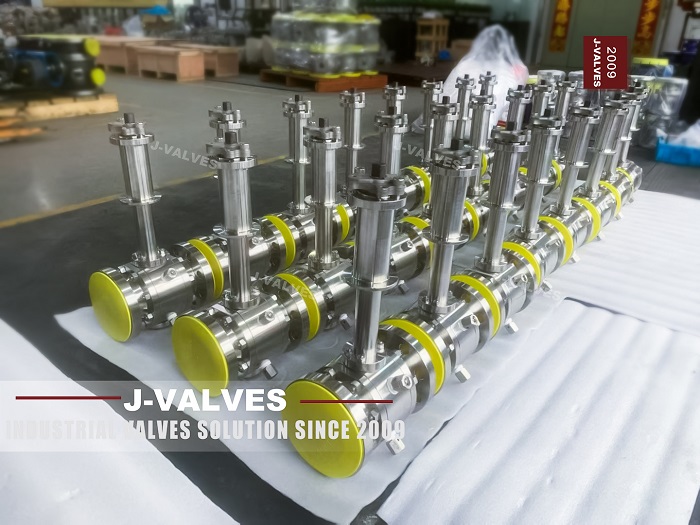
As shown in J‑VALVES factory batch‑production photos, these LNG‑oriented extended‑stem cryogenic ball valves adopt 3‑piece forged steel body, fully optimized for LNG operating conditions.
1. Body & Ball Material plus Cryogenic Pre‑treatment
Body material options include CF8M stainless steel and LCB low‑temperature carbon steel. Balls and seats go through full cryogenic treatment to release internal stress, minimizing dimensional deformation under repeated‑162°C thermal cycles and securing long‑term sealing performance, complying with API 6D material acceptance requirements.
2. Extended‑Stem Construction & Anti‑blow‑out Safety Design
Solid extended stem with anti‑blow‑out stem structure prevents stem ejection under cryogenic pressure fluctuation. Stem length can be customized for cold‑box or non‑cold‑box applications. For cold‑box penetration cases, extension length matches cold‑box insulation thickness so actuators stay fully outside cold zone at ambient temperature.
3. Cryogenic‑adapted Sealing System
Seat adopts PCTFE / PTFE low‑temperature resistant sealing compound with spring‑loaded preload structure to compensate sealing gaps caused by metal shrinkage. Special cryogenic packing maintains packing box temperature above 0°C, avoiding sticking by icing and mitigating external leakage risk.
4. Fire‑safe & Anti‑static Construction
Built to API 607 fire‑safe standard, integrated anti‑static grounding structure eliminates static electricity accumulation caused by flowing LNG media, meeting safety specifications for flammable cryogenic service.
IV. Common LNG Project Selection Pitfalls to Avoid in Procurement
Many buyers only focus on nominal pressure and size while overlooking critical validation items for extended‑stem cryogenic ball valves, resulting in frequent on‑site failures:
1. ❌ Only follow drawing dimension instead of thermodynamically calculated neck length; longer stem does not always equal better performance, length shall match site insulation;
2. ❌ Skip cryogenic treatment procedure: Untreated stainless steel tends to deform and leak under LNG thermal cycling;
3. ❌ Missing cryogenic type‑test & helium leak‑test reports. LNG projects require cryogenic cycle test and 100% helium mass‑spectrometer leak detection. Hydrostatic test alone cannot satisfy project acceptance criteria;
4. ❌ Apply standard packing instead of cryogenic‑grade packing, leading to icing and external leakage after short‑time operation.
V. Typical Application Scope in LNG Industrial Chain
Extended‑stem cryogenic ball valves are widely deployed across full LNG value chain:
‑ LNG receiving terminals & loading/unloading arms
‑ LNG storage tanks, vaporizer stations & LNG refueling stations
‑ Cold‑box penetration piping
‑ Other‑196°C cryogenic processes such as liquid oxygen, liquid nitrogen.
VI. How to Select Qualified Extended‑Stem Cryogenic Ball Valve Supplier for LNG
From E‑E‑A‑T engineering authority perspective, qualified suppliers shall satisfy:
1. Solid familiarity with API 6D, BS 6364, API 607 cryogenic valve standards;
2. In‑house capability for cryogenic type‑test and helium leak‑test, full material and inspection documentation deliverable;
3. Proven track‑record of bulk project deliveries with reference cases available;
4. Customizable extended‑stem length according to customer cold‑box thickness and medium temperature instead of one‑size‑fits‑all solution.
VII. Conclusion
For LNG cryogenic engineering, extended‑stem cryogenic ball valve is far more than “a valve with longer stem”. It represents a comprehensive solution integrating thermal engineering, material science and sealing technology. Specifying properly‑qualified extended‑stem cryogenic ball valves greatly reduces risks of leakage, icing blockage and equipment damage, ensuring long‑term safe and stable operation of LNG facilities.
CTA Call‑to‑Action
If you are searching for extended‑stem cryogenic ball valve solutions for your LNG project, contact J‑VALVES for technical consultation, drawings and project references.


