I. Why API 608 Serves as Authoritative Specification for Metallic Floating Ball Valves
For marine engineering, seawater desalination plants, offshore oil‑gas platforms and other heavy‑corrosion fluid handling applications, improper ball‑valve selection may result in medium leakage, severe body rust, unexpected shutdown and excessive lifecycle maintenance costs. Published by American Petroleum Institute, API 608 is the authoritative product standard for metal ball valves with flanged, threaded and welded ends. It defines mandatory rules covering floating ball structure, wall thickness, material compatibility, performance test and marking requirements, widely adopted for global overseas industrial procurement and engineering design.
C95800 (ASTM B148 UNS C95800 Nickel‑Aluminum Bronze) delivers outstanding seawater corrosion resistance, cavitation resistance and chloride‑ion tolerance, making it a dominant body material for marine fluid pipelines. Many engineers only focus on alloy grade while ignoring API 608 constraints on body construction, seat design, stem integrity and pressure‑temperature rating, which drastically shorten real‑world service life. This article interprets practical selection workflows for C95800 floating ball valves based on official API 608 clauses combined with bronze‑alloy characteristics, offering actionable reference for engineering designers and valve purchasers. 1.API 608 Material Compliance Requirements for C95800 Valve Body
API 608 specifies that pressure‑containing shell components shall comply with ASME B16.34 pressure‑temperature rating. The corrosion resistance of gaskets, stem packing and trim shall be equal or superior to shell material to avoid galvanic corrosion risks.
C95800 nickel‑aluminum bronze casting fits Class150‑Class300 pressure classes, mainly for seawater, brine and chloride‑containing service, operating temperature range ‑40℃~260℃. The first selection checkpoint: confirm valve castings conform to ASTM B148 specification with traceable material test reports. API 608 does not lock specific alloy grades, yet it explicitly warns that copper‑alloy shells cannot adopt carbon‑steel P‑T curves directly. Users must apply rating curves dedicated for C95800 nickel‑aluminum bronze. Misusing WCB carbon‑steel pressure‑temperature data is a frequent root cause of field safety hazards.
Per API 608 practice, stem and ball trim shall maintain equivalent corrosion resistance with C95800 body. Matching nickel‑aluminum bronze trim is highly recommended to prevent galvanic corrosion caused by dissimilar metal pairing.
2.API 608 Structural Requirements for C95800 Floating Ball Valves
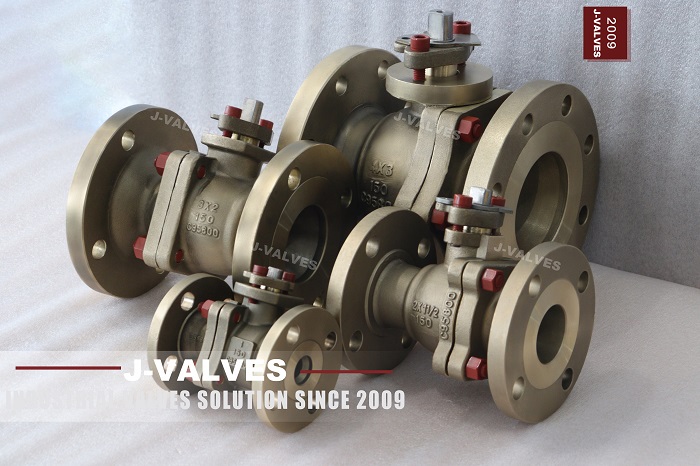
API 608 covers both floating‑ball and trunnion‑mounted ball‑valve designs. C95800 bronze floating ball valves are commonly manufactured for NPS 1/2”‑ NPS8” (DN15‑DN200), Class150 / Class300, matching the flanged C95800 valve product shown in the photo.
1. Bore Options: Full Bore vs Reduced Bore
API 608 defines three bore types: full bore, single‑reduced bore and double‑reduced bore. For seawater pipelines requiring pigging service, full‑bore C95800 floating ball valve is preferred to minimize flow resistance and sediment abrasion. Reduced‑bore version can be chosen for general on‑off service to cut capital cost.
2. End Connection: Flanged End per ASME B16.5
API 608 requires flanged dimension following ASME B16.5 and face‑to‑face dimension complying with ASME B16.10. Never mix GB standard flange dimensions for API 608 bronze flanged ball valves during project piping interface.
3. Blow‑out Proof Stem & Anti‑Static Device
As required by API 608, floating ball valves must adopt blow‑out‑proof stem construction. For flammable‑medium service, anti‑static assembly shall be equipped to establish continuous electrical conductivity across ball‑stem‑body. Even though C95800 bronze features good natural conductivity, mechanical anti‑static structure cannot be omitted.
4. Fire‑Safe Requirement: Supplement API 607
API 608 is general product specification without built‑in fire‑safe qualification. If fire safety is mandatory for projects, API 607 fire‑safe test certification shall be separately specified instead of assuming API 608 covers fire‑safe performance.
3.Seat Material Matching for C95800 Valves under API 608
PTFE / RPTFE: Cost‑effective for normal‑temperature seawater service under Class150 rating.
PEEK: For elevated‑temperature seawater or particle‑laden media with enhanced anti‑abrasion property.
Important note: Seat material often sets actual temperature limit for complete valve assembly. Even if C95800 bronze body tolerates high temperature, PTFE seat max operating temperature is approximately 200℃. Do not only refer to body alloy temperature capacity in selection work.
4.API 608 Mandatory Test & Marking for C95800 Bronze Ball Valves
API 608 requires shell‑strength test and seat tightness test performed per API 598 (ISO 5208), including hydro‑shell test, high‑pressure water sealing and low‑pressure gas sealing test.
Stainless‑steel nameplate shall be permanently fitted with mandatory marks: pressure class, nominal size, shell material grade C95800, API 608 designation, manufacturer ID and serial number. Low‑cost bronze ball valves without clear ASTM B148 C95800 marking violate API 608 marking rules and are not acceptable for international offshore projects. 5.Suitable & Restricted Service Conditions for C95800 Floating Ball Valves
✅ Recommended applications: Off‑shore platform seawater pipeline, seawater desalination RO/MSF units, coastal chemical brine circuit, chloride‑rich process fluid, marine shipboard piping.❌ Not suitable: Concentrated nitric acid and strong oxidizing acid. C95800 nickel‑aluminum bronze suffers rapid corrosion under high‑concentration nitric acid, even if mechanical structure fully meets API 608 requirements. II. Conclusion: Complete Selection Checklist for API 608 C95800 Floating Ball Valve
Selection should never rely solely on “C95800 material grade”. Please verify all below items:
1. Shell casting conforms to ASTM B148 C95800, adopt copper‑alloy exclusive P‑T rating instead of carbon‑steel rating.
2. Floating‑ball construction meets API 608: blow‑out‑proof stem; anti‑static for flammable service; add API 607 certification for fire‑safe demand.
3. Flange dimension ASME B16.5, face‑to‑face ASME B16.10, select proper bore type (full / reduced bore).
4. Seat material compatible with process temperature and particle content.
5. Acceptance test executed per API 598, complete nameplate marking for material & standard.
6 Confirm chemical compatibility with process fluid, avoid strong oxidizing acid service.
Strictly following API 608 authoritative specification maximizes C95800 nickel‑aluminum bronze’s seawater‑corrosion‑resistant advantage, extends valve service cycle and reduces costly replacement & maintenance for marine‑related industrial projects.
CTA