


Double Block and Bleed (DBB) ball valves are critical components in high-pressure and hazardous fluid systems, offering enhanced safety, operational efficiency, and maintenance flexibility. Among their key performance differentiators are the types of ball valve seats—floating and trunnion-mounted—which significantly impact reliability, sealing performance, and operational torque.
Understanding DBB Ball Valves
DBB ball valves feature a unique design that allows the isolation of fluid on both upstream and downstream sides, along with a bleed port for pressure release. This configuration ensures safer maintenance, minimizes the risk of fluid leakage, and enables accurate system purging. The seat type, whether floating or trunnion, plays a pivotal role in how 1effectively the valve can maintain tight sealing under varying pressure and temperature conditions.
Floating Ball Valves: Design and Performance
Structure
Floating ball valves are designed with the ball positioned between two resilient seats. The seats exert a compressive force on the ball, creating a tight seal. In a DBB configuration, the floating mechanism allows the ball to shift slightly under system pressure, enhancing the sealing contact.
Advantages
1.Self-Adjusting Seal: The ball naturally moves toward the downstream seat under pressure, improving leak-tightness.
2.Compact Design: Typically lighter and requiring fewer components, floating DBB valves are easier to install in tight spaces.
3.Lower Cost: Due to fewer manufacturing complexities, floating valves are generally more cost-effective for small to medium-sized applications.
Limitations
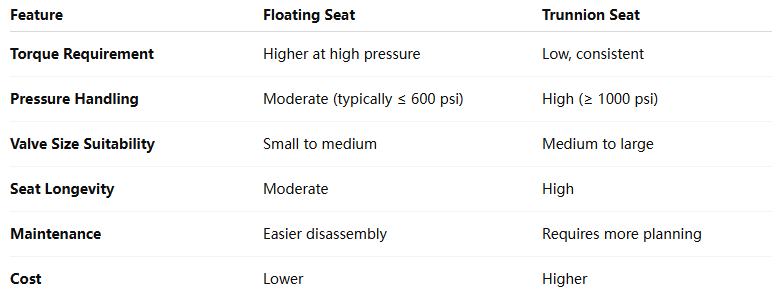
1.Torque Sensitivity: High-pressure applications increase operating torque, making manual operation challenging.
2.Size Constraints: Floating DBB valves are less suitable for diameters above 6–8 inches due to excessive torque requirements.
3.Pressure Limitations: At extremely high pressures, the risk of seat deformation or leakage increases.
Trunnion-Mounted Ball Valves: Design and Performance
Structure
Trunnion-mounted ball valves feature a ball supported by top and bottom trunnions, reducing direct stress on the seats. The trunnions absorb system forces, allowing the seats to maintain consistent contact with the ball regardless of pressure fluctuations.
Advantages
1.Low Operating Torque: The trunnion support minimizes seat stress, allowing easier actuation even under high-pressure conditions.
2.High-Pressure Compatibility: Ideal for large-diameter and high-pressure systems, often exceeding 1000 psi.
3.Enhanced Seat Longevity: Reduced wear and tear on seats ensures longer service life and fewer maintenance cycles.
Limitations
1.Complex Construction: Trunnion valves involve more components and precise machining, increasing cost.
2.Heavier Weight: The robust structure requires additional support for installation.
3.Space Requirement: Larger footprint compared to floating valves may restrict use in compact pipelines.
Performance Comparison in DBB Applications
Selecting the Right DBB Valve
Choosing between floating and trunnion DBB ball valves requires careful consideration of system pressure, pipe diameter, operational frequency, and maintenance strategy. Key considerations include:
1.System Pressure and Temperature: Trunnion valves are preferred for extreme pressures and temperatures due to their low torque and robust sealing.
2.Valve Size: Floating valves are ideal for smaller pipelines, while trunnion valves suit large-diameter lines.
3.Actuation Method: For automated systems, low-torque trunnion valves reduce actuator sizing and energy consumption.
4.Maintenance Frequency: Applications requiring minimal downtime benefit from trunnion seat durability.
Conclusion
Floating and trunnion seat DBB ball valves each offer unique advantages tailored to specific industrial needs. Floating valves excel in small to medium applications where cost efficiency and compact design are priorities, while trunnion-mounted valves dominate in high-pressure, large-diameter systems where operational torque and seat longevity are critical. A thorough understanding of these performance characteristics enables engineers and system designers to select the most suitable DBB valve, ensuring safety, efficiency, and long-term reliability.


