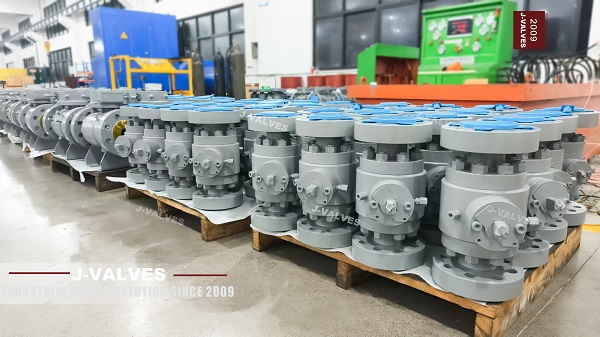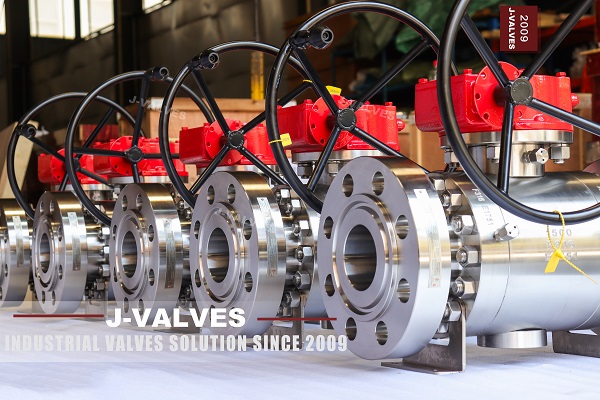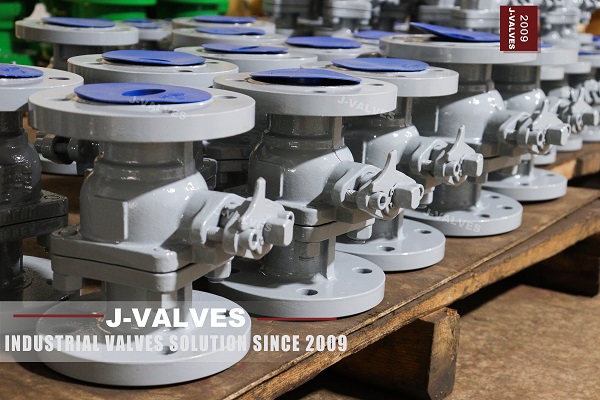
An injection manifold in a mature field was commissioned in June. The valves were new, the shop test sheets were clean, and the opening torque recorded at the works was a little under 900 newton metres on the DN100 Class 900 units. By the following spring the operator could not turn one of them with a two metre bar, and the actuator on the neighbouring tag had begun to trip on overload once a week. Nothing had corroded through. The valve had filled with scale and fine solids in the cavity, the seat had been asked to seal on a contaminated sphere, and the torque had roughly tripled.
Waterflood service punishes a ball valve in a way that its pressure rating does not anticipate. The pressure is high but steady, the cycling is low, and the fluid is water, which sounds benign. What actually arrives at the valve is produced water: a brine at twenty to a hundred and fifty grams per litre of chloride, carrying dispersed oil, fine solids, sulphate reducing bacteria, dissolved gas and a scaling tendency that changes every time the pressure drops. This article sets out what each of those does, why oxygen is the single most expensive constituent, and what a specification has to spell out in order that a valve installed in June can still be turned the following spring.
1. Injection is not production, and the difference is the duty cycle
The first correction is a habit of thought. Most valve selection experience in a field comes from production service, where the valve is cycled, the fluid is multiphase and the pressure fluctuates. Injection service is the opposite shape, and the failure modes follow the shape.
Attribute | Production duty | Injection duty | Consequence for the valve |
|---|---|---|---|
Cycling | Frequent, often daily, sometimes continuous | Rare: isolation for workover, filter change, pump swap | Seat wear is not the limiter; seizure after long idle is |
Pressure | Falling over field life | Steady and often rising as the reservoir tightens | No fatigue from pressure cycles, but no relief from a bad seat either |
Fluid | Multiphase with gas breakout | Water with 20 to 80 mg per litre of dispersed oil | Oil films the ball, holds solids, feeds bacteria |
Solids | Sand at production rates | 5 to 50 mg per litre of fine solids, plus corrosion products | Cavity packing, seat damage on the rare stroke, rising torque |
Time at rest | Short | Months in one position | Under deposit corrosion, scale bridging, dead legs |
Read the last two rows together and the central problem appears: an injection valve spends almost all of its life closed or open on water it cannot see, and the failures that matter are the ones that happen while it is not moving. That is the opposite of the wear model that a cycle rating describes.
2. What is in the water, and what each part of it does
Produced water is not one fluid. The composition varies field by field and, within a field, between the water plant outlet and the wellhead. Six constituents account for nearly all valve damage, and each asks for a different response.
Constituent | Typical range | Damage mechanism | Valve response |
|---|---|---|---|
Dissolved oxygen | Target below 20 micrograms per litre; excursions to 1 mg per litre during filter changes | Localised corrosion at the ingress point, then under deposit pitting | Oxygen scavenger, nitrogen blanketing, no dead ended sample lines |
Sulphate reducing bacteria | 10 thousand to 1 million cells per millilitre in deposits | Sulphide generation, pitting under biofilm and sediment | Biocide programme, no stagnant cavity, drain and flush ports |
Hydrogen sulphide | 0 to 200 parts per million, higher in sour fields | Sour service cracking of hard materials | Hardness limits, qualified materials, not a generic 316L call |
Chloride | 20 to 150 grams per litre | Pitting and stress corrosion cracking of austenitic grades | Duplex or super duplex above the temperature and chloride limit |
Carbonate and sulphate scale | Supersaturated at the wellhead | Bridging across the cavity, seat jacking, torque growth | Scale inhibitor, flush points, seat and cavity geometry |
Fine solids, including corrosion products | 5 to 50 mg per litre | Erosion at throttling surfaces, seat indentation | Filtration upstream, hard trim where throttling is unavoidable |
3. Oxygen: one milligram per litre is a large number
Oxygen deserves its own section because it is the constituent that most often turns a well designed waterflood into a corrosion problem, and because the arithmetic is easy to do and rarely done. The reaction consumes about 3.5 grams of iron for every gram of oxygen, so one milligram per litre of dissolved oxygen entering a thousand cubic metres a day of injection water represents 3.5 kilograms of iron a day, which is wall loss on a scale no inhibitor programme can absorb.
That figure also explains the shape of the damage. Oxygen does not spread itself evenly through the system; it is consumed within the first few metres downstream of wherever it entered, which is why the signature is a groove or a ring near a sample point, a filter housing or a pump seal, rather than general wastage across a line. For the valve, that means the tag immediately downstream of the water plant is the one that suffers, and it is often the tag nobody inspects.
The practical defences are procedural rather than metallurgical, and they are all about excluding air. Nitrogen blanketing on the deaerator and the surge drum, sealed sample pots instead of open buckets, a filter change procedure that floods the housing before it is opened, and pump seals that do not draw air when the suction pressure dips. A super duplex valve does not fix an oxygen ingress problem; it postpones the inspection.
4. Sour thresholds, and the number that decides the material
Hydrogen sulphide is present in many waterfloods as a result of bacterial activity rather than formation gas, which means its concentration can rise after commissioning and surprise a specification written at the design stage. The threshold that matters is the partial pressure: sour service limits begin to apply above 0.3 kilopascal. At an injection pressure of 250 bar, a hundred parts per million of hydrogen sulphide gives 2.5 kilopascal, already an order of magnitude above the threshold, and two hundred parts per million gives 5 kilopascal.
That single multiplication changes the material call. A hardness controlled carbon or low alloy steel is limited to 22 HRC in sour service, austenitic and duplex grades have their own limits tied to pH and chloride, and a generic 316L line item in a bill of materials is no longer a defensible answer. The specification also has to decide what happens if the sulphide appears later, because a valve ordered for sweet service and installed in a sour system is a valve whose material certificate no longer describes its duty.
5. Throttling a ball valve to set injection rate
This is the most expensive habit in waterflood operation and it is nearly universal on older fields. Injection rate has to be controlled, the wellhead has a ball valve, and so the ball valve is set at thirty percent open. Three things then happen at once, and none of them shows up in the first month.
The first is velocity. A partially open ball valve produces a high velocity jet at the seat edge, several times the line velocity, and that jet is aimed directly at the downstream bore and at the seat of the same valve. With five to fifty milligrams per litre of solids present, the erosion is concentrated exactly where the sealing surface is.
The second is that the pressure drop is in the wrong place. In a waterflood most of the total pressure is consumed at the formation face, not at the wellhead, so a valve throttled to control rate is dropping a hundred to two hundred bar that the reservoir would have taken without damage. The valve is absorbing an erosive duty to do a job that a choke, a variable speed pump or a smaller bean would do better.
The third is scale. A pressure drop releases carbon dioxide from the water, which raises pH and reduces the solubility of calcium carbonate, and the precipitation happens on the first cool surface downstream, which is the valve body and the seat pocket. That is how a valve that was clean in June is bridging in November.
The correct arrangement is a ball valve for isolation only, fully open or fully closed, with a dedicated choke or a control valve taking the pressure drop, and a hard faced trim in whatever device does the throttling. Where a ball valve has to modulate because nothing else is available, a segmented or V ported design with a hardened seat and a downstream wear sleeve is a much better compromise than a standard ball at thirty percent.
6. Solids, cavity packing and the torque that ends the argument
A ball valve keeps a pocket between its two seats, and in waterflood service that pocket behaves like a settling tank. Fine solids and corrosion products drop out of the slow moving water, compact against the cavity wall, and harden. Scale does the same thing chemically, and the two together produce a solid mass that the ball has to sweep aside on the next stroke, which may be nine months later.
The result is measurable and it is the number that should drive the actuator selection. A DN100 Class 900 valve that turns at 900 newton metres when new can require 3,000 to 4,000 newton metres after a year of scale and solids, and the increase is not gradual; it appears as a step when the deposit bridges the clearance. An actuator sized on the catalogue torque with a 1.3 factor will stall; an actuator sized on twice the aged torque will not, and the same margin applies to the gearbox and to the stem, which is the part that twists.
Three design choices reduce the problem before the actuator has to solve it. Drain and flush ports on both sides of the cavity allow the valve to be washed through before it is stroked. A trunnion mounted design keeps the ball supported so that the seat load does not have to overcome a wedged ball. And a seat arrangement that permits the cavity to be equalised before the valve is opened removes the need to break a scaled seat against full differential, which is where most stems are damaged.
7. The pump end: pulsation, check valves and the fatigue nobody models
Injection is usually driven by positive displacement pumps, often plunger or plunger style multiplex units, and the discharge piping sees a pressure ripple at the plunger frequency plus its harmonics. A ball valve upstream of a dampener, or one mounted on a short branch with no support, will see that ripple as a vibration input. The failure that follows is rarely a burst; it is a loosened packing gland, a fretted stem seal, a cracked bracket or a limit switch that stops indicating.
The valve side of the answer is a properly supported body, a stem seal arrangement that tolerates vibration, and a mounting that does not hang an actuator off a cantilever. The system side is a pulsation dampener sized for the pump, and a check valve that closes before the reverse flow starts, because a check valve slamming on every stroke is a water hammer source that will eventually find the weakest flange in the manifold.
8. Material selection by position, not by line
A waterflood is usually specified with one material for the whole injection line, and that is a commercial simplification that costs money at both ends: over specified at the filter outlet, under specified at the wellhead. The table below is the position based view.
Position | Dominant threat | Reasonable body and trim | Note |
|---|---|---|---|
Water plant outlet, deaerated | Oxygen excursions, low chloride if diluted | Carbon steel with inhibitor, 316 trim, soft seat | Cheapest tag with the highest oxygen risk; inspect, do not upgrade |
Filter outlet and manifold header | Solids, bacteria, moderate chloride | Carbon steel body, duplex trim, metal or PEEK seat | Flush ports and drain are worth more than a higher alloy |
Wellhead, high chloride and scaling | Chloride pitting, scale, sour if sulphide present | 22Cr or 25Cr duplex, hardened trim, metal seat | Hardness limits apply as soon as sulphide appears |
Chemical injection and scale inhibitor | Concentrated chemical, compatibility | 316L body, PTFE seat, no copper alloys | Small bore, high consequence; check elastomer compatibility |
Pump discharge, pulsating | Fatigue, vibration, erosion on recycle | Carbon steel or duplex, trunnion mounted, supported | Actuator mounting and support matter more than alloy |
9. What the datasheet has to say
Every failure in this article traces back to a line in a datasheet that was left at its default. The clauses that matter for waterflood are specific: chloride concentration and temperature together with the resulting grade, because neither number is meaningful alone; hydrogen sulphide partial pressure in kilopascal, computed at the maximum injection pressure rather than quoted in parts per million; hardness limits and the test method if the service is sour; solids concentration and size, which decides whether hard trim and flush ports are needed; the scale tendency and the inhibitor programme, which decides whether drain ports are a convenience or a necessity; the required opening torque at the end of a one year idle period, stated as a multiple of the new valve torque rather than as a single figure; and the test water chloride limit for the hydrostatic test, since a test with site water at fifty grams per litre has started a corrosion cell inside a valve that is then stored for a year.
J-VALVES supplies injection and manifold valves from DN15 up to DN1400, which is a half inch to 56 inch, covering ASME class 150 to 2500 and a temperature band of minus 196 to plus 650 degrees C. Every shell is proved at 150 percent of its rating and every seat at 110 percent. Trunnion mounted bodies with drain and flush ports, cavity pressure equalisation and a stated aged torque are the standard route for waterflood duty, and an enquiry carrying the water analysis and the idle period is priced within three working hours.
10. Frequently Asked Questions
Why does a water injection valve seize when it has barely been cycled?
Because the damage happens while it is standing still. Produced water carries five to fifty milligrams per litre of fine solids plus a scaling tendency, and the cavity between the two seats acts as a settling tank. Over months the deposit compacts and bridges the clearance, so the ball has to sweep aside a solid mass on the next stroke. A valve that turned at 900 newton metres when new can need 3,000 to 4,000 after a year, which is why the actuator has to be sized on the aged torque rather than the catalogue figure.
How much oxygen ingress is acceptable in injection water?
The target is below 20 micrograms per litre, and the reason is stoichiometric: about 3.5 grams of iron are consumed per gram of oxygen, so one milligram per litre in a thousand cubic metres a day means 3.5 kilograms of iron a day. Because oxygen is consumed within a few metres of where it enters, the damage appears as a groove or a ring near a sample point or filter housing rather than as general wastage, which is why the tag immediately downstream of the water plant is the one that fails.
At what hydrogen sulphide level does injection water become sour service?
Sour limits begin above a hydrogen sulphide partial pressure of 0.3 kilopascal. In parts per million that threshold depends entirely on pressure: at 250 bar, 100 parts per million gives 2.5 kilopascal, already an order of magnitude above the limit, and 200 parts per million gives 5 kilopascal. Because bacterial activity can raise sulphide after commissioning, the calculation should be done at maximum injection pressure and the material and hardness calls made against that figure, not against a design stage analysis.
Can a ball valve be used to control injection rate?
It can, and it is the most common cause of erosion damage on waterflood valves. At thirty percent open the seat edge produces a jet several times the line velocity, aimed at the downstream bore and the sealing surface, with solids present to do the cutting. The pressure drop is also in the wrong place, since most of it belongs at the formation face. Isolation only, fully open or fully closed, with a choke or a control valve taking the drop, is the arrangement that lasts; where modulation is unavoidable a segmented or V ported valve with hardened trim is the compromise.
Do I need duplex stainless for produced water injection?
It depends on chloride and temperature together, because neither number decides anything alone. Austenitic 316L is workable at low chloride and moderate temperature, 22Cr duplex extends the range, and 25Cr super duplex further still. As soon as sulphide appears the hardness limits of sour service apply on top of that, so the grade and the hardness specification have to be made together. Upgrading the alloy without fixing oxygen ingress or a stagnant cavity buys a postponement, not a solution.