


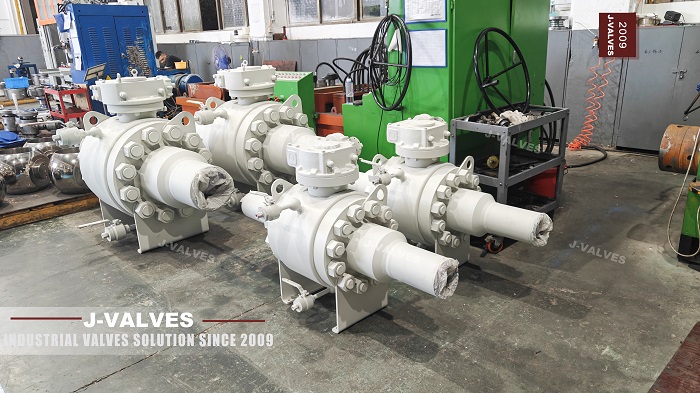
Large‑scale industrial pipelines are widely deployed in oil refining, long‑distance oil‑gas transmission, coal chemical industry and power plants. Pipeline systems operate continuously under high‑pressure impact, medium erosion, temperature fluctuation, thermal expansion and contraction, as well as frequent opening‑closing cycles.
Ordinary floating ball valves struggle to withstand heavy loads under large‑bore and high‑pressure conditions. Common failures include seat offset, sealing failure, valve body deformation and weld joint cracking.
Benefiting from 3‑piece split valve body, fixed‑ball cartridge and full butt‑weld ends, 3PC butt‑weld fixed ball valves are fully optimized from internal design to pipeline connection. They have become preferred isolation valves for heavy‑duty industrial pipeline projects. This article analyzes core advantages of this valve covering mechanical structure, sealing performance, butt‑weld end fabrication, real‑world working conditions and authoritative industry standards.
I. Body Design: 3‑Piece Structure & Fixed‑Ball for Heavy‑Load Pipeline Service
Core Merits of 3‑Piece (3PC) Split Valve Body
The 3‑piece valve body consists of left, middle and right body segments assembled together, different from monolithic valve body. Common materials include A105 forged steel, WCB carbon steel and stainless steel grades, complying with ASME B16.34 industrial valve standards.
Two key engineering values for pipeline applications:
First, convenient on‑site maintenance. Technicians can access internal components by loosening body bolting without removing the whole valve from pipeline. Spare parts such as ball, seat and packing can be replaced on‑site, greatly cutting downtime cost for long‑distance pipelines.
Second, reliable structural strength. Forged split body minimizes casting defects like porosity and sand holes which frequently appear in large‑size cast valve bodies. Enhanced resistance against high pressure and cyclic load makes it suitable for continuous heavy‑duty pipeline operation.
Fixed‑Ball Cartridge to Absorb Medium Thrust
In fixed ball valves, the ball is firmly supported by upper and lower bearings. The ball will not shift under medium pressure. For floating ball valves, fluid pressure pushes ball tightly against outlet seat, which accelerates seat wear under large‑bore high‑pressure pipeline conditions.
In large industrial pipelines, huge thrust generated by high‑pressure medium acts on ball surface. Fixed‑ball design transfers most fluid load onto bearings, while valve seats only undertake sealing duty. It reduces sealing pair abrasion and extends service life for non‑stop pipeline operation.
II. Butt‑Weld End Fabrication: Critical Connection Point for Pipeline Integrity
Seamless Pipeline Integration via BW Butt‑Weld Ends
3PC butt‑weld fixed ball valves adopt BW butt‑weld ends. End bevels are manufactured strictly in accordance with ASME B16.25 standard, enabling direct welding with process pipes.
Compared with flanged connection, butt‑weld brings obvious strengths for large‑scale pipelines:
1. Eliminate gasket leakage risk: Gasket aging and stress relaxation are frequent leakage sources for buried or outdoor flanged pipelines. Welded joints integrate valve and pipe as one assembly, removing potential leakage points at gaskets.
2. High structural integrity against pipeline stress: Pipelines produce mechanical stress caused by thermal expansion and ground settlement. Monolithic welded joints perform better under vibration and external force than flanged connections.
3. Ideal for buried pipeline: Anti‑corrosion coating can be fully wrapped around butt‑weld joints for buried oil‑gas pipelines, lowering corrosion risk at connection positions.
Engineering Remarks for Weld End Installation
Although butt‑weld connection delivers outstanding performance, welding quality directly decides pipeline reliability. Valve weld ends shall match pipe wall thickness and material grade. Qualified welding procedure specification shall be adopted. Heat input must be controlled during welding to avoid damage to internal soft‑seating components. Post‑weld non‑destructive test is required to detect welding defects.
III. Sealing Performance & Authoritative Industrial Standards for Pipeline Projects
Multi‑stage Sealing System for Positive Pipeline Isolation
3PC butt‑weld fixed ball valves are available in metal‑to‑metal hard‑seat or soft‑seat design with bi‑directional shut‑off capability. Metal hard‑seated version suits high‑temperature and particle‑containing medium; soft‑seat variant delivers bubble‑tight shut‑off for clean fluid. Anti‑blow‑out stem plus multi‑layer stem packing prevent stem fugitive emission, meeting pipeline safety requirements.
Compliance with Global Authorized Industrial Standards
High‑quality 3PC butt‑weld fixed ball valves follow ASME B16.34 pressure‑temperature rating and API 6D pipeline valve specifications. Some models obtain API 607 fire‑safe certification and SIL safety integrity certification.
Authoritative standards serve as vital reference for engineering design and tender evaluation. Standard‑compliant valves match international project specifications and reduce selection risks. Pressure classes range from Class150 to Class2500, size scope covers NPS2‑NPS48 to satisfy diversified pipeline requirements.
IV. Typical Application Scenarios for 3PC Butt‑Weld Fixed Ball Valves
1. Buried long‑distance oil‑gas transmission pipelines: Require zero external leakage and long service life for main‑line isolation.
2. Petrochemical process pipelines: High‑pressure process lines with frequent operation, demanding maintainable isolation equipment.
3. Coal‑chemical & synthetic energy pipelines: Severe working conditions with high pressure and complex medium.
4. Power‑plant fluid pipelines: Resist temperature cycling and mechanical vibration.
Selection Tip: Confirm medium property, design pressure, design temperature, pipe wall thickness, burial condition, fire‑safe and SIL requirement before ordering. Match proper body material, seat type and weld bevel specification accordingly.
V. Conclusion: Full‑Chain Design from Body to Weld End Solves Real‑World Pipeline Challenges
The competitiveness of 3PC butt‑weld fixed ball valves lies in systematic design targeting real‑world pipeline pain points, rather than single‑parameter advantage.
3‑piece body simplifies on‑site overhaul; fixed‑ball structure bears heavy pipeline fluid load; standardized butt‑weld ends eliminate joint leakage risk. Supported by globally‑recognized ASME and API standards, it becomes mainstream isolation solution for large‑bore, high‑pressure, long‑running industrial pipelines. Reasonable parameter‑based selection in design and procurement phase helps give full play to valve performance and guarantees safe and stable pipeline operation.


