


I. Why A105 Trunnion Mounted Ball Valves Are Preferred for High‑Pressure Oil & Gas Applications
For harsh working conditions such as long‑distance oil & gas transmission pipelines and processing stations, heavy‑duty ball valves play a decisive role in fluid isolation and control.
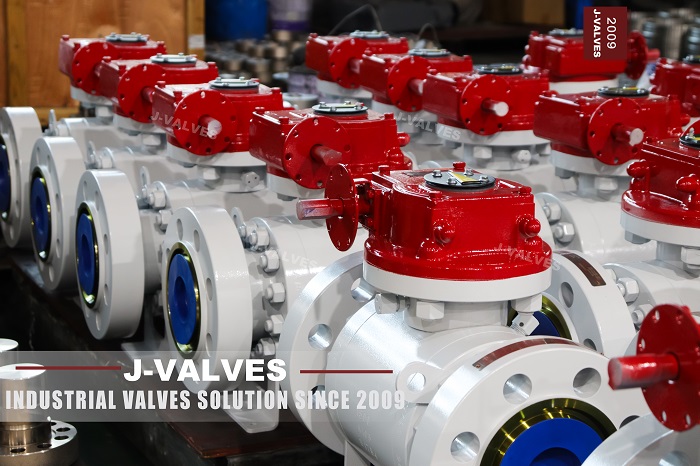
The workshop real‑shot displays finished 3‑inch Class 1500LB A105 trunnion mounted ball valves. These heavy‑duty industrial valves are engineered specifically for high‑pressure oil and gas engineering projects.
In the factory photo, batches of finished valves are neatly arranged. Valve bodies adopt heavy‑duty anti‑corrosion white coating, while worm‑gear operator housings are painted red for protection. Large‑size flanged ends, bolted connections and trunnion ball structures are clearly visible. Every valve goes through forging, precision machining, seat matching and full‑range pressure testing before delivery for oil‑gas end‑users.
II. Material & Technical Features of 3" 1500LB A105 Trunnion Ball Valve
A105 is widely‑used carbon steel forging material for oil‑gas valves. It performs well under high temperature and high pressure, with excellent impact resistance and stress‑crack resistance for Class 1500LB service.
Class 1500LB Pressure Rating: Designed for high‑pressure pipeline service, suitable for gas gathering lines and downstream wellhead process pipelines, coping with large pipeline differential pressure.
Trunnion‑mounted ball design: Supported by upper and lower trunnion shafts. Pipeline pressure loads act on valve seats rather than the ball itself. Operating torque is reduced significantly, bringing stable operation and tight sealing under high‑pressure conditions.
ASME B16.5 Flanged connection: Easy for on‑site pipeline installation and future maintenance.
Worm‑gear manual operator: The red worm‑gear box shown in photo allows easy manual operation. Actuators like electric or pneumatic can be retrofitted for automatic remote control.
These mass‑produced finished valves demonstrate full‑house manufacturing capacity. All procedures including raw material forging, CNC machining, assembly, hydrostatic shell test and seat leakage test are completed in‑house, complying with API 6D industrial standards.
III. Manufacturing Requirements for Ball Valves in Oil & Gas Projects
Oil‑gas industries demand extremely high valve reliability. Valve failure may cause shutdown or safety hazards. A qualified Class1500LB A105 trunnion ball valve shall meet these core requirements:
Use genuine A105 steel forging, casting material substitution is forbidden, complete material test reports shall be supplied.
Perform shell hydro‑test and bidirectional seat leakage test following API 6D specifications.
Trunnion seat with automatic cavity over‑pressure relief function to protect valve body.
Heavy‑duty anti‑corrosion coating for outdoor field oil‑gas station environment.
Full traceable documentation package: material certificate, test report, dimension drawing for project inspection & acceptance.
As shown in workshop photo, reinforced flange thickness and heavy‑duty bolt layout together with robust worm‑gear operators, all are typical features for Class1500LB high‑pressure service.
IV. Typical Application for Trunnion Ball Valves in Oil‑Gas Industry
3 inch 1500LB A105 trunnion ball valves are widely deployed in natural gas transmission pipeline isolation, oil‑gas processing plant process lines, wellhead downstream pipelines, compressor stations and refinery high‑pressure hydrocarbon loops.
Compared with floating ball valves, trunnion ball valves are the industry‑standard choice for high‑pressure and larger‑size conditions. Floating ball type can hardly handle 1500LB severe service.
Key Points for Project Specification
1. Check working media: if H₂S exists, NACE sour‑service material requirement shall be specified.
2. Pressure class shall match pipeline design pressure strictly, downgrading is not recommended.
3. Confirm applicable standards: API 6D, ASME B16.34, ASME B16.5.
4. Actuator options: manual worm gear, electric actuator or pneumatic actuator based on site automation requirement.


