


Introduction
In modern oil & gas, petrochemical, LNG, and energy industries, valves are required to operate safely and reliably under high pressure, large diameter, and long-term service conditions. Compared with traditional floating ball valves, Trunnion Mounted Ball Valves provide enhanced mechanical stability, lower operating torque, and improved sealing performance, making them an ideal choice for critical pipeline systems.
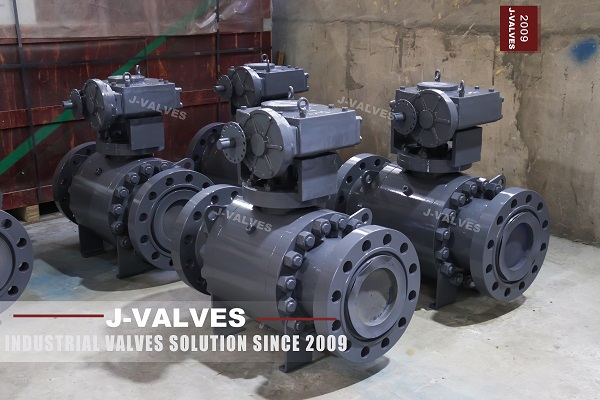
The valve shown in the image features a robust fixed ball structure with a flanged connection design and actuator assembly, representing a typical industrial Trunnion Mounted Ball Valve solution developed for demanding applications.
J-VALVES specializes in manufacturing high-performance trunnion mounted ball valves designed according to international standards, providing reliable solutions for oil, gas, LNG, chemical, and industrial pipeline systems.
What Is a Trunnion Mounted Ball Valve?
A Trunnion Mounted Ball Valve is a type of ball valve where the ball is supported by fixed trunnions at the top and bottom. Unlike floating ball valves, the ball does not move freely under pressure.
In high-pressure systems, fluid pressure generates a large force on the ball. The trunnion support absorbs this force and transfers it to the valve body, significantly reducing the load on the valve seats.
The main structural components include:
Fixed ball with upper and lower trunnion support
Valve body and bonnet structure
Double sealing seats
Anti-blowout stem design
Fire-safe sealing system
Manual, pneumatic, hydraulic, or electric actuator options
This design allows the valve to maintain stable operation under high pressure and large diameter conditions.
Key Advantages of Trunnion Mounted Ball Valves
1. Low Operating Torque for Large Size Applications
One of the biggest advantages of a trunnion mounted design is reduced operating torque.
Because the ball weight and pipeline pressure load are supported by the trunnion system, the valve requires less force to operate compared with floating ball valves.
Benefits include:
Smaller actuator requirements
Lower operating energy consumption
Improved automation efficiency
Longer service life of operating components
This makes trunnion mounted ball valves particularly suitable for large-diameter pipelines.
2. Excellent Sealing Performance Under High Pressure
High-pressure pipeline systems require reliable shut-off capability. Trunnion mounted ball valves use a pressure-assisted sealing design, where system pressure helps push the seat toward the ball surface.
Advantages include:
Reliable bidirectional sealing
Reduced leakage risk
Stable performance during pressure fluctuations
Suitable for critical isolation applications
Typical applications include:
Oil transmission pipelines
Natural gas pipelines
LNG terminals
Refinery process systems
3. Double Block and Bleed Capability
Many trunnion mounted ball valves can be designed with double block and bleed functionality.
This allows operators to:
Isolate upstream and downstream pressure
Verify valve sealing condition
Safely perform maintenance operations
This feature is especially important in industries where safety and equipment protection are critical.
Applications of Trunnion Mounted Ball Valves
Oil and Gas Pipeline Systems
Pipeline transportation requires valves capable of handling high pressure and continuous operation. Trunnion mounted ball valves are widely installed in:
Crude oil pipelines
Natural gas transmission systems
Gathering pipelines
Compressor stations
Their strong mechanical design ensures reliable operation over extended service periods.
LNG and Cryogenic Applications
LNG systems require valves with excellent sealing performance and precise manufacturing control.
Trunnion mounted ball valves can be customized for:
Low-temperature service
Cryogenic applications
Thermal cycling conditions
Special materials and sealing technologies help maintain reliability in extreme temperature environments.
Petrochemical and Chemical Plants
Chemical processing systems often involve corrosive and high-pressure media. Trunnion mounted ball valves provide:
Strong corrosion resistance
Reliable shut-off performance
Long maintenance intervals
Design Features of J-VALVES Trunnion Mounted Ball Valves
J-VALVES focuses on engineering reliability and manufacturing precision to deliver industrial valve solutions for global projects.
1. Robust Body Construction
J-VALVES trunnion mounted ball valves are designed with optimized body structures to withstand:
High pressure loading
Pipeline stress
Temperature changes
Long-term operation requirements
Available configurations include:
Two-piece body design
Three-piece body design
Forged or cast body options
2. Advanced Sealing Technology
Reliable sealing is essential for pipeline safety. J-VALVES applies advanced sealing solutions including:
Soft seat sealing
Metal seat sealing
Fire-safe design
Anti-static structure
These designs improve valve performance in demanding environments.
3. International Standard Manufacturing
J-VALVES manufactures trunnion mounted ball valves according to recognized industry standards, including:
API 6D
ASME B16.34
ISO 17292
NACE MR0175 (when required)
Each valve undergoes strict inspection procedures, including:
Pressure testing
Leakage testing
Functional testing
Dimensional inspection
Why Choose J-VALVES Trunnion Mounted Ball Valves?
With years of experience in industrial valve manufacturing, J-VALVES provides customized valve solutions for international energy and industrial markets.
J-VALVES Advantages:
Professional Engineering Capability
Experienced engineers provide optimized valve designs according to operating conditions, pressure ratings, and application requirements.
Wide Material Selection
Available materials include:
Carbon steel
Stainless steel
Duplex stainless steel
Low-temperature carbon steel
Special alloys
Customized Actuation Solutions
J-VALVES supports:
Manual operation
Pneumatic actuators
Hydraulic actuators
Electric actuators
Strict Quality Management
Every valve is inspected to ensure reliable performance before delivery.
Conclusion
The Trunnion Mounted Ball Valve is a reliable solution for high-pressure and large-diameter pipeline systems. Its fixed ball structure, low operating torque, strong sealing capability, and long service life make it widely used in oil & gas, LNG, petrochemical, and industrial applications.
With advanced manufacturing technology, professional engineering support, and strict quality control, J-VALVES provides high-performance trunnion mounted ball valve solutions designed to meet the demanding requirements of global industrial projects.


