

I. Baseline Performance Boundaries of API 6D Stainless Steel Trunnion Ball Valves
API 6D is a globally authoritative specification for pipeline valves in oil & gas industries. It defines core requirements for trunnion‑mounted ball valves including body wall thickness, bore size, stem blow‑out prevention, pressure classes, API 607 fire‑safe qualification, bi‑directional sealing and double block‑and‑bleed (DBB) functions. Manufactured with stainless steel material CF8, CF8M or A105 with stainless steel overlay, API 6D trunnion ball valves deliver reliable performance for pipeline pressure containment, tight shut‑off, pigging operations and fire‑safe service for transmission pipelines, gathering stations and petrochemical process lines.
However, API 6D does not mandate quantitative fugitive‑emission limits. It only provides optional guidance for low‑leakage service without defined acceptance thresholds for stem packing under thermal and mechanical cycling. Standard API 6D stainless steel trunnion ball valves fitted with conventional graphite packing may develop minor fugitive leakage at the stem when exposed to temperature swings and frequent valve operation. Without dedicated upgrades, they cannot satisfy ISO 15848 mandatory compliance for international environmental‑critical projects.
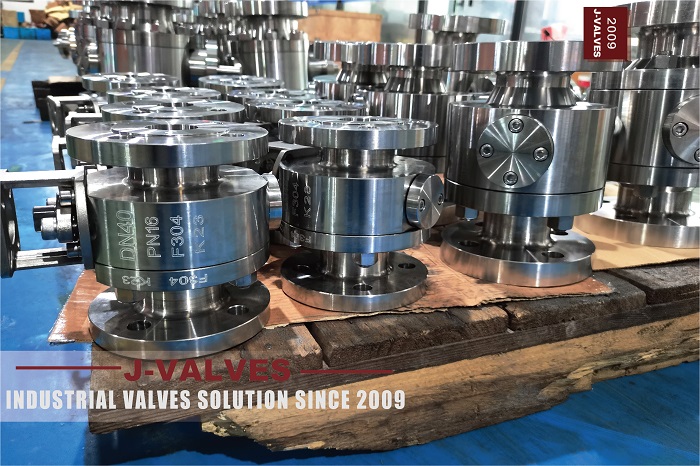
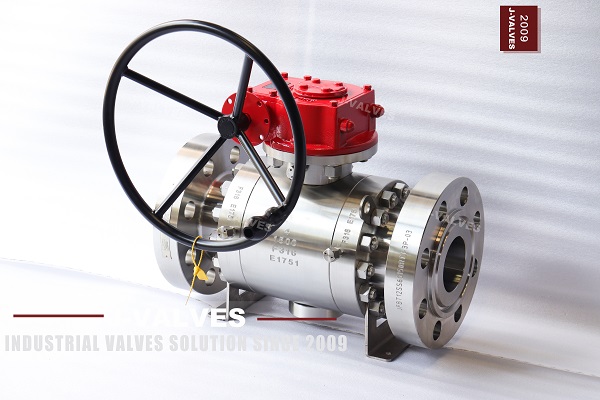
ALT text: Finished stainless steel flanged trunnion ball valves at workshop, API6D forged body for oil‑gas fugitive emission applications
II. What ISO 15848 Requires for Upgraded Trunnion Ball Valves
Core Test Framework of ISO 15848‑1
ISO 15848‑1 is the globally accepted standard for qualification of industrial valves for fugitive‑emissions. It requires combined mechanical cycling plus thermal cycling testing using helium test medium. Performance classes include Class A, Class B and Class C. Class B remains the mainstream requirement for most oil‑gas and petrochemical projects worldwideISO.
The critical difference from API 6D hydro‑static and pneumatic seat test: API 6D mainly validates static sealing under room temperature. ISO15848 simulates real‑world service conditions: after repeated valve operation and temperature cycling, stem fugitive leakage must stay within strict limits, assessing long‑term sealing stability instead of only static tightness for brand‑new valves.
Do We Need to Replace Stainless Steel Body Material?
In most retrofit and new‑build scenarios, existing API 6D‑compliant stainless steel body materials such as CF8 / CF8M do not need replacement. The upgrade does not target base body material. Improvement focuses on stem sealing assembly, packing stack design, stem surface finishing and stuffing‑box geometry. Body wall thickness, flange dimensions, ball and seat keep full API 6D compliance. This approach preserves proven pipeline‑grade mechanical performance while adding ISO15848 low‑emission capability.
III. Four Critical Upgrade Steps from API 6D to ISO 15848 for Stainless Steel Trunnion Ball Valves
1. Gradient‑Structure Stem Packing System
Standard API6D valves use single‑density homogeneous graphite packing. Pre‑load stress drops rapidly after thermal expansion‑contraction cycles.
For ISO15848 compliance, upgrade to multi‑layer gradient packing stack: high‑density anti‑extrusion outer rings, medium‑density graphite sealing core and low‑density inner layer contacting the stem. Combine with live‑loaded spring‑energized gland assembly to compensate packing stress loss during thermal cycles and suppress stem leakage drift, this is the most vital modification to achieve ISO15848 Class B rating.
2. Precision Hardened Stem Surface Treatment
API6D only specifies basic anti‑corrosion requirements for valve stems. ISO 15848 demands controlled surface roughness and anti‑galling performance. Hard‑coating treatment on stainless steel stem reduces abrasion caused by packing reciprocating motion and eliminates micro‑scratch gas leakage paths.
3. Stuffing‑Box & Bonnet Seal Optimization
Deepen stuffing‑box dimension to accommodate multi‑layer low‑emission packing. Keep mandatory API6D stem blow‑out proof design. Replace conventional spiral‑wound bonnet gasket with spring‑energized metal C‑ring gasket to minimise bonnet joint fugitive emission risk.
4. Complete Third‑Party Type Test Certification
Replacing packing parts alone does not equal full ISO 15848 qualification. Complete ISO15848‑1 third‑party type approval test is mandatory: including defined mechanical operation cycles, high‑low temperature thermal cycles and helium mass‑spectrometer leakage measurement with formal certification report. Component‑level certificates cannot prove full valve compliance to ISO 15848‑1.
IV. Common Pitfall: API 6D Compliance Does NOT Automatically Meet ISO 15848
A widespread procurement misunderstanding: “If a valve passes API 6D, it automatically satisfies ISO15848 fugitive‑emission requirements”. This statement is incorrect. API6D governs overall pipeline valve design and manufacture, while ISO15848 is a dedicated fugitive‑emission qualification standard. They complement each other and neither replaces the other.
A stainless steel trunnion ball valve can hold both API6D and ISO15848 certificates simultaneously: body, pressure rating and dimensional design follow API6D; stem sealing assembly is fully qualified under ISO15848‑1 thermal‑mechanical cyclic test. International petrochemical, LNG and hydrogen projects usually require both authoritative reports.
V. Typical Applications Requiring This Upgrade
1. Overseas oil‑gas, LNG and refinery projects with strict local environmental regulations
2. Process pipelines handling volatile hydrocarbon or toxic fluids
3. Service with frequent temperature fluctuation and repeated valve cycling
4. Project specification explicitly specifying ISO15848‑1 Class B / Class A fugitive emission
VI. Conclusion — Upgrade Does Not Reject Original API6D Design Philosophy
Upgrading stainless steel trunnion ball valves from API6D to ISO15848 does not discard the mature API6D pipeline‑grade design. It enhances stem‑sealing systems on top of existing proven valve bodies, validated via third‑party thermal‑mechanical fugitive emission testing. The final product combines high‑pressure pipeline safety and environmental low‑leakage performance.
When drafting project specifications or carrying out technical bid evaluation, verify whether suppliers provide both API6D valve reports and full valve ISO15848‑1 type‑test certificates. Avoid situations where only individual components are certified while complete valves fail real‑world cyclic service.