

Introduction
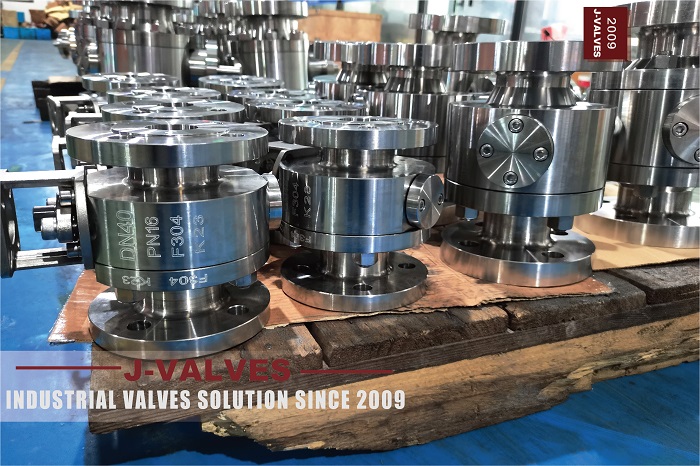
Bronze ball valves are widely used in industrial, marine, water, and fluid-control systems where corrosion resistance, mechanical reliability, and compact construction are important. The image shows a production batch of bronze floating ball valves manufactured in a series configuration, featuring robust metallic bodies, threaded end connections, compact quarter-turn construction, and protective blue component covers.
For high-pressure service, the valve structure must be carefully engineered to withstand pressure loads while maintaining reliable shut-off performance. A High-Pressure Bronze Floating Ball Valve combines the corrosion-resistant characteristics of bronze with the simple and efficient operating principle of a floating ball design.
With professional valve manufacturing experience, J-VALVES provides customized bronze floating ball valve solutions for industrial and marine applications, with a focus on material quality, precision machining, sealing reliability, and production consistency.
1. Structural Design of a Bronze Floating Ball Valve
The main components of a floating ball valve include the valve body, ball, seats, stem, packing system, and end connections.
The ball is not mechanically fixed by a lower trunnion. Instead, it is supported by the valve seats and can move slightly under differential pressure. When the valve is closed, upstream pressure pushes the ball toward the downstream seat, helping establish sealing contact.
The compact structure shown in the production image offers several practical advantages:
Compact installation dimensions
Simple quarter-turn operation
Robust metallic construction
Convenient integration into piping systems
Efficient shut-off performance
For high-pressure applications, body wall thickness, connection design, seat loading, and component strength must all be considered as part of the overall engineering design.
2. Floating Ball Working Principle
The operating principle of a floating ball valve is based on a 90-degree rotation of the ball.
When the valve is fully open, the ball passage is aligned with the pipeline, allowing fluid to flow through the valve with relatively low resistance.
When the stem rotates the ball to the closed position, the solid section of the ball blocks the flow passage. Differential pressure then assists the ball in moving toward the downstream seat, creating the sealing force required for shut-off.
This design provides a straightforward operating mechanism while maintaining effective flow isolation.
For higher-pressure applications, accurate ball and seat machining becomes particularly important because sealing performance depends on the interaction between these components.
3. Bronze Material Advantages
Bronze is an established material choice for applications where resistance to water and marine corrosion is required. Depending on the specific bronze alloy selected, the material can provide a useful combination of mechanical strength, corrosion resistance, and durability.
A bronze floating ball valve can be particularly advantageous in:
Seawater-related systems
Marine piping
Cooling-water systems
Industrial water pipelines
Shipbuilding applications
General fluid-control systems
For specific high-pressure projects, the exact bronze alloy and pressure rating should be selected according to the applicable design standards and operating conditions.
J-VALVES can evaluate material requirements based on pressure, temperature, fluid characteristics, and environmental conditions to provide an appropriate valve configuration.
4. Robust Valve Body and Connection Design
The valve body is the primary pressure-containing component. For a high-pressure bronze ball valve, the body must maintain dimensional stability and mechanical integrity under the specified operating conditions.
The valves shown in the image feature compact threaded connections, which can be useful for applications requiring a relatively simple and space-efficient installation arrangement.
Key engineering considerations include:
Body material integrity
Thread dimensional accuracy
Wall thickness
Ball chamber geometry
Connection strength
Sealing-surface alignment
J-VALVES applies controlled machining processes to improve dimensional consistency across production batches. This is particularly important when manufacturing multiple valves for the same industrial project.
5. Ball, Stem and Seat Sealing System
The ball and seats determine the primary internal shut-off performance, while the stem and packing system help control external leakage.
A properly engineered sealing system should provide a balance between sealing force and operating torque. Excessive friction can increase actuator or manual operating requirements, while insufficient sealing force can affect shut-off performance.
Important design factors include:
Ball roundness and surface finish
Seat material compatibility
Stem dimensional accuracy
Packing selection
Operating temperature
Pressure differential
J-VALVES uses precision machining and controlled assembly to maintain the required relationship between the ball, stem, and seats.
6. High-Pressure Performance Considerations
The term high-pressure should always be associated with a defined pressure class or design pressure rather than used as a general product description.
For a high-pressure bronze floating ball valve, engineers should evaluate:
Design pressure and temperature
Valve size and connection type
Bronze alloy grade
Seat and packing materials
Pressure-temperature rating
Required leakage performance
Operating frequency
Pressure testing should be conducted according to the applicable valve standard and project specification before the valve is placed into service.
J-VALVES incorporates inspection and pressure-testing procedures into its manufacturing process to verify the integrity and sealing performance of finished valves.
7. Production Advantages of J-VALVES
The production image illustrates an important advantage of J-VALVES: the ability to manufacture bronze ball valves in consistent batches while maintaining controlled component quality.
Consistent Manufacturing
Batch production requires stable control of machining dimensions, assembly procedures, and inspection standards. This helps maintain consistency between individual valves supplied for the same project.
Precision Machining
Accurate machining of threaded connections, valve chambers, stems, and sealing surfaces contributes to reliable assembly and smooth operation.
Material Control
J-VALVES can select bronze alloy grades according to application requirements, with material verification forming an important part of quality management.
Sealing and Pressure Testing
Finished valves can undergo appropriate pressure and leakage testing to verify body integrity and shut-off performance.
Customized Engineering
J-VALVES can provide different connection configurations, pressure classes, sizes, sealing materials, and operating methods according to customer specifications.
8. Applications of Bronze Floating Ball Valves
Depending on the specific alloy, pressure rating, connection design, and applicable standards, bronze floating ball valves can be used in:
Marine piping systems
Shipbuilding
Seawater and cooling-water applications
Industrial water treatment
Pump and equipment isolation
General industrial fluid systems
Offshore auxiliary systems
For particularly demanding services, the valve material and configuration should be verified against the actual medium and operating conditions before selection.
Conclusion
The High-Pressure Bronze Floating Ball Valve combines a compact floating-ball mechanism with the corrosion-resistant characteristics of suitable bronze alloys. Its quarter-turn operation, pressure-assisted seating principle, robust body construction, and practical connection design make it a valuable solution for many industrial and marine fluid-control applications.
The production image also highlights the importance of manufacturing consistency when supplying valves in quantity. With professional machining, material control, pressure testing, and customized engineering capabilities, J-VALVES provides bronze floating ball valve solutions designed for reliable performance, consistent quality, and long-term service in demanding industrial environments.