


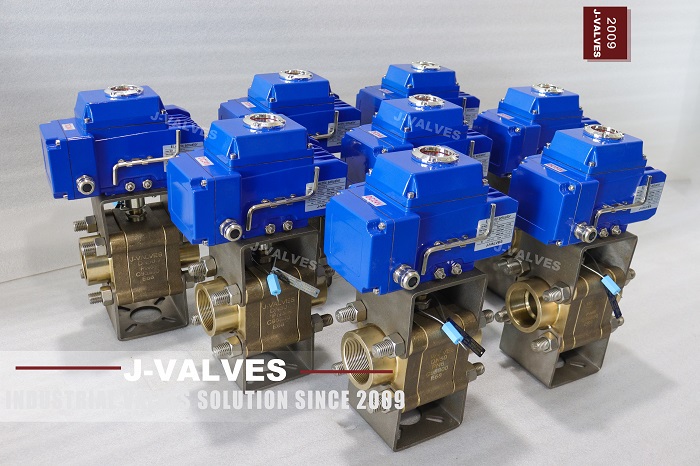
1. What problem does this electric ball valve solve?
Manual ball valves require a person to operate the handle at the installation point. An electric ball valve can receive an open or close command from a control panel, PLC or automation system. This makes it useful where a pipe section must be isolated remotely or where repeated local operation would be inconvenient.
In this product description, DN50 identifies the nominal size, PN6 is the supplied pressure designation, and C95800 identifies the copper-alloy grade. The terms “electric,” “3-piece” and “t
hreaded” describe the actuation method, body configuration and pipe connection concept.
A product photograph helps a reader understand the visible configuration, such as the blue electric actuator and compact bronze valve body. It does not replace a drawing, material certificate, pressure test record or actuator datasheet.
2. Why does C95800 nickel aluminum bronze matter?
C95800 is a cast copper-aluminum-iron-nickel alloy commonly classified as nickel aluminum bronze. Copper Development Association data lists C95800 among aluminum bronze alloys and identifies valve bodies, seawater-contact valves, marine hardware and machinery among typical application categories. ASTM B148-24 covers requirements for several aluminum-bronze sand castings, including UNS C95800.
These references are useful for material research, but they do not prove that a particular valve complies with ASTM B148 or that it is suitable for every seawater, chemical or high-temperature service. The valve body, ball, stem, seats, seals and fasteners may use different materials, and the least suitable component can determine the operating boundary.
Before purchase, request the following information:
the actual alloy designation for the body and other pressure-containing parts;
the material certificate or heat information where required;
the casting route and material standard used for the body;
the materials of the ball, stem, seats, seals and fasteners;
the medium chemistry, chloride level, temperature and flow conditions.
Material boundary: “Bronze is corrosion resistant” is not a universal service statement. C95800 compatibility must be checked against the actual medium, temperature, velocity and electrochemical environment.
3. How can a 3-piece body support maintenance?
A typical 3-piece ball valve consists of a center body, two end sections, a ball, stem, seats, seals and bolting. Where the piping layout permits, the center section can be separated for inspection or replacement of selected internal components. This is one reason 3-piece construction is often considered for equipment skids and piping that require periodic maintenance.
However, a 3-piece construction does not permit disassembly while the line is pressurized. The line must be isolated, depressurized, drained and made safe before maintenance. The parts that can actually be replaced must be confirmed from the manufacturer’s maintenance instructions.
4. Threaded ends: confirm the thread standard
“DN50 threaded ball valve” is not a complete connection specification. An export or industrial project should identify the thread standard, thread direction, engagement length, end dimensions and mating fittings. NPT, BSPT and ISO 228-1 G are not interchangeable by name alone: their profiles, dimensions and sealing methods differ.
Procurement item | What to confirm |
Thread standard | NPT, BSPT or ISO 228-1 G must be stated explicitly. |
Nominal size | Check DN50 against the actual pipe NPS, end dimensions and mating fittings. |
Sealing method | Confirm thread sealant, installation direction and site requirements. |
Maintenance access | Check the removal direction of the 3-piece body and the clearance around the actuator. |
5. What does PN6 mean?
PN is a nominal pressure designation used in piping component systems. PN6 should not be treated as the maximum working pressure at every temperature, and it should not be directly converted into an ASME Class rating. The allowable pressure can also be limited by the material group, temperature, body design, seats, stem and other components.
It is technically safer to write that the product data identifies the valve as PN6. Unless an approved pressure-temperature table, test record and project condition are available, the article should not claim a fixed maximum pressure, “high-pressure service” or equivalence to Class 600. If a rating table is available, publish it together with the applicable standard, temperature and service conditions.
6. Selecting the electric actuator
The actuator should be selected from the actual operating torque rather than from nominal size alone. Differential pressure, seat friction, operating frequency, seal material, ambient temperature and a suitable margin can all affect the required torque.
Actuator parameter | Selection check |
Power supply | Voltage, frequency and single- or three-phase supply must match the site. |
Control signal | On-off, three-point, analogue or fieldbus control should be defined. |
Output torque | Match the measured or calculated valve torque and confirm the operating margin. |
Position feedback | Confirm whether open, closed, alarm or remote status feedback is required. |
Environmental protection | Check IP rating, ambient temperature, outdoor installation and hazardous-area requirements. |
Failure action | A standard electric actuator should not automatically be described as fail-open or fail-closed. The project requirement must define this function. |
7. Potential applications and service limits
Potential application directions
industrial water lines that require remote on-off control;
marine or offshore auxiliary piping, after medium compatibility is verified;
isolation points on equipment skids and automated process packages;
piping that requires periodic inspection of seats or internal parts;
HVAC, process-water and general industrial fluid systems when pressure, temperature and seals are compatible.
Services that require additional review
chloride-containing fluids, strong acids, strong alkalis, ammonia or other media that may react adversely with copper alloys;
high-temperature, low-temperature, steam or hot-oil service;
continuous throttling, severe pressure drop, cavitation, flashing or high-noise conditions;
hazardous areas, functional-safety systems or applications requiring a defined loss-of-power position;
potable water, food or pharmaceutical applications requiring health or hygiene certification.
MSS SP-110 describes the relevant threaded metal ball valves as intended for on-off operation. Modulating or throttling service should be used only when recommended by the manufacturer. A quarter-turn mechanism does not by itself make every ball valve suitable for continuous control.
8. Installation, commissioning and maintenance
Before installation, check the valve marking, flow direction, thread standard and mating dimensions.
Clean the pipe and remove welding slag, chips and loose sealing material.
Prevent pipe loads from being transferred directly to the valve body or actuator.
Before energizing the actuator, verify voltage, control wiring, rotation direction and limit settings.
Carry out a controlled opening and closing check and confirm the full-open and full-closed positions.
Before maintenance, isolate, depressurize and drain the line. Never disassemble a 3-piece valve under pressure.
Follow the project maintenance plan for threaded joints, actuator fasteners, leakage and electrical terminals.
9. Documents to request before purchase
A product name is not a complete technical specification. A professional inquiry should request:
the product datasheet and general arrangement drawing;
material certificates for the body and pressure-containing parts;
the pressure-temperature rating and service temperature range;
the thread standard and end-dimension drawing;
the seat, seal and stem material list;
the actuator datasheet, including power, torque, control and protection rating;
pressure, leakage or project-specified inspection records;
valid certificates or declarations where the project requires them.
10. Frequently asked questions
What is C95800 material?
C95800 is a cast copper-aluminum-iron-nickel alloy commonly referred to as nickel aluminum bronze. Its actual performance depends on casting practice, heat treatment, component design and service conditions.
Is PN6 the same as Class 600?
No. PN and Class belong to different pressure-designation and dimensional systems. PN6 should not be written as Class 600.
Can a 3-piece ball valve be opened under pressure?
No. The 3-piece configuration can support maintenance, but the line must be isolated, depressurized and drained before the body is separated.
Can this valve be used for seawater?
C95800 can be considered for seawater-contact valve applications, but the complete valve still requires review of velocity, chloride exposure, temperature, seat materials and other components. Supplier confirmation is required for the specific service.
Can a threaded ball valve be used for continuous throttling?
Only when the manufacturer specifically recommends it and supplies suitable flow and pressure-drop information. Otherwise, position the valve as an on-off isolation valve.
Which actuator information is required?
At minimum, specify power supply, control method, operating time, torque, environmental conditions, feedback requirements and any hazardous-area or defined failure-action requirements.
Conclusion: replace broad claims with traceable technical information
The value of a DN50 PN6 C95800 electric 3-piece bronze threaded ball valve should not be presented as a collection of promotional words such as “bronze,” “corrosion resistant,” “high pressure” and “electric.” A responsible selection connects the alloy grade, pressure designation, thread standard, seals, actuator and actual service medium. Drawings, material certificates, test records and project conditions are the evidence that determines whether the valve is suitable.
Technical inquiry checklist: Provide the pipe size, thread standard, medium, operating temperature, working pressure, differential pressure, power supply, control signal and environmental requirements so that the valve and actuator can be reviewed as one assembly.


