


Introduction – Threaded Ball Valves: Core Control Components for Fluid Pipelines
2-piece threaded ball valves feature easy disassembly, stable sealing and compatibility with small & medium-bore pipelines, widely applied in chemical, oil & gas, water treatment, HVAC and hydraulic industrial piping systems. However, products on the market vary drastically in material, manufacturing process and safety standards. Inferior ball valves are prone to leakage, stem fracture and high-temperature failure, posing severe safety hazards.
Combined with on-site photos of J-VALVES’ modern production workshop for mass production of blue-handle 2-piece threaded ball valves, this guide sorts out a set of practical selection standards for procurement engineers from five dimensions: material grade, safety structure, manufacturing craftsmanship, inspection standards and certification qualifications, to help you avoid costly procurement pitfalls.
I. Understand Valve Body Materials to Match Media & Working Conditions
Material grade determines the service life of 2-piece threaded ball valves. J-VALVES standardized production lines stock three mainstream valve body materials to accommodate different corrosion, temperature and pressure working scenarios:
WCB Carbon Steel Valve Body: Suitable for water, steam and general oil products, rated PN16, PN40 and 1000WOG. Cost-effective, the top choice for HVAC and general industrial pipelines.
SS304 Stainless Steel Valve Body: Resists weak acid, weak alkali, tap water and food-grade fluids, ideal for general anti-corrosion applications under ambient temperature.
SS316 Stainless Steel Valve Body: Designed for highly corrosive chemical fluids and seawater, with superior intergranular corrosion resistance compared to SS304.
Procurement Tip: Low-cost manufacturers often use recycled impure steel for valve body forging without metallurgical inspection, leading to cracking under high pressure. Reputable manufacturers like J-VALVES provide full material test certificates with traceable heat numbers for all raw valve body materials.
II. Core Safety Structural Designs – Must-Have for High-Risk Industrial Working Conditions
Premium industrial-grade 2-piece threaded ball valves are equipped with multiple safety structures, which is the key distinction from low-end civilian valves. All finished products in our workshop assembly line come with the following designs as standard:
1. Blow-out Proof Stem
A limiting shoulder is added to the bottom of the stem, preventing the stem from being ejected by internal pipeline pressure and eliminating the risk of hazardous medium spray leakage – a mandatory requirement for oil & gas and high-pressure hydraulic pipelines.
2. API 607 Fire-Safe Design
Compliant with API 607 fire safety specifications. In case of open flame and high temperature, after PTFE seats melt, the built-in metal seat ring forms a metal-to-metal seal automatically to block continuous leakage of flammable and explosive media, a non-negotiable feature for petrochemical and gas pipelines.
3. Anti-Static Structure
Conductive springs are installed between the ball, stem and valve body to discharge static electricity generated by fluid friction, avoiding ignition risks for flammable and explosive medium pipelines.
4. Full Port Design
The full range of J-VALVES 2-piece threaded ball valves adopts full port design. The inner bore diameter matches the pipe inner diameter to minimize medium pressure drop without throttling loss, perfect for high-flow transmission pipelines.
5. Optional PTFE / RPTFE Seats
Pure PTFE seats are suitable for normal-temperature clean water and oil products; reinforced RPTFE seats are recommended for high-temperature or particle-laden media, featuring enhanced wear resistance and anti-creep performance, extending sealing service life by over 3 times and achieving Class VI zero-leakage sealing grade.
III. Manufacturing Craftsmanship – CNC Precision Machining Ensures Sealing Accuracy
Many procurement teams overlook processing standards. Ball valves made with rough casting and ordinary lathe machining have excessive tolerance on ball surfaces and threads, resulting in internal and external leakage after short-term operation.
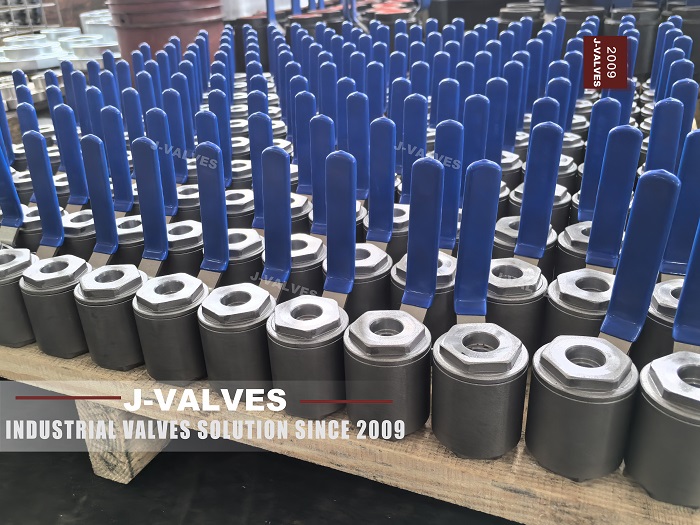
Take a look inside J-VALVES’ modern production workshop (pictured mass production line of blue-handle 2-piece threaded ball valves): the whole production flow adopts CNC numerical control precision machining equipment:
Integral CNC turning for NPT/BSP/BSPT valve body threads, fully compliant with American and British standards. Threads fit tightly during installation to prevent slippage and seepage.
Mirror CNC grinding for ball surfaces with micron-level roundness tolerance, realizing zero leakage when paired with PTFE seats.
CNC milling for the two-piece valve body joint surface, ensuring uniform gasket contact and eliminating external leakage at the middle flange.
Standardized assembly lines enable consistent dimensions for all finished handles and valve bodies, stable delivery cycles, and mass order compatibility for industrial projects.
IV. Factory Inspection – 100% Full Inspection + Standardized API 598 Testing
Never purchase valves without complete inspection procedures, as leakage under high pressure may cause equipment damage and major safety incidents.J-VALVES strictly follows international industrial valve inspection standards:
100% Offline Pressure Testing: Every finished 2-piece threaded ball valve undergoes shell hydrostatic test and seat air tightness test right after assembly. Defective products are reworked immediately to avoid flawed units entering the market.
API 598 Standard Type Testing: Batched sampling is conducted regularly to complete cycle switching fatigue tests and long-term durability tests under variable pressure per API 598 valve inspection standards, verifying stable long-term performance.
All inspection records are archived, and full test reports can be provided to buyers for factory equipment acceptance and third-party audit compliance.
V. Authoritative Certifications – Mandatory for Export & Tender Projects
For overseas projects and large industrial bidding, valve certifications are hard requirements. Prioritize manufacturers with complete certification credentials during selection:
ISO 9001 Quality Management System: Standardized full-process control covering raw material warehousing, CNC machining, assembly, inspection and shipment.
CE EU Pressure Equipment Directive Certification: Mandatory for pipeline engineering exports to the EU, required for customs clearance and client acceptance.
SIL Safety Integrity Level Certification: SIL2/SIL3 certified valves are required for high-risk chemical and oil & gas automatic control pipelines to reduce process failure risks.
API 607 fire-safe and API 598 inspection qualifications, aligned with petroleum and natural gas industry standards.
Founded in 2009, J-VALVES specializes in industrial valve manufacturing with a full set of valid certifications. Copies of certification documents can be supplied for project bidding filing.
VI. Quick Selection Reference of Standard Specifications
1.Thread Connection Standards
NPT: American tapered pipe thread, widely used in North America and petroleum equipment.
BSP / BSPT: British standard pipe thread, common for European, Southeast Asian and water treatment pipelines.
2. Pressure Rating Coverage
PN16, PN40, 1000WOG (6.9MPa), covering low-pressure HVAC to medium-high pressure hydraulic and chemical pipelines.
VII. Key Pitfalls to Avoid for Procurement Engineers
Avoid low-cost 2-piece threaded ball valves without material test reports and factory pressure test records.
For oil, gas and flammable/explosive media, confirm three core designs: fire-safe API 607, anti-static structure and blow-out proof stem.
For export orders, verify the manufacturer’s CE, ISO 9001 and API series certifications in advance.
Select full port models for high-flow pipelines to reduce pipeline energy consumption.
For long-term bulk procurement, choose manufacturers with self-owned modern CNC workshops and full inspection production lines (like J-VALVES workshop shown in photos) for stable supply and fast after-sales support.
Conclusion
High-quality 2-piece threaded ball valves cannot be judged solely by price. Superior performance relies on five core factors: premium raw materials, precision machining, integrated safety structures, standardized full inspection and complete international certifications. Since its establishment in 2009, J-VALVES has operated standardized modern production workshops. Our full range of 2-piece threaded ball valves complies strictly with global industrial standards, with customizable bore sizes, handle types and seat materials to fit all types of fluid pipeline projects worldwide. Contact our technical team directly to get free samples, quotations and certification documents for one-on-one customized selection solutions.


