


Introduction
With the rapid development of LNG, hydrogen energy, petrochemical, and cryogenic storage industries, the demand for reliable cryogenic ball valves has continued to increase. In extremely low-temperature operating conditions, valve performance is directly related to system safety, operational stability, and long-term reliability.
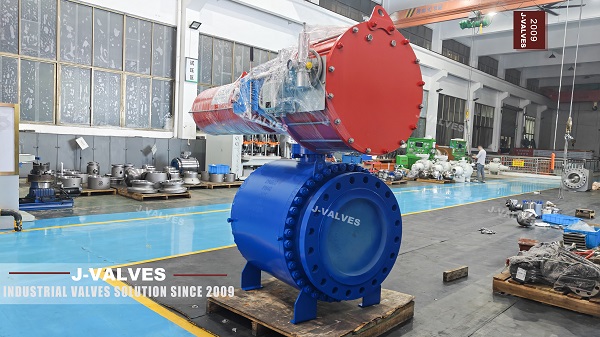
The pneumatic cryogenic trunnion mounted ball valve is designed specifically for applications requiring high pressure capability, low-temperature resistance, and automated operation. Compared with conventional floating ball valves, the trunnion mounted design provides superior mechanical stability, reduced operating torque, and enhanced sealing performance, making it an ideal solution for large-diameter cryogenic pipeline systems.
1. Structural Characteristics of Cryogenic Trunnion Mounted Ball Valves
A cryogenic trunnion mounted ball valve consists mainly of the valve body, ball, trunnion support system, seats, stem, extended bonnet, and pneumatic actuator.
Unlike floating ball valves, the ball in a trunnion mounted ball valve is fixed by upper and lower shafts. The pressure load generated by the pipeline medium is transferred through the trunnion structure rather than directly acting on the valve seat.
This design provides several important advantages:
Reduced seat loading under high pressure conditions
Lower operating torque
Improved actuator efficiency
Stable sealing performance during frequent operation
Suitable for large diameter valve applications
For large-size valves such as DN600 and above, the trunnion structure significantly improves mechanical reliability.
2. Cryogenic Design Features for Low Temperature Service
Cryogenic applications require special consideration because materials experience contraction, sealing changes, and lubrication challenges at extremely low temperatures.
A high-performance cryogenic ball valve normally incorporates the following design features:
2.1 Extended Bonnet Design
The extended bonnet creates a thermal isolation area between the cold fluid zone and the stem packing area.
Benefits include:
Preventing packing from freezing
Maintaining sealing flexibility
Reducing heat transfer into the valve body
Protecting actuator and stem components
The extended stem design is especially important for LNG and liquid gas transportation systems.
2.2 Cryogenic Material Selection
Material selection determines the reliability of valves operating in low-temperature environments.
Common cryogenic valve materials include:
ASTM A350 LF2 carbon steel for low-temperature pressure parts
Stainless steel trim components
Low-temperature sealing materials
Specialized cryogenic packing systems
LF2 material offers excellent impact toughness at low temperatures and is widely used in cryogenic pipeline applications.
3. Pressure Assisted Sealing Technology
One of the key advantages of trunnion mounted ball valves is the pressure-assisted sealing mechanism.
During operation, upstream pressure pushes the seat ring toward the ball surface, increasing sealing force automatically.
This design provides:
Reliable shut-off performance
Reduced leakage possibility
Stable sealing under pressure fluctuations
Longer seat service life
For critical applications such as LNG terminals, gas transmission pipelines, and cryogenic storage systems, pressure-assisted sealing is essential for maintaining system integrity.
4. Pneumatic Actuation Advantages
The integration of pneumatic actuators allows the cryogenic trunnion ball valve to achieve fast and reliable automatic operation.
Compared with manual operation, pneumatic actuation provides:
Fast Response
The actuator can quickly complete opening and closing actions, improving emergency shutdown capability.
Remote Control Capability
Pneumatic valves can be integrated with:
PLC control systems
Emergency shutdown systems
Process automation platforms
High Reliability
Pneumatic actuators are suitable for harsh industrial environments because of their simple structure and excellent durability.
5. Zero Leakage Performance and Sealing Reliability
For cryogenic pipeline systems, leakage prevention is one of the most important requirements.
A high-quality cryogenic trunnion ball valve achieves excellent sealing performance through:
Precision-machined ball surface
Advanced seat design
Double sealing structure
Anti-static design
Fire-safe construction when required
Manufacturing according to international standards such as API 6D, ASME B16.34, and ISO 5208 ensures reliable performance in demanding applications.
6. Application Areas of Pneumatic Cryogenic Trunnion Ball Valves
Due to their excellent low-temperature performance, these valves are widely used in:
LNG Transportation Systems
Used for:
LNG loading and unloading pipelines
Storage tanks
Gasification facilities
Cryogenic Storage Plants
Suitable for:
Liquid nitrogen systems
Liquid oxygen systems
Liquid hydrogen applications
Oil and Gas Pipelines
Used in:
High-pressure transmission pipelines
Offshore platforms
Processing facilities
Petrochemical Industries
Providing reliable isolation and flow control solutions.
7. Advantages of J-VALVES Cryogenic Trunnion Ball Valve Solutions
J-VALVES focuses on the development and manufacturing of industrial valves for demanding applications.
The advantages of J-VALVES cryogenic trunnion mounted ball valves include:
Customized Engineering Solutions
Valves can be designed according to customer requirements, including:
Pressure class
Size range
Material specifications
Actuation systems
Strict Quality Control
Manufacturing processes include:
Material inspection
Dimensional inspection
Pressure testing
Cryogenic performance evaluation
Professional Experience
With extensive experience in industrial valve manufacturing, J-VALVES provides reliable valve solutions for energy, chemical, and pipeline projects worldwide.
Conclusion
The pneumatic cryogenic trunnion mounted ball valve represents an advanced solution for modern low-temperature pipeline systems. Through robust trunnion support, cryogenic material selection, pressure-assisted sealing technology, and reliable pneumatic automation, this valve provides excellent performance in challenging operating environments.
For LNG, hydrogen, petrochemical, and cryogenic industries, selecting a properly engineered cryogenic trunnion ball valve is essential for improving system safety, reducing maintenance requirements, and achieving long-term operational reliability.


