


CHINA J-VALVES Offers Various High-quality I ndustrial Ball Valves
J-VALVES, a distinguished professional ball valve manufacturer rooted in China, takes pride in its extensive product portfolio. Our offerings span a wide range, including trunnion-mounted ball valves, floating ball valves, high-temperature ball valves, high-pressure ball valves, metal-sealed ball valves, ultra-low temperature ball valves, DBB ball valves, Three-way And Four-way Ball Valve, and fully welded ball valves. Each product is a testament to our commitment to precision engineering and reliable performance. Meticulously crafted, they are designed to not only meet but exceed the most stringent industrial demands, ensuring stable operation even under extreme conditions. This enables us to provide our clients with high-value services and makes our valves widely sought-after in industries.
Product Category
Contact Us


-
J-VALVES-Q647F
-
J-VALVES
Overview of the J-VALVES A105 three piece high pressure flanged trunnion ball valve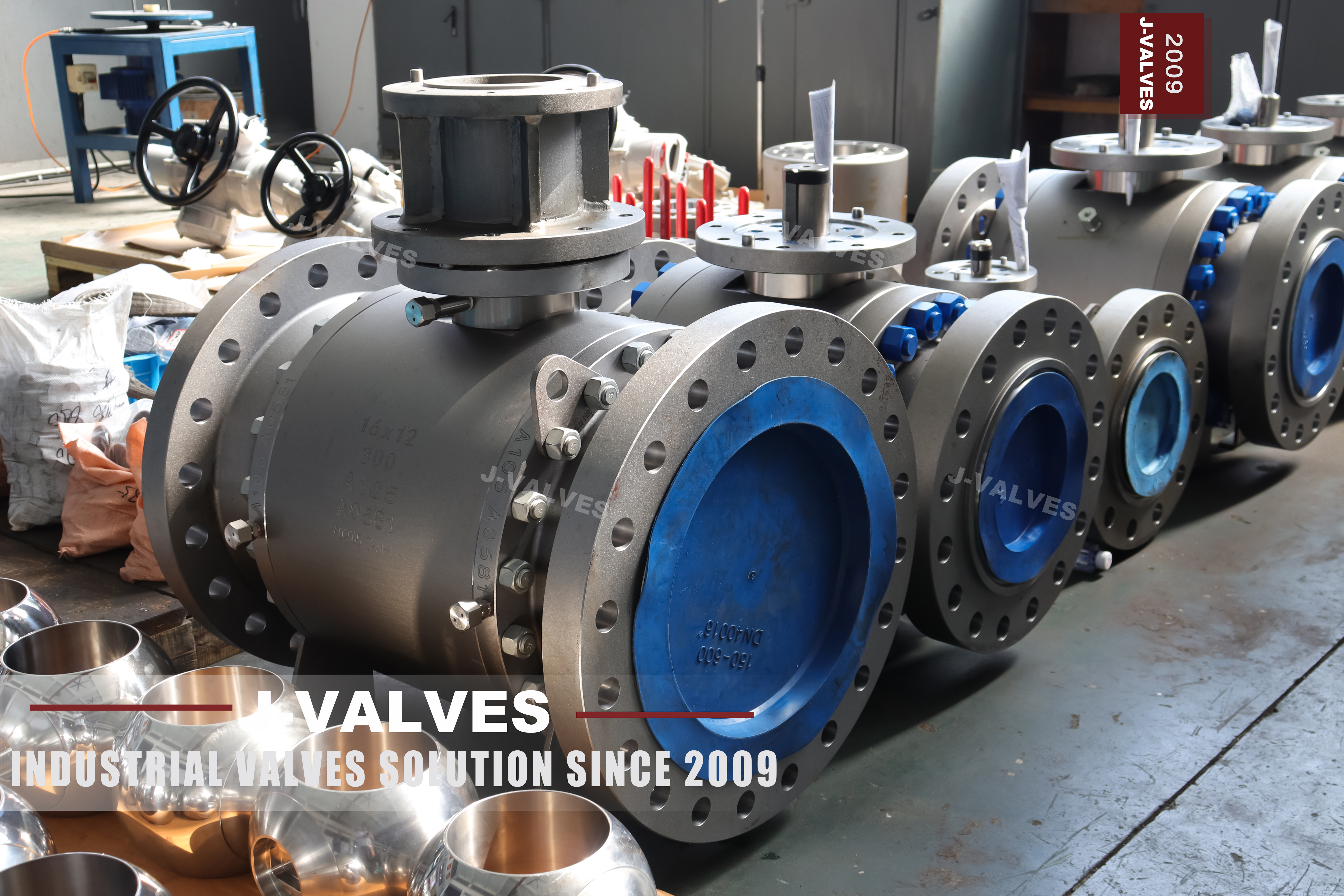
The seat row on this page reads like a menu: PTFE, reinforced PTFE, PPL, or metal with hardfacing as an option. Four choices, one valve, pick the one you like. That reading is wrong, and it is the reading the layout invites. A seat is not selected from a list; it is the answer to a pressure, a temperature and a size, and at the top of the range on this page only one of those four answers exists.
The valve itself is a forged carbon steel three piece trunnion body from two inch to twenty four inch, Class 150 to Class 2500, with raised face or ring joint ends. That is a wide span, and the span is why the seat row cannot be a menu: the same seat that is correct at two inch and 150 class is not the seat that holds at twenty four inch and 2500, and no amount of hardfacing turns a polymer ring into a metal one.
This page is about the line where the seat list stops being a list. It is the line where a polymer seat is extruded out of its pocket rather than compressed against the ball, and it is the line a buyer crosses without noticing when a quotation says PTFE and the service is at the top of the range.
Design and Construction
The body is three pieces: two end bodies and a centre section carrying the ball and both seats, bolted at two joints. The centre section is where the seats live, and the split exists so that both seat pockets can be cut from the two faces of that one piece in one setting. Coaxial seats by machining is a different guarantee from coaxial seats by assembly, and at high class it is the difference between a valve that seals both ways and one that seals on one side.
The ball is carried on an upper and a lower trunnion, so the thrust from line pressure goes into the shafts and their bearings rather than into the seats. The seats are pushed onto the ball by springs and then loaded further by line pressure, and their job is to seal, not to hold. That division is what makes a three piece trunnion body work from two inch to twenty four inch with the same architecture and different walls.
The seat pocket is the part of the design that the seat row ignores. A seat ring sits in a pocket with a running clearance, and the pressure that pushes it onto the ball also tries to push it past the pocket wall. What resists that is the pocket clearance, the seat ring wall thickness and, where the design uses one, a back-up ring. At low class the clearances and the loads are small and a polymer survives. At high class the same polymer is forced into the gap and the seal fails from the back.
Fire safe design is named on the page and it depends on the same geometry. When the polymer burns away, the seat ring has to land metal on metal against the ball and still be held in its pocket. A seat that has already been extruded has no ring left to land with, which is why a fire test on a valve that has been running beyond its seat limit proves very little about the valve in that service.

Material Options
A105 is a forged carbon steel, and the normalized condition improves toughness and uniformity without changing the alloy. At the top of the pressure range it is a common body choice because its strength is high and its cost is low, and because ASME B16.34 gives it a wall thickness that is heavy but well understood. What it does not do is make the seat any easier: a stronger body holds a higher pressure against a seat ring that has to keep that pressure out of its own clearance.
| Part | Material on This Build | What It Decides |
|---|---|---|
| Body and end pieces | ASTM A105 or A105N forged | Wall, weight and the rating at temperature |
| Ball | A105 with ENP or hard chrome, or CF8 and CF8M | The sealing band and its finish |
| Seat, low class | PTFE, reinforced PTFE or PPL | Temperature and pressure ceiling |
| Seat, high class | Metal with hardfacing | Extrusion resistance and wear |
| Stem | 316 or 17-4PH | Torque and packing wear |
| Packing | Flexible graphite, or graphite braid with alloy wire | The stem seal and its temperature |
| Bolting | A193 B7 with A194 2H, or B7M with 2HM | Joint preload, and sour service |
| Ends | Raised face or ring joint to ASME B16.5 | The joint at the pipe |
| Operator pad | To ISO 5211, size by torque | Which operator can be fitted |
The seat rows are deliberately split in this table and joined in one line on the page. That is the whole argument: a polymer seat and a metal seat are not two colours of the same part, they are two different solutions to the same load, and the load is set by class and size rather than by preference. A buyer who wants PTFE at 2500 is asking for a seat ring that will be extruded into its own clearance on the first pressurisation.
The ball row has a smaller version of the same problem. A105 with electroless nickel is a carbon steel ball with a thin barrier coating, and the coating protects the ball from the medium but not from a hard seat face. Against a hardfaced seat the coating wears at the edge of the sealing band, and the wear shows up as a leak path rather than as a visible scar. Where the seat is metal, the ball face should be the harder of the two or the one with the coating that can take the contact.
The bolting row carries a choice that has nothing to do with pressure and everything to do with the medium. B7 with 2H nuts is the standard high strength pair. B7M with 2HM is the same bolt with a hardness cap and a different marking, and it exists for service where sulphide stress cracking is a risk. The two are not interchangeable on a certificate, and a purchase order that says only B7 has chosen the first one.
Technical Specifications
| Item | Value |
|---|---|
| Size range | Two inch to twenty four inch, DN 50 to DN 600 |
| Class range | Class 150 to Class 2500, PN 20 to PN 420 |
| Body | ASTM A105 or A105N forged, three pieces |
| Ball | A105 coated, or CF8 and CF8M |
| Seat | Polymer at the low end, metal at the high end |
| Temperature | Minus 29 to plus 425 Celsius, limited by the seat |
| Ends | Raised face or ring joint to ASME B16.5 |
| Face to face | ASME B16.10 |
| Design | ASME B16.34 and API 6D |
| Test | API 598 and API 6D |
| Operation | Lever, gear, or actuator on an ISO 5211 pad |
The range line is where the seat question becomes concrete. Two inch at 150 class and twenty four inch at 2500 are in the same column and are not the same valve: the wall, the bolting, the stem, the bearings and the seat all change, and the seat changes in kind rather than in size. A quotation that answers the range with one seat material has answered the small end and ignored the large one.
The face to face line hides a second variable that matters to anyone replacing a valve in an existing line. ASME B16.10 lists lengths for full bore and for reduced bore separately, because the two have different ball sizes and different body lengths at the same nominal size. A valve bought against the nominal size alone can arrive with the right flanges and the wrong face to face, which is a problem that cannot be solved with a gasket.
Standards and Compliance
| Document | What it fixes | What it does not fix |
|---|---|---|
| ASME B16.34 | Wall, material groups, class ratings | Seat material or leakage |
| API 6D | Pipeline valves, classes to 2500, test and marking | Seat selection |
| API 608 | Steel ball valves, DN 15 to DN 600, Class 150 to Class 600 | Anything above Class 600 |
| ASME B16.5 | Flange dimensions, both facings | The internals |
| ASME B16.10 | Face to face, full bore and reduced bore | Weld end lengths |
| API 598 | Shell and seat test, acceptance | Which seat belongs in the valve |
API 608 is named in the design line and the range on this page runs past it. The document stops at Class 600, so for the upper part of the range the governing document is API 6D and 608 is at best a reference for the small end. That distinction matters on a quotation, because a specification that lists 608 for a 2500 class valve has named a document that does not reach the valve.
The fire test is a type test and it is worth stating what it assumes. It assumes the valve is in the condition it left the works in: seat rings in their pockets, clearances as designed, polymer present. A valve that has run at twice its seat's pressure limit is not in that condition, and its fire certificate describes a valve that no longer exists. That is not a reason to skip the test; it is a reason to keep the service inside the seat's envelope.
The 2500 class facing needs one line because it is a common specification error. Above a certain size ASME B16.5 does not publish a raised face dimension at 2500, and the end is a ring joint. A page that offers raised face across the whole range is describing the small sizes, and the order has to say which facing applies to the size being bought.
Manufacturing Process
The three body pieces are forged, normalized and machined. The centre section is set up once, both seat pockets are bored from its two end faces, and the trunnion bores are cut square to the same axis. The pockets are then checked for depth, squareness and finish, and the finish is the one that is easiest to get wrong, because a pocket that is smooth but out of square looks acceptable and seals badly.
The ball is turned, ground and lapped, and the lap is what produces the sealing band. On a metal seated build the ball and the seat are lapped as a pair, and the pair stays together through assembly and through spare parts, because a lapped band is a matched surface and not a tolerance. That is a manufacturing fact that becomes a purchasing fact: a replacement seat for a metal seated valve is not a spare part in the ordinary sense.
Assembly closes the centre section between the end bodies, torques the studs in a crossing sequence and checks that the ball turns through its quarter without a tight spot. The seat is checked at the same time for freedom to move in its pocket, because a seat that is tight in the pocket cannot follow the ball and a seat that is loose in the pocket will extrude. The window between those two is the design.

Quality Control and Testing
The shell test proves the body and the two joints. The seat test proves each seat, from each side, and the acceptance is a rate rather than a zero. On the polymer builds the rate is tight and the test is quick. On the metal builds the rate is looser and the test is read, because a metal seat that is asked for zero is being asked for something the design does not claim.
The pressure test does not prove the seat against extrusion, because extrusion is a time effect. A seat ring that is being forced into its clearance will pass a short test and fail after a few hundred cycles at temperature. That is why the seat's pressure limit is a design limit and not a test result, and why the honest place to settle it is on the order rather than on the bench.

Applications and Industry Service
High pressure oil and gas is the first use, from wellheads to injection and test lines, and it is where the metal seat earns its cost. At 2500 class with sand or scale in the medium, a polymer seat is destroyed by erosion before it is destroyed by pressure, and the metal pair is the only one that survives both.
The middle of the range is where most of the volume sits, at 300 and 600 class with clean fluids at moderate temperature. There the polymer seat is correct, the leakage rate is tight, and the valve is cheap to renew. The mistake is to carry the polymer habit upward when the class rises, which is how a plant ends up with a 2500 class valve that leaks from the back of its seat rather than from its sealing band.
Where the valve should not be used is on a line that needs throttling, and on a line where the class is at the top of the range and the medium is abrasive. Both are cases where a ball valve of any seat type is the wrong instrument, and the answer is a different valve rather than a different seat.

Installation, Operation and Maintenance
Installation is a flange joint at each end, with the faces parallel and the valve supported so the pipe does not hang from the body. At the large sizes the valve is heavy and the two joints are long levers, so the support is not optional. Studs are tightened in a crossing pattern to the torque the joint design names, and the joint is checked again after the line has been through a temperature cycle.
Operation is a quarter turn, and on the large sizes it is a geared quarter turn. The gear is there because the torque at 2500 on a twenty four inch valve is beyond a handwheel, not because the valve is slow. The operator pad is to ISO 5211 so that a gear, a pneumatic cylinder or an electric actuator can go on the same pad, and the pad size follows the torque rather than the valve size.
Maintenance is where the seat limit shows up as money. A polymer seat is a ring that can be replaced with the valve in line on a three piece body. A metal seat is a lapped pair, and the pair has to be replaced as a pair, which means the ball comes out. Both are reasonable; they cost differently, and the choice between them is made by the service rather than by the price of the spare.
How to Specify and Order
| Line on the order | What to write | Why it matters |
|---|---|---|
| Seat type and class | Polymer or metal, with the class it is bought for | The list on the page is not a menu |
| Leakage acceptance | The rate and the standard | A metal seat is accepted against a rate |
| Facing | Raised face or ring joint for the size and class | Above a certain size at 2500 only ring joint exists |
| Bore | Full or reduced, with the face to face | B16.10 lists them separately |
| Bolting | B7 or B7M, with the nuts | Sour service needs the M pair |
| Operator | Gear or actuator, sized on torque at temperature | The pad follows the torque, not the size |
Read the seat row as a range rather than a list and the page becomes useful. At the bottom of the class range all four options are real. At the top only one is, and the line where the others stop is a property of the geometry, not of the catalogue. A buyer who writes the class next to the seat on the order has already avoided the most expensive mistake this page can cause.
FAQ
Q: Can this valve be supplied with PTFE seats at Class 2500?
A: Not usefully. A polymer seat ring is held in a pocket with a running clearance, and the pressure that pushes it onto the ball also tries to push it past the pocket wall. At 2500 the ring is forced into that gap, the sealing face loses contact and the leak appears from behind the seat. The metal pair is the answer at that class.
Q: What actually decides which seat I get?
A: Class, size and temperature, in that order. Temperature decides whether a polymer can be used at all, class and size decide whether the ring can stay in its pocket, and only inside those limits does preference matter. A quotation that offers four seats without asking for the class has not answered the question.
Q: Are raised face and ring joint ends both available across the range?
A: No. Raised face is published across the small sizes and the lower classes, but above a certain size at 2500 ASME B16.5 gives only a ring joint. A page that lists both facings for the whole range is describing the small end, and the order has to name the facing for the size being bought.
Q: Does the API 607 certificate cover my service?
A: It covers the valve as it was built and tested: rings in their pockets, clearances as designed, polymer present. A valve run beyond its seat pressure limit is no longer in that condition, so the certificate describes a valve that no longer exists. The certificate is a type test, not a statement about a worn unit.
Q: What is the difference between B7 and B7M bolting?
A: Both are high strength alloy steel studs. B7M carries a hardness cap and a different marking, and it exists for service where sulphide stress cracking is a risk. The two are not interchangeable on a certificate, so a purchase order that says only B7 has made a choice the buyer may not have intended.


Hot Products


News
Direct Air Capture Ball Valves The Vacuum Side Runs The Seal Backwards, And Three Hundred Thousand Strokes Decide The Design
A solid sorbent DAC plant moves 1.3 million cubic metres of air per tonne of CO2, then asks a DN50 ball valve to hold 0.9 bar from the wrong side.
Read More
Your Ball Valve Is Not A Test Blind: What A Hydrotest Does To The Seats
A line test puts pressure on the wrong side of the seat logic, above the valve's own seat test, with water that stays in the pocket. What to arrange instead.
Read More
Remanufactured Ball Valves: Five Checks That Decide Whether A Rebuild Deserves A Certificate
A rebuild at 45 percent of price with half the life is no saving. Five checks that separate a real remanufacture from a repaint with a certificate.
Read More
The Squeeze Is A Residual: How Tolerance Stack-Up Decides Whether A Ball Valve Seals
No dimension sets the seat squeeze. Five tolerances do, in series. Why identical valves feel different, and why a new ball changes the arithmetic.
Read More