


CHINA J-VALVES Offers Various High-quality I ndustrial Ball Valves
J-VALVES, a distinguished professional ball valve manufacturer rooted in China, takes pride in its extensive product portfolio. Our offerings span a wide range, including trunnion-mounted ball valves, floating ball valves, high-temperature ball valves, high-pressure ball valves, metal-sealed ball valves, ultra-low temperature ball valves, DBB ball valves, Three-way And Four-way Ball Valve, and fully welded ball valves. Each product is a testament to our commitment to precision engineering and reliable performance. Meticulously crafted, they are designed to not only meet but exceed the most stringent industrial demands, ensuring stable operation even under extreme conditions. This enables us to provide our clients with high-value services and makes our valves widely sought-after in industries.
Product Category
Contact Us

-
J-VALVES-Q347F
-
J-VALVES
Overview of the J-VALVES three piece high temperature and high pressure trunnion ball valve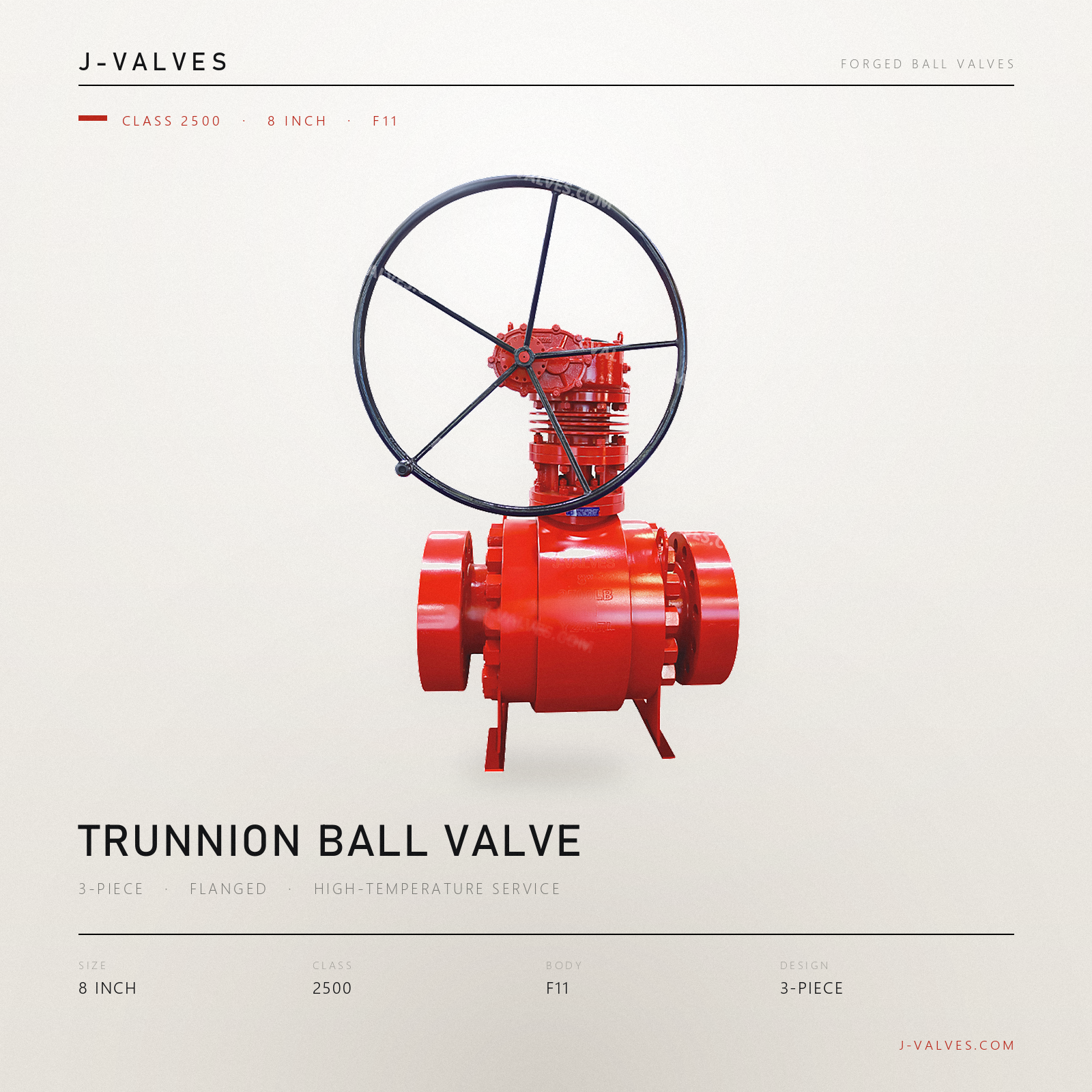
This page names three design standards: API 6D, ASME B16.34 and ISO 17292. Two of them do different jobs and can be held at the same time. The third is a different kind of document, and a valve that lists all three without saying which one governs has left the most important question on the page unanswered.
API 6D is written for pipeline valves. It carries requirements for the design, the pressure test, the fire test, the marking and the documentation, and it has a scope that starts at the small end and runs to very large valves at high classes. ISO 17292 is written for general refinery and petrochemical service: metal ball valves for the petroleum and allied industries, with its own references for testing and for the actuator interface.
The two overlap for most of the range and they are not identical where they overlap. The pressure test hold times are set by different documents, the fire test is named by number, and the marking requirements are not written the same way. A valve that is to be accepted on a refinery project against 17292 and a valve that is to be accepted on a pipeline against 6D are two different pieces of paperwork even when the hardware is the same.
That is the argument of this page: the standard is a choice, and it belongs on the order before the valve is built rather than in the certificate afterwards. The second argument is about the temperature line, which on this page runs from minus 46 to 650 Celsius and, like every range of that width, is a union of different builds rather than a property of one. Written that way, the high temperature trunnion valve stops being a range with two standards attached and becomes a valve: a named body grade for a named temperature, a named seat with a named effect, a named end form for the class, and a single standard it will be accepted against.
Design and Construction
The body is three pieces with two gasketed joints, and the reason is access rather than strength. The centre comes out with the ball and the seats attached, so the internals can be inspected without cutting the pipe, which on a welded in valve or a very large one is the only way to look at them at all.
The ball is trunnion mounted, so the seats do not carry it, and each seat has its own spring set and its own piston arrangement. Whether a seat is single or double piston effect is a real decision on a high pressure valve: a double piston seat is loaded by the cavity pressure as well as by the line pressure, so it seals from both sides, and that is what makes a double block and bleed function possible without a second ball.
The consequences of a double piston seat are not all convenient. Because the cavity pressure pushes the seats outward, a valve left closed with a liquid in the cavity and a rise in ambient temperature will build pressure in the cavity until something relieves it. That is why a cavity relief is part of the design and why a valve on a liquid line should be specified with one.
At 2500 class and three inch and above the ends are ring type joint, because a raised face is not offered by the flange standard at that combination. A page that lists raised face as an option without that qualification is describing the lower half of its own range, and a buyer who orders raised face at eight inch and 2500 has ordered something that does not exist.
The three piece layout has one more consequence at high temperature, and it is about the bolts. The body bolts run the length of the valve, so they sit close to the hot centre and their temperature is close to the medium temperature. A bolting grade that is comfortable at ambient may be at its creep limit at 650, and the grade is part of the high temperature build rather than a detail of it.

Material Options
The body list runs from carbon steel to the chrome moly grades, and the temperature column follows the body rather than the seat. A105N is the ordinary forged carbon steel; F304 and F316 are the austenitic options; F22 and F91 are the chrome moly grades that carry the top of the range.
| Part | Material on This Build | What It Decides |
|---|---|---|
| Body | A105N, F304, F316, F22 or F91 | The temperature ceiling and the strength |
| Ball | F304, F316 or F6a with surface hardening | Wear at the band |
| Stem | 17-4PH, F304 or F316 | Torque at the drive and packing wear |
| Seats | PTFE, reinforced PTFE, PEEK, or metal with a cobalt based overlay | Tightness against temperature |
| Body gasket | Spiral wound with graphite | The two joints at temperature |
| Packing | Graphite | Stem sealing above the polymer range |
| Bolting | A193 B7 for the standard build, B16 at the top of the range | Preload that survives creep |
The two ends of the temperature line are two different builds, and neither is an option on the other. A minus 46 build is a low temperature valve: impact tested body, low temperature bolting, a seat that does not embrittle. A 650 build is a high temperature valve: chrome moly body, metal seat with graphite, graphite packing, and a bolting grade with a creep ceiling above the service temperature.
The grade that carries the middle of the range is the one that gets overspecified. F22 is a 2.25 chrome 1 moly steel and F91 is a 9 chrome steel; both are more expensive to weld than A105N and both demand a welding procedure that is qualified and followed. Above roughly 425 Celsius the carbon steel body is out of its range and one of them is necessary; below that, buying one is buying a welding procedure rather than a capability.
The seat line is where the page is least precise. It offers four seat materials in one list and the temperature column does not say which one applies where. Read as a list, the metal seat with graphite is the only one that goes to the top; read as a single specification, the page would be promising a polymer seat at 650, which no polymer can do.
Technical Specifications
The table keeps the page entries, separates the two ends of the temperature line, and puts the standard question on its own line so it cannot be skipped.
| Item | Value |
|---|---|
| Size range | Two to 56 inch, DN 50 to DN 1400 |
| Pressure class | Class 150 to Class 2500 |
| Body | A105N, F304, F316, F22 or F91, forged |
| Construction | Three pieces, two gasketed joints, long body bolts |
| Ball | F304, F316 or F6a with surface hardening |
| Seats | PTFE, reinforced PTFE, PEEK, or metal with graphite |
| Temperature printed | Minus 46 to plus 650 Celsius |
| Temperature on an A105N body | Minus 29 to plus 425 Celsius |
| Ends | Raised face or ring joint flange, butt weld |
| Design | API 6D, ASME B16.34, ISO 17292, with the governing one to be named |
| Test | API 598, API 6D, ISO 5208 |
| Face to face | ASME B16.10 and API 6D |
The face to face line names two documents and that is not redundancy. ASME B16.10 tabulates flange to flange dimensions; API 6D adds weld end dimensions and a set of requirements that the dimensional standard does not carry. On a valve that can be supplied either way, both apply to their own end form. Written that way, the high temperature trunnion valve stops being a range with two standards attached and becomes a valve: a named body grade for a named temperature, a named seat with a named effect, a named end form for the class, and a single standard it will be accepted against.
Standards and Compliance
The standards question is the one this page argues, and it is worth setting out what each document actually settles.
| Document | What it fixes | What It Does Not Fix |
|---|---|---|
| API 6D | Design, pressure test, fire test, marking for pipeline valves | Refinery general service requirements |
| ISO 17292 | Metal ball valves for petroleum and allied industries, with its own test and interface references | Pipeline specific marking |
| ASME B16.34 | Wall, material groups, class ratings | Which of the two valve standards governs |
| API 598 | Shell and seat test procedure and acceptance | The fire test |
| ISO 5208 | Leakage rate classes for industrial valves | The design of the valve |
A valve can be built to satisfy both, and that is what most manufacturers do: the design is compatible, the tests overlap, and the marking can carry both. The problem is not compatibility, it is acceptance. When a refinery inspector asks for the test record, the record has to be in the form his standard asks for, and when a pipeline inspector asks, it has to be in the form his does.
That is why the order should name a governing standard rather than a list. A list is a statement about what the factory can do; a governing standard is a statement about what this valve will be accepted against, and those are different sentences. Written that way, the high temperature trunnion valve stops being a range with two standards attached and becomes a valve: a named body grade for a named temperature, a named seat with a named effect, a named end form for the class, and a single standard it will be accepted against.
Manufacturing Process
The forging route depends on the body grade. A105N and the austenitic grades forge and machine in a familiar way; F22 and F91 are harder to forge, harder to machine, and much harder to weld. On a chrome moly body the welding procedure is the cost centre, not the machining, because the preheat, the interpass temperature and the post weld heat treatment all have to be controlled and recorded.
Machining establishes the bore axis and the joint faces first, then the seat pockets from the joint faces, then the stem bore. On a large body the seat pockets are the operations that decide the valve: pocket depth, squareness and finish all have to hold, and all three are easier to hold when the pocket and its joint face are cut without moving the part.
The ball is turned, ground and lapped, and if the seat is metal it is surfaced before the finish grinding. The two seats are lapped against the ball they will run with rather than against a master, so that the band matches the sphere it will touch. That is a slower process and it is the one that produces a seat that holds at temperature.
Assembly fits the trunnion bearing, the ball, both seats with their springs and graphite rings, closes the joints, and fits the stem and the graphite packing. The packing is tightened to a torque rather than to a feel, because graphite packing behaves differently from a polymer one: it does not recover, so an over tightened gland is a gland that will leak when the stem cools.

Quality Control and Testing
The shell test is applied at the multiple of the class that the test standard names, with both body joints watched. On a chrome moly body the test is also the first time the welding procedures are proved on the finished part, and a leak at a weld is a procedure problem rather than a valve problem. Written that way, the high temperature trunnion valve stops being a range with two standards attached and becomes a valve: a named body grade for a named temperature, a named seat with a named effect, a named end form for the class, and a single standard it will be accepted against.
The band check applies to the metal seated build: marking compound, a few degrees of rotation, and a measured band width. It is recorded against the heat number, because a seat that is correct at assembly and wrong after a thermal cycle is a pairing problem that only the record will reveal. Written that way, the high temperature trunnion valve stops being a range with two standards attached and becomes a valve: a named body grade for a named temperature, a named seat with a named effect, a named end form for the class, and a single standard it will be accepted against.

Applications and Industry Service
Refinery and petrochemical service is the ordinary duty, and it is where the 17292 route is the natural one. Hydroprocessing, catalytic cracking, coking and the high temperature transfer lines around them are the services where an F22 or F91 body with a metal seat is the ordinary choice rather than an upgrade. Written that way, the high temperature trunnion valve stops being a range with two standards attached and becomes a valve: a named body grade for a named temperature, a named seat with a named effect, a named end form for the class, and a single standard it will be accepted against.
Steam and hot transfer service is the third, and it is the one where the temperature line is most often read as a single number. A valve at 540 Celsius is a chrome moly valve with graphite packing and a metal seat; a valve at 650 is at the top of the F91 range and much closer to the limits of the materials than the number suggests.
Where this valve is the wrong choice is on a line that needs tight shut off at temperature, on a line where the thermal cycling is severe enough to work the body joints, and on a line where the class is high but the temperature is ambient. The first needs a different seat, the second needs a different body construction, and the third is paying for a high temperature build it does not use.

Installation, Operation and Maintenance
Installation is a flange joint or a weld at each end, with the valve supported so the pipe does not hang from the body. On a ring joint the faces have to be parallel before the bolts are tightened, and the ring is replaced rather than reused, because the seal is made by deforming the ring into the groove.
On a high temperature line the valve should be insulated with the rest of the line and the gland left accessible, because a valve that is insulated over its packing cannot be serviced and a valve that is left bare in a hot line loses heat through its body. Both mistakes are common and neither is visible until the first winter. Written that way, the high temperature trunnion valve stops being a range with two standards attached and becomes a valve: a named body grade for a named temperature, a named seat with a named effect, a named end form for the class, and a single standard it will be accepted against.
Maintenance divides into the packing, which is serviced from the top, and the internals, which are reached through the body joints. On a chrome moly valve the joints are also the place where a gasket that was correct at ambient may not be correct after a few thermal cycles, so the gasket is renewed whenever the body is opened and the joint faces are checked for fretting.
How to Specify and Order
The lines below are the ones the page's range statement does not settle, and the first one is the question the page raises without answering.
| Line on the order | What to write | Why it matters |
|---|---|---|
| Governing standard | API 6D, or ISO 17292 | They test and mark differently |
| Temperature | The service temperature, not the range | It decides the body, seat, packing and bolting |
| Body grade | A105N, F304, F316, F22 or F91 | The grade follows the temperature |
| Seat type | Metal with graphite, or a polymer | It sets tightness and torque |
| Seat effect | Single or double piston | It decides whether DBB is available |
| End form | Ring joint above three inch at 2500 | Raised face is not offered there |
| Cavity relief | Fitted or not | A liquid filled cavity needs one |
Written that way, the high temperature trunnion valve stops being a range with two standards attached and becomes a valve: a named body grade for a named temperature, a named seat with a named effect, a named end form for the class, and a single standard it will be accepted against.
FAQ
Q: API 6D or ISO 17292, which one applies?
A: Whichever the order names. API 6D is written for pipeline valves and carries its own requirements for the fire test, the marking and the documents. ISO 17292 is written for general refinery and petrochemical service and references the ISO test and interface documents instead. A page that lists both without saying which governs has not answered the question a purchaser is asking.
Q: Can a 650 Celsius valve have an A105N body?
A: No. A105N is a carbon steel and its useful range ends around 425 Celsius in this service; above that the strength falls away and the material is no longer the right choice. The 650 in the range belongs to the F22 and F91 bodies with a metal seat and graphite, and those are different forgings.
Q: Why three pieces at high temperature?
A: For access and for inspection, not for strength. The middle comes out and the internals are visible without cutting the pipe, which matters on a valve that is welded in or is too large to move. The price is two body joints and a set of bolts whose length is the length of the valve.
Q: What does high pressure mean on this page?
A: It means the class column, up to 2500, and at three inch and above that class comes with ring joint ends because a raised face is not offered there. The word high on its own is not a rating, and the plate is what carries the number.
Q: Does the fire test change with the standard?
A: The test is required either way and the difference is which document is named. API 6D calls the fire test by its API number, and ISO 17292 points at the ISO fire test standard. Both are type tests on a design and a size, not a test of the unit in the crate.



Hot Products


News
Direct Air Capture Ball Valves The Vacuum Side Runs The Seal Backwards, And Three Hundred Thousand Strokes Decide The Design
A solid sorbent DAC plant moves 1.3 million cubic metres of air per tonne of CO2, then asks a DN50 ball valve to hold 0.9 bar from the wrong side.
Read More
Your Ball Valve Is Not A Test Blind: What A Hydrotest Does To The Seats
A line test puts pressure on the wrong side of the seat logic, above the valve's own seat test, with water that stays in the pocket. What to arrange instead.
Read More
Remanufactured Ball Valves: Five Checks That Decide Whether A Rebuild Deserves A Certificate
A rebuild at 45 percent of price with half the life is no saving. Five checks that separate a real remanufacture from a repaint with a certificate.
Read More
The Squeeze Is A Residual: How Tolerance Stack-Up Decides Whether A Ball Valve Seals
No dimension sets the seat squeeze. Five tolerances do, in series. Why identical valves feel different, and why a new ball changes the arithmetic.
Read More