


CHINA J-VALVES Offers Various High-quality I ndustrial Ball Valves
J-VALVES, a distinguished professional ball valve manufacturer rooted in China, takes pride in its extensive product portfolio. Our offerings span a wide range, including trunnion-mounted ball valves, floating ball valves, high-temperature ball valves, high-pressure ball valves, metal-sealed ball valves, ultra-low temperature ball valves, DBB ball valves, Three-way And Four-way Ball Valve, and fully welded ball valves. Each product is a testament to our commitment to precision engineering and reliable performance. Meticulously crafted, they are designed to not only meet but exceed the most stringent industrial demands, ensuring stable operation even under extreme conditions. This enables us to provide our clients with high-value services and makes our valves widely sought-after in industries.
Product Category
Contact Us

-
J-VALVES-Q347F
-
J-VALVES
Overview of the J-VALVES duplex steel three piece trunnion valve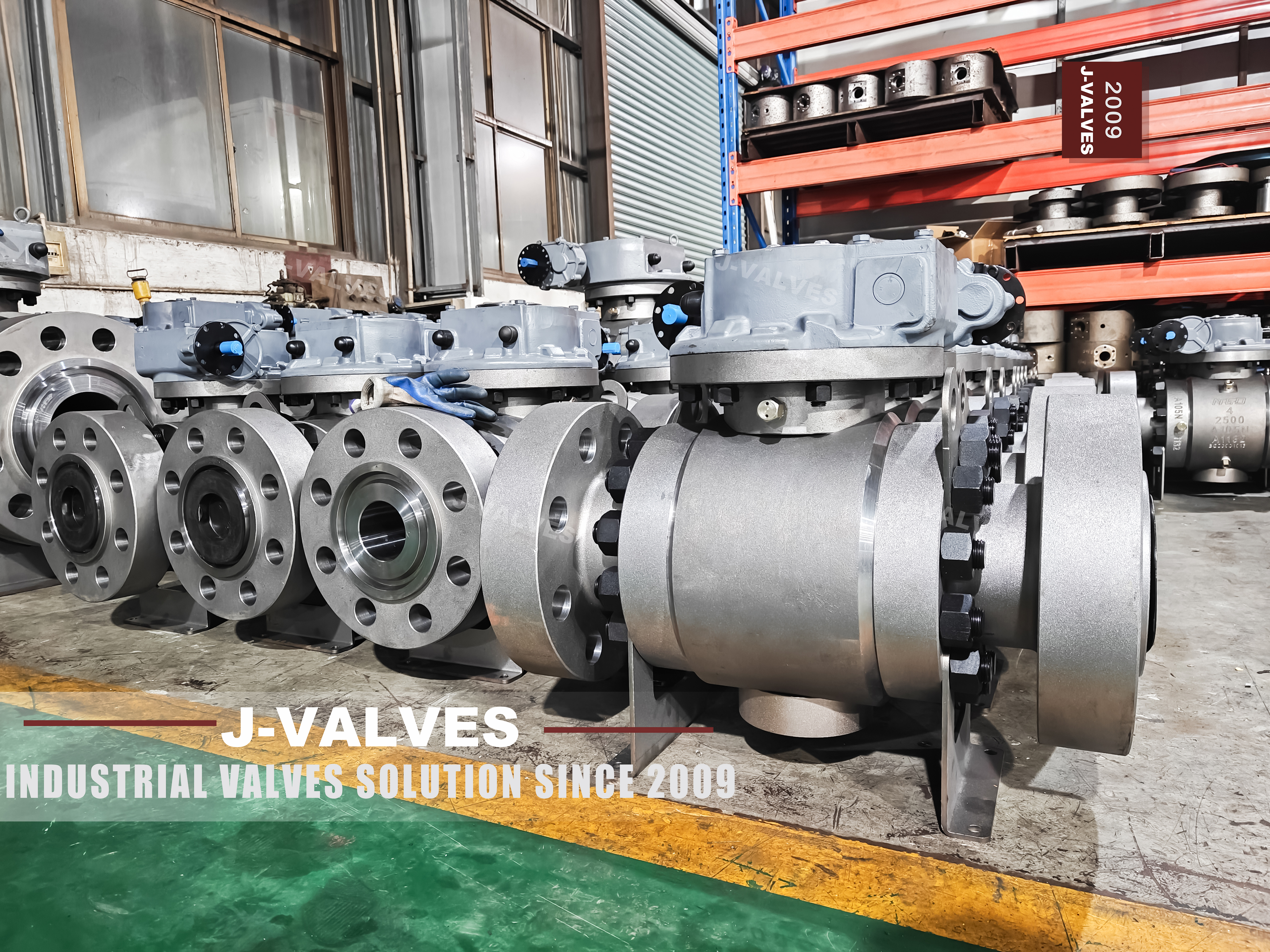
The plate on the body of this valve reads twelve by ten, twenty five hundred, F51. Every other line on the page that describes the material says super duplex 2507 or S32750, and those are not the same grade. F51 is the UNS designation for the 2205 duplex stainless family, and 2507 is a different alloy with more chromium, more molybdenum and a higher strength. A buyer reading both would be entitled to ask which one he is being quoted.
This page follows the plate. The article is a twelve by ten inch Class 2500 three piece trunnion valve in F51 duplex, with ring joint faces, feet under the centre section and a gearbox on a bracket. The photograph is the only one on the page and it shows the whole valve, which is enough to fix the shape and not enough to fix the grade.
The argument here is that on a duplex valve the grade is a certificate question and never a photograph question. F51, F11 chrome moly, and F316 all look the same from the outside once the body is painted or machined, and the difference between 2205 and 2507 is invisible even to a positive material identification gun that has not been calibrated for the alloy.
Design and Construction
The body is a three piece forged pattern: a centre section with the ball and both seats, and two end pieces bolted to it with a stud ring at each joint. The ball is trunnion mounted on an upper and a lower shaft, so the pressure load is carried by bearings and the seats only have to seal. On a twelve inch body at Class 2500 those bearings and that centre section are substantial.
The end faces are ring joint, which is what Class 2500 asks for on a body of this size. The groove takes a solid metal ring, the ring sits in the matching groove of the pipe flange, and the seal is a line contact between two machined surfaces rather than a compressed sheet. At this class a raised face joint depends on a gasket that has to be replaced every time the joint is broken, and on a duplex body the reason for the ring is as much about the joint as about the pressure.
The feet are welded or bolted under the centre section and they carry the valve on a structural support. A twelve inch Class 2500 body in duplex is a heavy article, and hanging it between two flanges puts a bending moment into the body joints that no gasket is designed for. The feet exist because the alternative is a valve that leaks at a body joint six months after installation.
The gearbox is mounted on a bracket above the body with a large handwheel. At this size and class the torque needed to seat the ball is beyond a lever, and the bracket puts the wheel at a height and in a plane where a person can apply it. The bracket carries its own bearing, so the side load from the wheel does not go into the gearbox input seal.

Material Options
The plate says F51, and F51 is the forged duplex grade in the A182 family corresponding to UNS S31803. The stainless option on the same drawing would be F316, and the high temperature option would be F11, and all three have been built on this pattern, which is exactly why the plate matters.
| Grade | UNS | Family | Where It Belongs |
|---|---|---|---|
| F51 | S31803 | Duplex 2205 | Chloride service, moderate temperature |
| F55 | S32760 | Super duplex | More aggressive chloride, higher strength |
| S32750 | 2507 | Super duplex | Not the grade on this plate |
| F316 | S31600 | Austenitic | Chemical service without chlorides |
| F11 | K11597 | Chrome moly | High temperature, refinery duty |
The two super duplex lines in that table are there because they are what the page text claims, and the point of printing them beside F51 is to show that they are different alloys rather than marketing synonyms. A quotation that says duplex and means any of the three has quoted a family, and a certificate that says F51 has named an alloy.
The duplex family buys two things over austenitic stainless. The first is resistance to chloride stress corrosion cracking, which is what puts duplex into seawater, brine and produced water. The second is a yield strength well above the austenitic grades, which is a design advantage in a body and not a licence to reduce the wall, because the wall on a pressure boundary comes from the ASME B16.34 table for the material group and not from the material's yield.
Technical Specifications
| Item | Value |
|---|---|
| Size | Twelve inch by ten inch, DN 300 by DN 250 |
| Pressure class | Class 2500, PN 420 in the API 6D table |
| Body grade | A182 F51 duplex, UNS S31803 |
| Body | Three piece forged, two bolted joints |
| Bore | Reduced, ten inch through a twelve inch body |
| Ends | Ring joint to ASME B16.5 |
| Face to face | ASME B16.10 for twelve inch Class 2500 |
| Temperature | Minus 46 to plus 200 Celsius |
| Operator | Gearbox on a bracket with a handwheel |
| Support | Feet under the centre section |
| Design | API 6D, ASME B16.34 |
| Test | API 598 shell and seat |
The temperature row on a duplex valve is a material limit rather than a seat limit, and it is worth separating from the austenitic case. Duplex steels become brittle in the region well above the boiling point of water because of a phase change in the ferrite, and they also have a ductile to brittle transition at the low end, so the useful window is narrower than the one an austenitic body has. Minus 46 to plus 200 Celsius is the window this plate is sold in.
The wall row is not on the table because it is not a single figure. The wall comes from the B16.34 table for the material group at the class ordered, and it is a minimum rather than a nominal. A duplex body with a higher yield than an austenitic one does not get a thinner wall at the same class, because the table is not derived from yield strength alone and the standard does not allow a substitution.
Standards and Compliance
| Requirement | Document | What It Means Here |
|---|---|---|
| Product requirements | API 6D | Design, materials, marking, testing |
| Wall and rating | ASME B16.34 | Class 2500 for the group set by F51 |
| Forged duplex grade | ASTM A182 | F51 chemistry and mechanicals |
| Flanges and groove | ASME B16.5 | Ring joint facing at this size and class |
| Ring gasket | ASME B16.20 | Ring dimensions and material |
| Pressure test | API 598 | Shell at 1.5 times, seat at 1.1 times |
| Material certificate | EN 10204 3.1 | Heat number and grade, as F51 |
The A182 row is where the grade question is settled. A182 lists F51 and it also lists the super duplex grades, and each has its own chemistry range, its own mechanical requirements and its own heat treatment. A certificate that says duplex without a UNS number has not named a grade, and on a valve at this class the certificate is the only document that ties the plate to the metal.
The ring joint row on that table is not a formality at this class either. B16.20 defines the ring and the groove it fits, and a ring of the wrong hardness either does not yield and leaks or yields too far and is destroyed on the first make up. On a duplex body the ring is usually a softer alloy than the body, so the ring is the part that is designed to give, and that is the opposite of what most people assume about a high pressure joint.
The hydrostatic test deserves a line of its own on a duplex valve. The test medium is water, and the water has chlorides in it, and a duplex body left wet with chloride bearing water in a warm climate is a stress corrosion cracking risk on a surface that has residual stress from machining. The test is drained and the bore dried, and on a duplex body that is a procedure rather than a habit.
Manufacturing Process
The three pieces are forged, solution annealed and quenched, then machined. The anneal is what gives duplex its phase balance, and the cooling rate after the anneal is part of the heat treatment rather than a detail of it: too slow and a brittle phase forms, too fast and the balance moves the other way.
Machining duplex is harder than machining the austenitic grades, and the difference shows in the seat pockets and the ring grooves, where the surface finish is a sealing requirement. A duplex body that has been machined with the feeds used on 316 will have a torn surface in the groove, and a torn groove is a leak path under a ring gasket whatever the grade of the ring.
The ring groove is cut last on each face, referenced to the bore, and the groove is checked for form, width and concentricity. On a Class 2500 joint the ring has very little room to accommodate a groove that is out of position, and the check is a measurement rather than a visual inspection.

Quality Control and Testing
| Step | Check | Acceptance |
|---|---|---|
| 1 Incoming | Heat number and grade against the mill certificate | F51, chemistry and mechanicals |
| 2 Phase balance | Ferrite and austenite reported | Per the material specification |
| 3 Heat treatment | Solution anneal and cooling record | By heat |
| 4 Machining | Ring groove form, width, concentricity | ASME B16.5 |
| 5 Identity | Positive material identification on body and ends | Grade match to the plate |
| 6 Shell test | Body and both joints at 1.5 times | API 598, no leakage |
| 7 Seat test | Each seat at 1.1 times, both directions | API 598 rate |
| 8 Final | Bores dried, faces protected, crated | Works standard |
The phase balance row is the check that has no equivalent on a carbon or austenitic body. Duplex is a two phase material by design, and the proportions of the two phases are what give it the combination of strength and corrosion resistance it is bought for. A heat that is out of balance passes a tensile test and fails in a chloride environment, which is the one place the valve was bought for.
Positive material identification is the row that ties the whole page together. The plate says F51, the certificate says F51, and the identification check is what confirms the two are talking about the same piece of metal rather than about the same paperwork.

Applications and Industry Service
A twelve inch Class 2500 duplex body belongs where a large high pressure line carries a chloride bearing medium: produced water and seawater injection, desalination, offshore process lines, and the chloride bearing streams around a chemical plant where an austenitic body would crack under stress.
In those services the duplex grade is doing the corrosion job and the trunnion design is doing the pressure job, and the two are independent decisions that happen to point the same way. A large body at Class 2500 needs a trunnion because the seat load at that class would crush a floating ball design, and it needs duplex because the medium would attack carbon steel.
It is the wrong valve where the temperature is high, because duplex has a ceiling well below the austenitic grades and a chrome moly body would be the right answer. It is also the wrong valve where the medium is chloride free and the pressure is the only issue, because a carbon steel body would do the same job for less.

Installation, Operation and Maintenance
The valve is set on its feet before the flange studs are tensioned, and the feet are shimmed rather than loaded by pulling the pipe down. On a body this size the pipe on either side is stiff, and a valve that is bolted up first and supported afterwards has already put its weight into the joints.
The ring joint is assembled with new rings, clean dry grooves and a cross pattern tensioning sequence, and the rings are not reused after a break. Duplex has a higher yield than carbon steel, and one consequence is that a flange face takes a higher bolt load before it yields, which is an advantage as long as the studs are tensioned to the figure on the drawing rather than to feel.
The test water is the one duplex specific instruction. Any hydrostatic test on a duplex body uses water with a chloride content inside the limit for the alloy, and the body is drained and dried afterwards rather than left wet. A duplex valve that passes its test and then sits in a humid warehouse with chloride water in the cavity is a valve that can crack before it is installed.
How to Specify and Order
The six entries are size, class, body grade, seat, end connection and operator, and on this valve the body grade entry must be written as a UNS number and not as a family name. Duplex, super duplex and 2507 are three different answers to one question, and the price, the delivery and the certificate all move with the answer.
The second entry that needs care is the facing, because a Class 2500 body at this size is normally ring joint and the rings belong to the piping scope. A valve supplied with ring joint faces and no rings is a valve that cannot be installed, and the same is true of a valve whose facing was assumed rather than written.
Documents to name: the EN 10204 3.1 certificate with the heat number and the F51 designation, the solution anneal and cooling record, the phase balance report, the positive material identification report, the shell and seat test record, and the general arrangement drawing with the face to face dimension, the ring joint facing and the position of the feet.
FAQ
Q: Is F51 the same as 2507?
A: No. F51 is the UNS designation for the 2205 duplex family, S31803, and 2507 is a super duplex, S32750, with more chromium, more molybdenum and a higher strength. They are different alloys with different certificates, and the plate on this valve reads F51.
Q: Why does the page text say super duplex 2507?
A: Because the family is offered in more than one duplex grade and the text describes the family rather than the build. The plate is what the article is, and a quotation or a certificate that says 2507 for this valve would be describing a different body.
Q: Does a higher yield strength allow a thinner wall?
A: No. The wall on a pressure boundary comes from the ASME B16.34 table for the material group at the class ordered, and that table is not derived from yield strength alone. A duplex body does not get a thinner wall than an austenitic one at the same class.
Q: Why is the test water a duplex issue?
A: Because duplex is bought for chloride resistance and the hydrostatic test uses water that contains chlorides. A body left wet with chloride bearing water, with residual stress from machining, is a stress corrosion risk. The test is drained and the bore dried as a procedure rather than as a habit.
Q: Why are ring joint faces used at this class?
A: Because at Class 2500 the joint has to close on metal. A raised face joint depends on a soft gasket squeezed to a stress that deforms the flange first, and on a body this size the ring joint is the face that the duty calls for. The rings come from the piping scope.



Hot Products


News
Your Ball Valve Is Not A Test Blind: What A Hydrotest Does To The Seats
A line test puts pressure on the wrong side of the seat logic, above the valve's own seat test, with water that stays in the pocket. What to arrange instead.
Read More
Remanufactured Ball Valves: Five Checks That Decide Whether A Rebuild Deserves A Certificate
A rebuild at 45 percent of price with half the life is no saving. Five checks that separate a real remanufacture from a repaint with a certificate.
Read More
The Squeeze Is A Residual: How Tolerance Stack-Up Decides Whether A Ball Valve Seals
No dimension sets the seat squeeze. Five tolerances do, in series. Why identical valves feel different, and why a new ball changes the arithmetic.
Read More
Why A Ball Valve Gets Harder To Turn: Five Causes, And The Test That Tells Them Apart
A ball valve that stiffens over months points at one of five parts. Measure torque with the line pressurised and again vented, and the split becomes visible.
Read More