


CHINA J-VALVES Offers Various High-quality I ndustrial Ball Valves
J-VALVES, a distinguished professional ball valve manufacturer rooted in China, takes pride in its extensive product portfolio. Our offerings span a wide range, including trunnion-mounted ball valves, floating ball valves, high-temperature ball valves, high-pressure ball valves, metal-sealed ball valves, ultra-low temperature ball valves, DBB ball valves, Three-way And Four-way Ball Valve, and fully welded ball valves. Each product is a testament to our commitment to precision engineering and reliable performance. Meticulously crafted, they are designed to not only meet but exceed the most stringent industrial demands, ensuring stable operation even under extreme conditions. This enables us to provide our clients with high-value services and makes our valves widely sought-after in industries.
Product Category
Contact Us

-
J-VALVES-Q347F
-
J-VALVES
Overview of the J-VALVES 8 inch 900LB F304 three piece cryogenic trunnion ball valve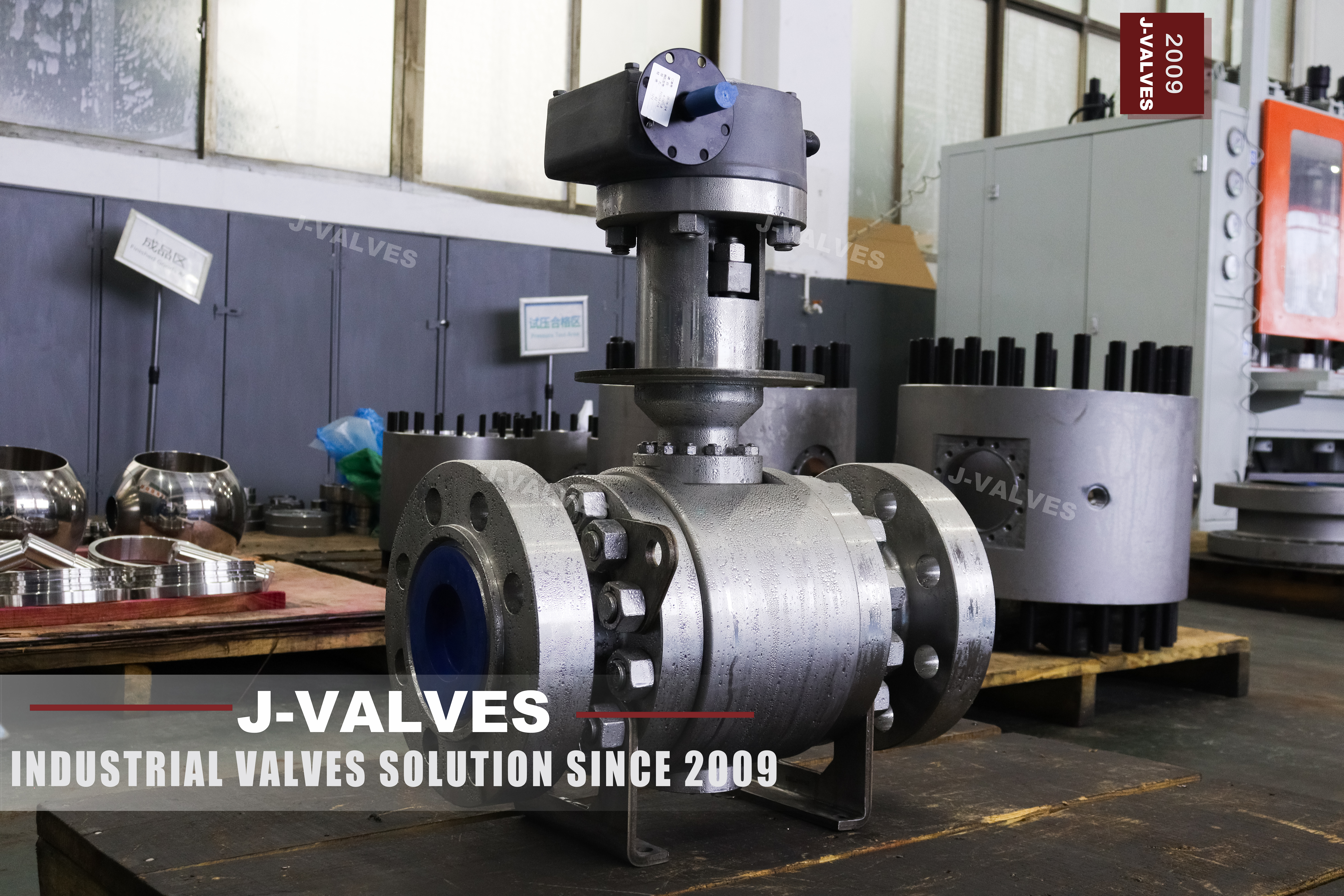
A cryogenic ball valve is not a cold version of an ordinary one. The body is the same shape and the ball is the same shape, but the design has to answer a question that does not exist at ambient temperature: what happens to the liquid that is trapped inside the body cavity when the valve is closed. That liquid warms, boils, and expands to several hundred times its volume, and the pressure it generates has nowhere to go unless the design gives it a route.
The page names the right parts and then lists the seats as options without connecting them to that question. Modified PTFE, PEEK and a metal seat with graphite are all offered, and the same paragraph offers double piston effect and double isolation and bleed as options. A double piston seat is the one arrangement that guarantees the cavity cannot relieve into the line, which is exactly what a warm-up needs it to do.
So the order of this page is: what the cavity has to do, which seat arrangements let it, and what the cold end demands of the stem, the bolting and the test. The 8 inch 900 class build is the frame; the cavity is the subject.
Design and Construction
The body is three pieces: a centre section carrying the ball and both seats, and two end pieces that carry the flanges. Both seat pockets are bored from the two faces of the centre section, so the seats are coaxial by machining. On a cryogenic valve that matters more than usual, because the seats operate at a temperature where the clearances have already changed and there is no room for an angular error to be absorbed by a soft seat.
The ball is carried on an upper and a lower trunnion and is not supported by the seats. That is what allows a metal seated cryogenic valve to work at all: the seats can be preloaded by springs to a controlled force and do not have to hold the ball against the line pressure. The trunnion bearings run at the cold end as well, which is why the bearing material and its clearance appear on a cryogenic drawing and not only on a high pressure one.
The extension between the body and the operator is the part that decides whether the design works. It has to be long enough that the packing sits far enough from the cold end to stay above the frost line, and it has to be a closed column, so that the extension itself is part of the pressure boundary and the stem inside it is a wet stem. An open frame with the packing down in the body would put the packing at the cold end, which is the one place it cannot be.
Inside the cavity, the ball sits between two seats with a space around it. When the valve is closed and the line is cold, that space fills with liquid. When the line is purged, or when the valve is taken out of service and warms up, the liquid in that space turns to gas and the pressure rises until something gives. A seat that relieves into the downstream side gives first, quietly. A seat that cannot relieve turns the cavity into a pressure vessel with no relief valve.
Material Options
F304 is the austenitic stainless that makes a cryogenic body possible. It has a face centred cubic structure that does not undergo the ductile to brittle transition that carbon steels do, so it keeps its toughness at minus 196 instead of becoming glassy. A350 LF2, offered on the page as the economical option, is a low temperature carbon steel that is rated to about minus 46, and the page is right to put the number beside it.
| Part | Material on This Build | What It Decides |
|---|---|---|
| Body, centre, ends | ASTM A182 F304 or F304L forged | Toughness at the cold end |
| Body alternative | F316 or F316L, or A350 LF2 to minus 46 | Corrosion resistance, or cost with a warmer limit |
| Ball | F304 with ENP, hard chrome or hardfacing | The sealing band at the cold end |
| Trunnion | Surface hardened F304 or 17-4PH | Ball location and bearing wear |
| Stem | Extended, F304 or 17-4PH | Heat leak down the stem |
| Seats | Modified PTFE, PEEK, or metal with graphite | The lowest temperature the valve can hold |
| Packing | Graphite braid with alloy wire reinforcement | The stem seal at the warm end |
| Bolting | A320 B8M with A194 8M, or L7M in the warmer range | Joint integrity at the cold end |
| Ends | Raised face or ring joint to ASME B16.5, BW option | The joint at the pipe |
The seat row is a temperature ladder, not a menu. Modified PTFE covers the cold end down to the liquid nitrogen range and stops around 150 at the top. PEEK goes higher but not as low, with a floor around minus 60. Metal with graphite covers both ends and is accepted against a rate rather than against zero. The three options do not overlap across the whole range, so the seat is chosen by the coldest and hottest points of the service, not by preference.
The bolting row needs a correction. A320 L7 and L7M are alloy steel bolts qualified for low temperature service down to about minus 101, and at minus 196 they are outside their range. The austenitic B8M is the grade that goes to the bottom of the cryogenic range, and a specification that offers L7M at minus 196 is offering a bolt that will be brittle at the temperature the valve is designed for.
The packing line names a trade name for the wire reinforcement. A purchase specification should carry the alloy designation instead, because the brand says who drew the wire and not what the wire is. What the packing has to do at this end is simple: stay resilient at the warm end, conduct as little heat as possible down the stem, and not turn into a path for leakage when the gland is adjusted cold.
Technical Specifications
| Item | Value |
|---|---|
| Size | Eight inch, DN 200 |
| Class | Class 900, PN 150 |
| Body | ASTM A182 F304, three pieces |
| Ball | F304, trunnion mounted |
| Seats | Modified PTFE, PEEK, or metal with graphite |
| Temperature | Minus 196 to plus 100 Celsius |
| Ends | Raised face or ring joint, ASME B16.5 Class 900 |
| Face to face | ASME B16.10 |
| Design | ASME B16.34 and API 6D |
| Test | API 598 and API 6D, plus a cold test |
| Operation | Gear with extended stem, cryogenic actuator on request |
The temperature range on this page is written as one band from minus 196 to plus 100, and that band is a property of the assembly rather than of the body. The body would go colder in the sense that it would not crack, but the seats, the packing and the bolting each set a floor, and the floor of the assembly is the highest of those floors. Writing the range as one number is convenient for a catalogue and misleading for an order.
The 900 class end deserves one line because it is often misunderstood at this size. At 900 class an eight inch valve can be supplied with a raised face or a ring joint, and both are published in ASME B16.5. The choice is made by the piping specification and by the consequence of a leak, not by the class alone. What changes with the choice is the end piece, which is why the end form has to be on the order before the body is machined.
Standards and Compliance
| Document | What it fixes | What it does not fix |
|---|---|---|
| ASME B16.34 | Wall, material groups, class ratings | Cold performance, cavity relief |
| API 6D | Pipeline valves, classes to 2500, test and marking | Cryogenic qualification |
| API 608 | Steel ball valves, DN 15 to DN 600, Class 150 to Class 600 | This class, which is above its range |
| ASME B16.5 | Flange dimensions and facing | The internals |
| API 598 | Shell and seat test at ambient | Behaviour at the cold end |
| BS 6364 or ISO 28921 | Cryogenic test of the assembled valve | Nothing about warm service |
The page names API 608 in its design line, and at 900 class that document is out of scope: it stops at Class 600. The document that covers this valve is API 6D, and the cold behaviour is covered by neither. A cryogenic valve is qualified by a test at temperature, either to BS 6364 or to ISO 28921, and that test is the one that tells a buyer whether the seat still seals when the whole assembly has shrunk.
The difference between a room temperature test and a cold test is not thoroughness, it is mechanism. At ambient the seat is pressed onto the ball by a spring whose force was set at ambient. At minus 196 the spring, the seat ring, the ball and the body have all shrunk by different amounts, and the preload that was correct in the workshop may be gone. A valve that passes at ambient and has never been cold is a valve with an untested assumption in it.
Fire safe certification and cryogenic qualification are separate certificates and neither implies the other. A fire test destroys the soft parts and checks that the metal parts still restrict flow. A cold test checks that the soft parts still seal when they are cold. A valve can hold one and fail the other, which is why both lines belong on a specification for a valve that will see both conditions.
Manufacturing Process
The body pieces are forged and then machined, and the machining sequence is the same as for the warm build until the extension. The centre section is bored from both faces so the two seat pockets are coaxial, the trunnion bores are cut square to that axis, and the end pieces are faced and drilled to the flange standard. The difference is in the tolerances, which are tightened where a cold assembly has to close a gap that warm machining left open.
The extension is machined as a pressure retaining part, welded or flanged to the body and then machined true to the stem axis, because a stem that is not concentric with the packing over that length will wear the packing on one side. The stem itself is long, and length is a heat path: the cross section and the material decide how much heat reaches the packing from the cold end, and that is a design decision rather than a manufacturing one.
Assembly follows the warm sequence with two additions. The cavity is cleaned to a standard that removes every particle, because at cryogenic temperature a particle on a seat face is a leak and there is no soft material to embed it. And the bolting is tightened to a torque that was calculated for the cold condition, not for ambient, since the differential contraction between an austenitic body and its bolting changes the preload between the workshop and the line.

Quality Control and Testing
The shell test and the ambient seat test are run as they would be on any 900 class valve, from each side, with the leakage measured. Those tests prove the body and the joints. They do not prove the seats at temperature, and the page's test line stops there, which is the gap a cryogenic buyer has to fill.
The cold test is run with the valve in a bath or a jacket at the lowest service temperature, and it is run after the valve has been cycled at that temperature rather than only after it has been soaked. A seat that seals on the first cold closure and leaks on the fifth is common, because the first closure is made with the preload that was set warm. The test sequence is what separates a valve that works once from a valve that works.
The cavity relief path is checked at the same time. On a design with relieving seats the check is that the cavity pressure falls when the upstream pressure falls; on a design with non relieving seats the check is that the relief device is fitted, sized and clear. That single check is the one that is most often skipped, and it is the one that decides whether the valve is safe to warm up.

Applications and Industry Service
Liquefied gas service is the first use: LNG, liquid nitrogen, liquid oxygen and liquid argon, in terminals, on ships and in air separation plants. In all of those the valve spends most of its life either fully open or fully closed, and the closed position is the one that traps liquid in the cavity. The warm up after a shutdown is when the cavity sees its highest pressure, not while the plant is running.
The second family is cold boxes and cryogenic pumps, where the valve is inside an insulated box and the operator is outside it. There the extension is what makes the valve operable at all, and its length is set by the insulation thickness rather than by a formula. A valve that is correct on the bench and too short for the box cannot be fixed on site.
Where the valve should not be used is where the service crosses the temperature band often, or where the cavity cannot be given a relief path. A cryogenic valve that is cycled between cold and ambient weekly is a valve whose seats and bolting are being asked to do something the design was not tested for, and the honest answer is a different design rather than a longer datasheet.

Installation, Operation and Maintenance
Installation follows the flange standard, with the extension vertical where the design calls for it and the operator clear of insulation. The valve is supported independently of the pipe, because the extension adds leverage and a cold line moves. Insulation is applied to the body and up the extension to a marked line, and that line is the one the designer set, not the one that looks neat.
Operation is slow and deliberate. A cryogenic valve that is slammed closed traps liquid and generates a pressure spike in the cavity in the same movement, and the seat takes the load. Opening is the reverse: the cavity pressure has to bleed before the ball turns freely, which is why a valve that has been closed at pressure can feel locked until the first few degrees of travel.
Maintenance is planned around a warm up, and the warm up is the event the cavity relief exists for. Before the line is warmed, the cavity is vented if the design provides a vent, or the upstream pressure is reduced so that the relieving seat can do its job. Packing is adjusted cold only to the point where it does not leak, because a gland tightened at ambient will be loose at the cold end and a gland tightened cold will be over-compressed when the valve warms.
How to Specify and Order
| Line on the order | What to write | Why it matters |
|---|---|---|
| Seat and cavity behaviour | Relieving or non relieving, and the relief path | The cavity has to vent when the valve warms |
| Lowest temperature | The coldest the assembly will see, not the body limit | The seat and the bolting set the floor |
| Bolting | A320 B8M for the cold end | L7M stops around minus 101 |
| Cold test | BS 6364 or ISO 28921, with the sequence | Ambient tests do not prove the seats cold |
| Extension length | The dimension, with the insulation thickness | The packing has to sit above the frost line |
| Ends | Raised face or ring joint, to the piping spec | It changes the end piece, not the body |
The page is a good list of cryogenic parts and a weak guide to cryogenic behaviour. Read it as a bill of materials, then add the two lines it does not carry: what the cavity does when the valve warms, and which cold test the valve will be accepted against. Those two answers decide whether an eight inch 900 class valve is a cryogenic valve or a stainless valve that has been painted for the cold.
FAQ
Q: What happens to the liquid trapped in the body cavity?
A: It warms, boils and expands to several hundred times its liquid volume, and the pressure rises until something gives. If the seats can relieve into the line the cavity empties quietly. If they cannot, the cavity is a pressure vessel with no relief valve, and the warm up after a shutdown is when it sees its highest pressure.
Q: Are double piston seats a good choice for a cryogenic valve?
A: They solve one problem and create another. A double piston seat is pushed onto the ball by cavity pressure as well as by line pressure, which gives a double barrier, and it also means the cavity cannot relieve through either seat. That is why a non relieving design needs an external relief device, and why the two decisions belong on the same drawing.
Q: Which seat reaches minus 196?
A: The metal seat with graphite, and modified PTFE for the lower part of the range. PEEK stops around minus 60, so it is a warm end option on a cold valve. The seat is chosen by the coldest and the hottest point of the service, and the assembly floor is the highest of the three floors.
Q: Can A320 L7M bolts be used at minus 196?
A: No. L7 and L7M are alloy steel bolts qualified to about minus 101. At minus 196 the bolting has to be austenitic, which means A320 B8 or B8M with A194 8 or 8M nuts. A specification that offers L7M at the bottom of the cryogenic range is offering a brittle bolt.
Q: Does API 598 prove a cryogenic valve?
A: No. API 598 is a shell and seat test at ambient temperature, and at ambient the spring preload and the seat interference are the ones set in the workshop. The cold behaviour is proven by a test at temperature to BS 6364 or ISO 28921, and the two tests answer different questions.


Hot Products


News
Direct Air Capture Ball Valves The Vacuum Side Runs The Seal Backwards, And Three Hundred Thousand Strokes Decide The Design
A solid sorbent DAC plant moves 1.3 million cubic metres of air per tonne of CO2, then asks a DN50 ball valve to hold 0.9 bar from the wrong side.
Read More
Your Ball Valve Is Not A Test Blind: What A Hydrotest Does To The Seats
A line test puts pressure on the wrong side of the seat logic, above the valve's own seat test, with water that stays in the pocket. What to arrange instead.
Read More
Remanufactured Ball Valves: Five Checks That Decide Whether A Rebuild Deserves A Certificate
A rebuild at 45 percent of price with half the life is no saving. Five checks that separate a real remanufacture from a repaint with a certificate.
Read More
The Squeeze Is A Residual: How Tolerance Stack-Up Decides Whether A Ball Valve Seals
No dimension sets the seat squeeze. Five tolerances do, in series. Why identical valves feel different, and why a new ball changes the arithmetic.
Read More