


CHINA J-VALVES Offers Various High-quality I ndustrial Ball Valves
J-VALVES, a distinguished professional ball valve manufacturer rooted in China, takes pride in its extensive product portfolio. Our offerings span a wide range, including trunnion-mounted ball valves, floating ball valves, high-temperature ball valves, high-pressure ball valves, metal-sealed ball valves, ultra-low temperature ball valves, DBB ball valves, Three-way And Four-way Ball Valve, and fully welded ball valves. Each product is a testament to our commitment to precision engineering and reliable performance. Meticulously crafted, they are designed to not only meet but exceed the most stringent industrial demands, ensuring stable operation even under extreme conditions. This enables us to provide our clients with high-value services and makes our valves widely sought-after in industries.
Product Category
Contact Us

-
J-VALVES-947F
-
J-VALVES
Overview of the J-VALVES three piece forged steel flanged trunnion mounted ball valve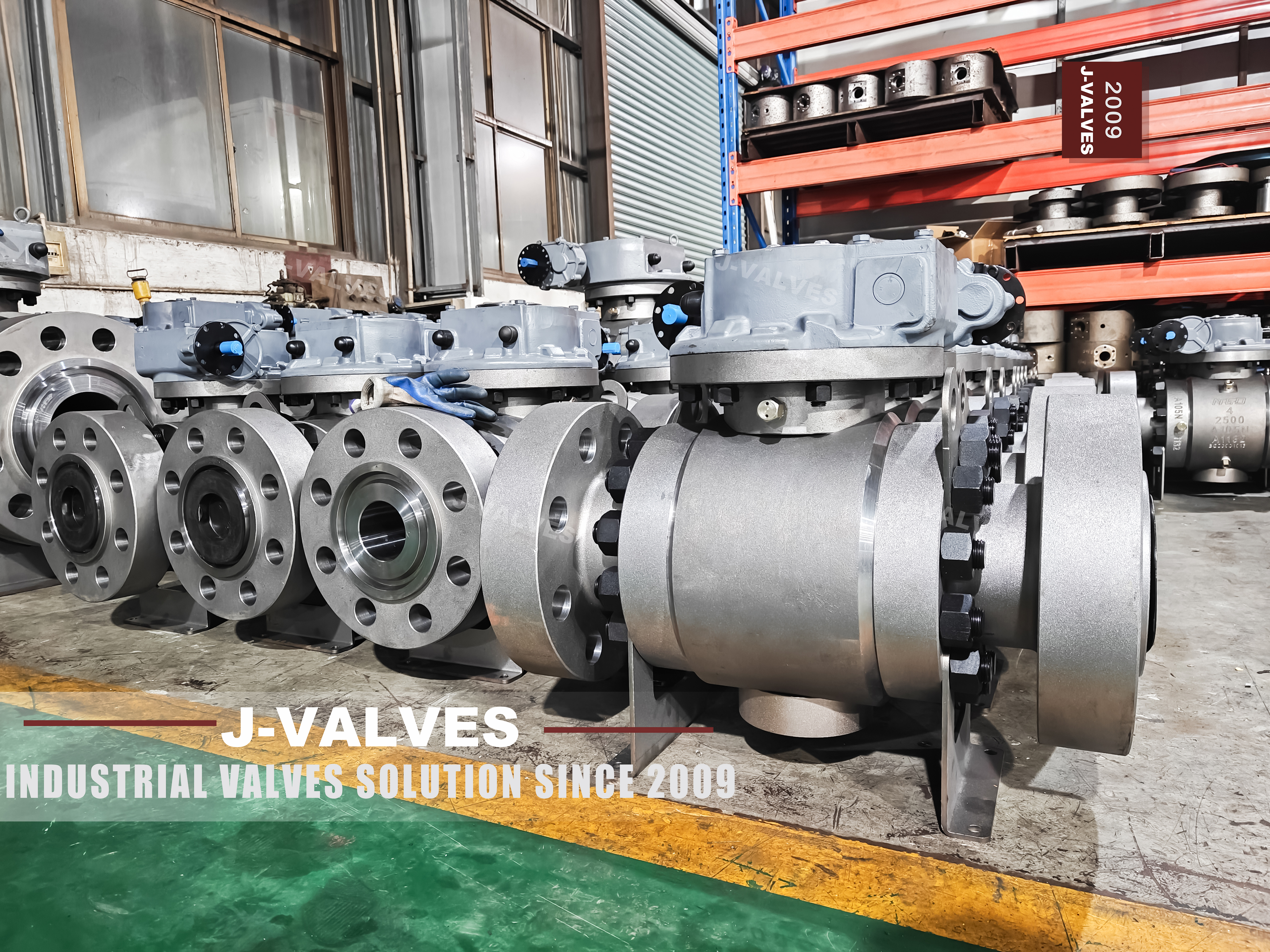
There are two pages on this site that describe this valve. One is titled three piece forged steel trunnion mounted ball valve, the other adds the word flanged. The parameter tables are the same table, line for line: same sizes, same classes, same body grades, same seat list, same bolting, same standards. The only word that differs is the one in the title.
That word is not a product. It is one entry from a list of five end forms that the same body can be built with. The page itself gives the list: raised face flange, ring joint flange, butt weld, socket weld and threaded end. A three piece body built with weld ends is not a different valve from the same body with flanges; it is the same valve with two different end pieces.
This matters commercially more than it matters technically. A buyer who treats the word flanged as a product name will ask for a quotation on a flanged valve, get one, and then discover that the spares he should have stocked are end pieces, not bodies. A buyer who reads it as an option orders the end form his piping needs and treats the centre piece as the part that does not change.
The valve is forged, three pieces, with a trunnion mounted ball, from half inch to 56 inch, Class 150 to 2500, in carbon steel, low temperature steel, austenitic stainless or duplex, with ends to ASME B16.5 or a weld preparation and an operator that can be a lever, a gear, or an actuator of any of four kinds.
Design and Construction
The end piece is the busiest part on the valve. It carries the flange and its bolt holes, it carries the seat pocket on its inner face, it carries the gasket face that closes the body joint, and it carries the bolt holes that the long body bolts pass through. Every one of those features is referenced to the same bore axis, and the seat pocket in particular has to be concentric with the flange so that the seat sits square to the pipe.
That combination is why the end piece is not a cheap part and why it is the part that gets replaced. A flange face that has been gouged by a hard gasket, or a ring joint groove that has been dented, or a thread that has been cross threaded, all take the end piece out of service. The centre piece, the ball and the trunnion bearing are usually still good.
The five end forms are not five machining operations on one forging. A raised face end piece is a flange with a machined face; a ring joint end piece needs a flange thick enough to carry a groove, so it starts from a heavier forging and removes more material. A butt weld end has no flange at all and instead has a bevel that has to match the pipe wall. A threaded end has a thread cut where the flange would be. Four different forgings, one body pattern.
The body bolts run the whole length, from one end piece, past the centre piece, into the other end piece. Their length is the length of the valve. A long bolt stretches more under the same load than a short one, so its preload is more sensitive to torque, to lubrication and to thread friction, and the grade of the bolt matters more here than it does on a compact joint.

Material Options
The body and the end pieces are made from the same grade on a standard build, and there is no technical reason they have to be. A carbon steel centre with stainless end pieces would be an unusual order but not a wrong one, and a duplex centre with carbon steel ends would be a mistake. The material table is written for the body as a whole because that is how it is normally bought.
| Part | Material on This Build | What It Decides |
|---|---|---|
| Centre piece | Forged A105, A350 LF2, A182 F304 or F316 | The pressure boundary at the middle of the valve |
| End pieces | Same grade as the centre piece, forged separately | Flange, seat pocket and joint face in one part |
| Ball | Forged with ENP, hard chrome, carbide coating or cobalt based overlay | Wear at the sealing band |
| Stem | 17-4PH, A105 with ENP, or F316 | Torque transmission and packing wear |
| Seats | PTFE, reinforced PTFE, PPL, PEEK, or metal with graphite | The temperature window |
| Body gaskets | Spiral wound with graphite, or ring joint | The two joints |
| Bolting | A193 B7, B7M, B8 or B8M with A194 nuts | Preload across the length of the body |
The gasket is the part that changes most between the two joint types, and it is worth separating them. A spiral wound gasket with a graphite filler sits in a machined groove or is located by the bolts, and it is compressed between two flat faces. A ring joint is a metal ring that sits in a groove cut in each face, and it seals on a line contact rather than over an area.
A ring joint has two consequences that the end piece has to accommodate. The groove reduces the face area available for the gasket seat, so the flange has to be thicker; and the ring is deformed on assembly, so it is replaced rather than reused. A maintenance plan that assumes the rings can be annealed and put back will produce a leak at the first restart.
The duplex grades are worth a line because they appear in the body list and are often chosen for the wrong reason. F51 and F53 are chosen for chloride resistance and for yield strength, and the strength does not buy a thinner wall, because wall thickness comes from the material group table in the design standard rather than from the yield strength of the steel.
Technical Specifications
The table below is the page table with the end forms separated out, because that is the line that the two pages on this valve disagree about.
| Item | Value |
|---|---|
| Size range | One half inch to 56 inch, DN 15 to DN 1400 |
| Pressure class | Class 150 to Class 2500, PN 20 to PN 420 |
| Body and end pieces | Forged A105, A350 LF2, A182 F304 or F316 |
| Construction | Centre piece, two end pieces, four long body bolts |
| End forms | Raised face, ring joint, butt weld, socket weld, threaded |
| Flange standard | ASME B16.5, ring groove to ASME B16.20 |
| Face to face | ASME B16.10 for the flanged builds |
| Ball | Forged, with ENP, hard chrome, carbide or cobalt based overlay |
| Seats | PTFE to 200 Celsius, PEEK to 260, metal with graphite to 650 |
| Design | ASME B16.34, API 6D, API 608 |
| Test | API 598 and API 6D |
The face to face line only applies to the flanged builds, and that is not a detail. ASME B16.10 tabulates flange to flange dimensions; a butt weld valve is dimensioned by its own standard or by the drawing, and a threaded valve has no tabulated length at all. A page that prints B16.10 for a range of end forms is printing a standard that applies to one of them. Written that way, the flanged valve and the weld end valve stop being two products and become one product with a stated end. The body, the ball, the seats and the bolts are the same parts either way; what changes is two forgings, and those are the two forgings that a store should hold.
Standards and Compliance
The standards divide the work between the body and the ends, and the split explains why the end form can change the rating of a valve whose body has not changed.
| Document | What it fixes | What it does not fix |
|---|---|---|
| ASME B16.34 | Wall, material groups, class ratings | The end form or its drilling |
| ASME B16.5 | Flange dimensions and drilling by class and size | A weld end or a thread |
| ASME B16.10 | Face to face for flanged valves | Weld end or threaded lengths |
| ASME B16.20 | Ring joint groove and ring dimensions | Whether the ring may be reused |
| API 6D | Valve requirements including the fire test | Seat material |
| API 608 | Ball valves to DN 600 and Class 600 | Anything above Class 600 |
The end form can change the rating because a rating belongs to the weakest pressure boundary on the valve, and the ends are boundaries. A flanged end carries the class of its flange. A threaded end carries no class at all, because the thread standard defines the thread form and the gauging and says nothing about pressure. A valve with one flanged end and one threaded end is therefore rated by the threaded end.
That is the reason this page argues the word flanged is an option rather than a product. The option is not decoration on the end of a body; it is a change to one of the boundaries that the rating depends on, and a quotation that does not name it is a quotation for a valve that has not been defined. Written that way, the flanged valve and the weld end valve stop being two products and become one product with a stated end. The body, the ball, the seats and the bolts are the same parts either way; what changes is two forgings, and those are the two forgings that a store should hold.
Manufacturing Process
The end pieces are forged separately from the centre piece, and that is the practical advantage of the three piece layout: a small forging is easier to make sound than a large one with a bore through it. Each forging is then machined with the flange face, the seat pocket and the joint face referenced to one bore axis, in as few settings as the part allows.
The order of operations on the end piece runs roughly from the outside in. The flange outside diameter and the raised face are turned, the bolt holes are drilled on a circle referenced to the bore, the joint face is faced, and the seat pocket is bored last from the joint face side. That order puts the pocket on the same axis as the flange, which is what makes the seat sit square to the pipe rather than square to the body.
The ring joint version inserts a grooving operation between the facing and the drilling, and the groove is cut with a form tool that has to be dressed to the ring profile. The groove depth and the groove width are both toleranced, and both are checked with the ring profile rather than with a caliper, because a groove that is the right depth but the wrong width will not seat a ring.
Assembly closes the two joints on their gaskets, torques the long bolts in a crossing sequence, and fits the stem and packing afterwards. The bolt torque sequence matters more on this body than on a two piece one because there are two joints being closed by the same set of bolts, and a sequence that closes one joint before the other will leave the first one loose again.

Quality Control and Testing
The shell test is applied with the ball open and both joints visible. On a three piece body the two joints are the parts under test as much as the wall is, and a joint that weeps under the shell test is a face, a gasket or a torque sequence problem. Finding it at the works is the whole point of testing before the valve is insulated or boxed into a skid. Written that way, the flanged valve and the weld end valve stop being two products and become one product with a stated end. The body, the ball, the seats and the bolts are the same parts either way; what changes is two forgings, and those are the two forgings that a store should hold.
A ring joint build gets an extra check on the groove, done with the ring that will be supplied rather than with a gauge. The ring should sit in the groove without rocking, and the gap between the ring and the groove bottom should be visible. A ring that bottoms in the groove has no room left to be compressed, and the joint will leak no matter how much torque is applied. Written that way, the flanged valve and the weld end valve stop being two products and become one product with a stated end. The body, the ball, the seats and the bolts are the same parts either way; what changes is two forgings, and those are the two forgings that a store should hold.

Applications and Industry Service
The ordinary duty is isolation on a line where the class is high enough to want a trunnion ball, and where the piping is flanged because it is large, or because it is to be removed, or because the specification is written that way. Gas transmission, crude and product lines, pump and compressor isolation, and the inlet of metering skids are the usual places.
The weld end versions appear where the line is to be welded and the valve is not expected to come out. A butt weld body in the same three piece pattern gives the same internals with two fewer joints to leak, at the cost of having to cut the line to remove the valve. That is a maintenance strategy decision, not a valve decision, and it is made at the same time as the end form.
The threaded versions appear at the small end of the range, where the line is small bore and the piping is screwed. At the large end they do not exist, because the make up torque and the pipe support would both be impractical. The five end forms are therefore not equally available across the size range, which is another reason the word flanged cannot stand for the product.
Where this valve is the wrong choice is on a line that needs a fully welded body, on a line where the space between flanges is fixed to a dimension the valve does not meet, and on a line that needs tight shut off at temperature with a metal seat. All three are answered by a different product, not by a different end.

Installation, Operation and Maintenance
Installation is a flange joint or a weld at each end, and the valve is supported so that the pipe does not hang from the body. On a ring joint the two flange faces have to be parallel before the bolts are tightened, because the joint closes metal to metal and cannot pull itself square; a joint pulled square by its bolts leaks at the groove. Written that way, the flanged valve and the weld end valve stop being two products and become one product with a stated end. The body, the ball, the seats and the bolts are the same parts either way; what changes is two forgings, and those are the two forgings that a store should hold.
Maintenance is the part where the end piece argument pays. With the line isolated and drained, the end pieces come off, the seats and the ball come out, and the parts that are worn are replaced. The joint gaskets are renewed as a matter of course and the ring joint rings are replaced rather than reused, because a ring that has been compressed once has already done the job it was bought for.
A spare parts policy for a plant with several of these valves is a policy about end pieces. The centre piece and the ball are common across the range; the end pieces are specific to the size, the class and the end form. A store that keeps a spare body and no end pieces has stocked the part that fails least.
How to Specify and Order
The lines below are the ones the range statement does not carry, and the second one is the line that separates this page from its twin.
| Line on the order | What to write | Why it matters |
|---|---|---|
| Size, class and bore | For example eight inch, Class 900, full bore | These fix the wall and the internals |
| End form | Raised face, ring joint, butt weld, socket weld or threaded | One word, and it changes the end piece forging |
| Flange standard and drilling | ASME B16.5, or the EN drilling if the line is EN | The two do not interchange |
| Seat material | PTFE, PEEK, or metal with graphite | It sets the temperature window |
| Gasket type | Spiral wound, or ring joint with rings | Ring joint rings are consumables |
| Operator | Lever, gear, or actuator with a failure position | The pad and bracket follow |
Written that way, the flanged valve and the weld end valve stop being two products and become one product with a stated end. The body, the ball, the seats and the bolts are the same parts either way; what changes is two forgings, and those are the two forgings that a store should hold.
FAQ
Q: Is this a different valve from the non flanged three piece one?
A: It is the same valve with a different end piece. The centre piece, the ball, the seats and the stem are unchanged; the two end pieces are machined to carry a flange instead of a weld preparation or a thread. A catalogue that lists both as separate products is describing one product with an option list.
Q: Can I change a raised face end to ring joint later?
A: Only by replacing the end piece. The ring joint groove is cut into a face that has to be thick enough to hold it, so the two end pieces start from different forgings and are not the same part with one more operation. That is also why a ring joint version costs more than the flange thickness suggests.
Q: What spare should I keep for a three piece valve?
A: End pieces, seat kits and body gaskets, in that order, because those are the parts that wear or get damaged. The centre piece and the ball rarely fail. A flange face that has been gouged, or a thread that has been cross threaded, takes the whole end piece out of service and nothing else with it.
Q: Does the end form change the pressure rating?
A: It can, and the rating follows the weaker end. A flanged end to B16.5 carries the class of the flange. A threaded end carries no class at all, because ASME B1.20.1 defines the thread form and the gauging and not a pressure. A valve with one of each is rated by the threaded end.
Q: Why are the body bolts so long on a three piece body?
A: Because they run from one end piece to the other, past the centre piece, so their length is the length of the valve. A long bolt stretches more for the same load, which makes preload less certain and makes the bolt grade matter more than it does on a short bolted joint.


Hot Products


News
Direct Air Capture Ball Valves The Vacuum Side Runs The Seal Backwards, And Three Hundred Thousand Strokes Decide The Design
A solid sorbent DAC plant moves 1.3 million cubic metres of air per tonne of CO2, then asks a DN50 ball valve to hold 0.9 bar from the wrong side.
Read More
Your Ball Valve Is Not A Test Blind: What A Hydrotest Does To The Seats
A line test puts pressure on the wrong side of the seat logic, above the valve's own seat test, with water that stays in the pocket. What to arrange instead.
Read More
Remanufactured Ball Valves: Five Checks That Decide Whether A Rebuild Deserves A Certificate
A rebuild at 45 percent of price with half the life is no saving. Five checks that separate a real remanufacture from a repaint with a certificate.
Read More
The Squeeze Is A Residual: How Tolerance Stack-Up Decides Whether A Ball Valve Seals
No dimension sets the seat squeeze. Five tolerances do, in series. Why identical valves feel different, and why a new ball changes the arithmetic.
Read More