


CHINA J-VALVES Offers Various High-quality I ndustrial Ball Valves
J-VALVES, a distinguished professional ball valve manufacturer rooted in China, takes pride in its extensive product portfolio. Our offerings span a wide range, including trunnion-mounted ball valves, floating ball valves, high-temperature ball valves, high-pressure ball valves, metal-sealed ball valves, ultra-low temperature ball valves, DBB ball valves, Three-way And Four-way Ball Valve, and fully welded ball valves. Each product is a testament to our commitment to precision engineering and reliable performance. Meticulously crafted, they are designed to not only meet but exceed the most stringent industrial demands, ensuring stable operation even under extreme conditions. This enables us to provide our clients with high-value services and makes our valves widely sought-after in industries.
Product Category
Contact Us

-
J-VALVES-Q347F
-
J-VALVES
Overview of the J-VALVES three piece forged steel trunnion mounted ball valve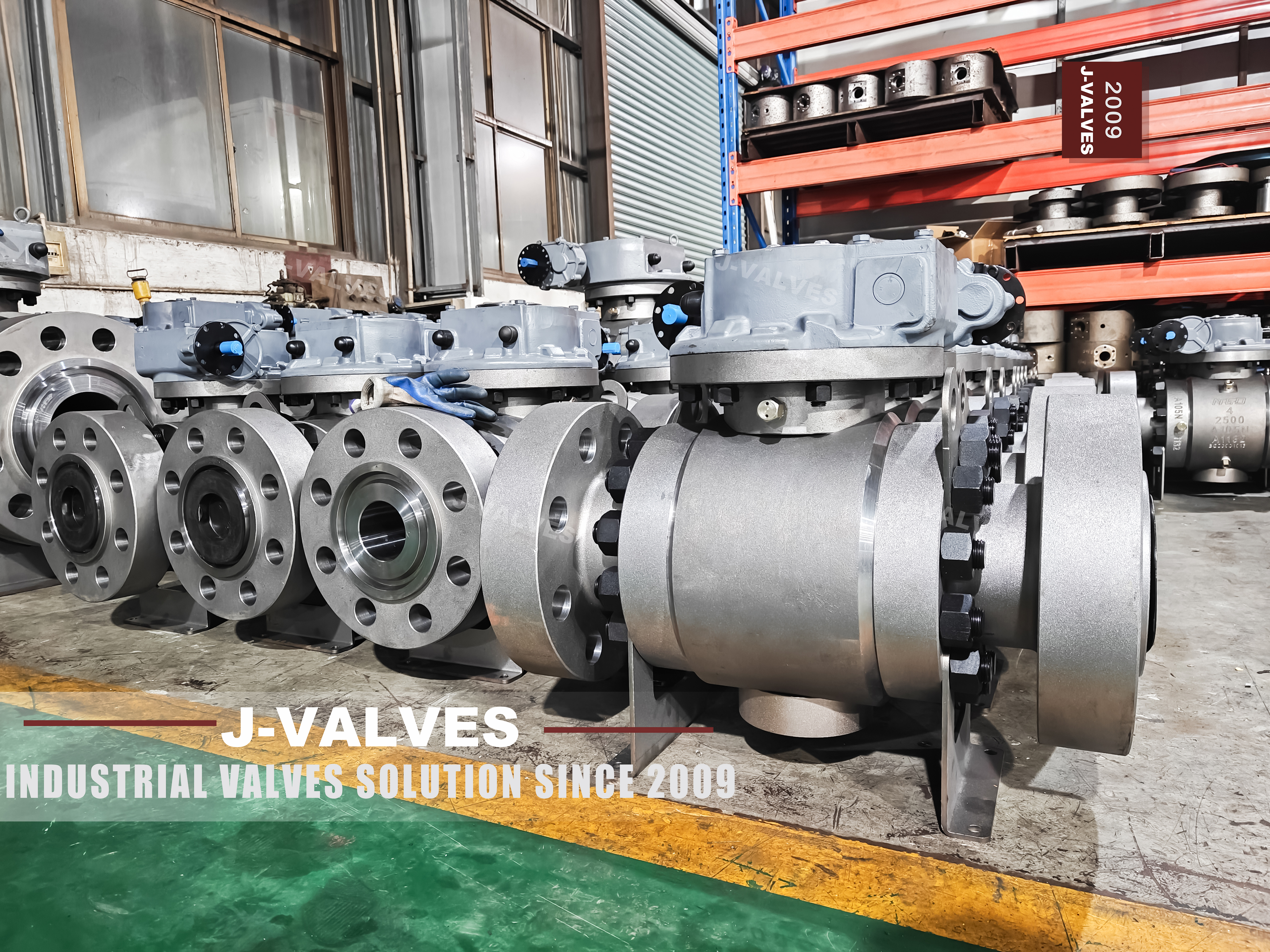
A temperature range on a valve data sheet looks like a fact about a valve. On this page it is a fact about a list. The page prints minus 29 to plus 425 Celsius in one line, and two paragraphs later it lists four seats with four different windows: PTFE or reinforced PTFE from minus 196 to 200, PPL from minus 40 to 280, PEEK from minus 60 to 260, and metal with flexible graphite from minus 29 to 650.
None of those four pairs is minus 29 to 425. Read as a statement about the product, the printed line is wrong; read as a statement about the family, it is a compromise that fits nobody exactly. The valve that arrives will have one seat in it, and that seat decides what the valve can do at temperature far more than the body does.
The body itself is forged, in A105, A350 LF2, A182 F304 or F316, or the duplex grades F51 and F53, and it is built as a centre piece with an end piece at each end, closed by bolts that run the length of the valve. A forged trunnion ball sits on upper and lower supports, so the seats do not carry the ball, and the ends are raised face or ring joint flanges or butt weld preparations. Size runs from half inch to 56 inch and class from 150 to 2500.
The argument of this page is that the temperature column belongs to the seat, and that the seat is a choice with a bill of materials attached. A buyer who reads the column as a property of the valve will specify a window that no single build can meet, and will find out at the hydrotest or, worse, in the second winter of service.
Design and Construction
The three piece layout exists because of how the seats are cut. The upstream seat pocket is machined from one end
face and the downstream pocket from the other, so the two pockets are concentric by the setup rather than by a transfer between operations. One centre piece cannot present both faces to a tool in a single setting, which is why the body is split at both ends rather than at one.
The ball does not rest on the seats. It is carried on a stem above and a trunnion below, and the trunnion runs in a bearing in the bottom of the body. That is what separates this pattern from a floating valve: the seats can be pushed against the ball by springs and by line pressure without also having to hold the ball up, so the seat load is a designed quantity rather than a consequence of the bore area.
The two seats are independent. Each has its own spring set between the seat ring and the body, and each is free to move a small distance along the bore axis. That independence is what makes a double block and bleed function possible without a second ball, provided the seats are arranged so that both can be loaded from the cavity side as well as from the line side. Whether they are is a seat configuration question, and it is not settled by the words double block and bleed on a data sheet.
The joints are pressure boundaries. Each is a machined face, a gasket and a ring of studs, and each is tested like any other boundary on the valve. What the three piece layout costs is two boundaries instead of one, plus a bolt whose length is the length of the valve, so its stretch under load is larger and its preload is less certain than a short bolt in a compact joint.

Material Options
The body list is a list of service conditions rather than a list of preferences. Carbon steel covers the ordinary range, the low temperature grade covers the cold end, the austenitic grades cover the corrosive duty, and the duplex grades cover chloride plus strength. The seat list is a separate decision, and it is the one that moves the temperature window.
| Part | Material on This Build | What It Decides |
|---|---|---|
| Body and end pieces | Forged A105, A350 LF2, A182 F304, F316, F51 or F53 | Corrosion allowance and low temperature toughness |
| Ball | Forged base with ENP, hard chrome, tungsten carbide or cobalt based overlay | Wear at the sealing band |
| Trunnion and bearings | Forged with surface hardening, or stainless | Whether the ball stays centred under load |
| Stem | 17-4PH, A105 with ENP, or F316 | Strength at the drive end and corrosion at the packing |
| Seats | PTFE, reinforced PTFE, PPL, PEEK, or metal with graphite | The temperature window of the whole valve |
| Body gasket | Spiral wound with graphite, or ring joint | The joint at the top of the range |
| Bolting | A193 B7, B7M, B8 or B8M with A194 nuts | Preload that survives the temperature |
The seat line is where the four windows come from, and they are not variations on a theme. A polymer seat seals by conforming, so it is limited by the temperature at which the polymer stops recovering. A metal seat seals by contact between two lapped surfaces, so it needs a graphite backing to keep the ring pressed against the ball when the body grows, and it will pass a small quantity by design.
That is why the metal seat line reaches 650 and the polymer lines stop below 300. It is also why the metal seat is not simply the better option: it needs more torque, it needs a harder ball, and it accepts a leakage rate where a polymer seat accepts almost nothing. The choice is a trade between temperature and tightness, and the printed range hides the trade by putting all four in one column.
The duplex grades deserve a separate note because they are often added for the wrong reason. F51 and F53 are chosen for chloride resistance and for yield strength, and a higher yield strength does not allow a thinner wall. Wall thickness comes from the material group table in the design standard, and that table does not give a discount for a stronger steel. What the duplex grade buys is corrosion margin and, at the top of the range, a body that keeps its toughness.
Technical Specifications
The table below keeps the page entries and separates the temperature column into the four lines the page already contains, so that the number on a quotation can be traced to a seat.
| Item | Value |
|---|---|
| Size range | One half inch to 56 inch, DN 15 to DN 1400 |
| Pressure class | Class 150 to Class 2500, PN 20 to PN 420 |
| Body | Forged A105, A350 LF2, A182 F304, F316, F51 or F53 |
| Ball | Forged, with ENP, hard chrome, carbide coating or cobalt based overlay |
| Stem | 17-4PH, A105 with ENP, or F316 |
| Seat, polymer | PTFE or reinforced PTFE, minus 196 to plus 200 Celsius |
| Seat, PPL | Minus 40 to plus 280 Celsius |
| Seat, PEEK | Minus 60 to plus 260 Celsius |
| Seat, metal with graphite | Minus 29 to plus 650 Celsius |
| Temperature printed on the page | Minus 29 to plus 425 Celsius |
| Ends | Raised face or ring joint flange, butt weld on request |
| Design | ASME B16.34, API 6D, API 608 |
| Test | API 598 and API 6D |
The pressure column is the one place where the page is exact. The class to PN pairs in API 6D clause 7.2 are a fixed table, and 150, 300, 600, 900, 1500 and 2500 map onto PN 20, 50, 100, 150, 250 and 420. There is nothing to interpret there, and a page that writes a different PN for a class has introduced an error rather than a variant.
The temperature column is the opposite. There is no single figure to copy, because the answer depends on a part that the size and class do not fix. A 2500 class valve with a PEEK seat and the same valve with a metal seat are the same casting and two different products, and only one of them is the valve that a 600 Celsius line needs.
Standards and Compliance
Three documents appear on this page and they divide the work cleanly, which is worth setting out because the overlap between them is where most specification errors begin.
| Document | What it fixes | What it does not fix |
|---|---|---|
| ASME B16.34 | Wall thickness, material groups, pressure and temperature ratings | Seat material or leakage |
| API 6D | Valve requirements for pipeline service, including the fire test | A seat temperature window |
| API 608 | Steel ball valves, DN 15 to DN 600, Class 150 to Class 600 | Anything above Class 600 |
| API 598 | Shell and seat test procedure and acceptance | Which seat the valve should have |
| ASME B16.10 | Face to face dimensions for flanged valves | Weld end lengths |
API 608 appears on this page alongside a range that goes to 2500, and that is a scope mismatch rather than a mistake in the valve. The 608 route ends at Class 600 and DN 600; above that, the document that covers a ball valve in this family is API 6D. The page is a family page covering the whole ladder, so it names both, and a specific order at 1500 or 2500 sits under 6D alone.
The fire test needs one line of explanation because pages in this industry tend to list two numbers for it. API 6FA and API 607 describe the same kind of test applied to two families of valve, and a ball valve is qualified to the ball valve document. Listing both as if they were two certificates on one valve is a habit rather than a requirement. What none of the documents fixes is the temperature column. A standard can tell you the allowable stress of a material at a temperature and the wall that follows from it; it cannot tell you whether the seat in the valve will still seal. That is a manufacturer's statement, and it should be traceable to a seat grade rather than to a range.
Manufacturing Process
The body starts as a forged billet or a forged near shape, and the difference between the two shows up in the grain flow. A billet machined into a body cuts across the flow lines; a near shape forged to the outline keeps them following the contour, which is the reason forgings are chosen for high class work at all. The first operation is usually to establish the bore axis, because every other feature is referenced to it.
The seat pockets are then cut, one from each end face, and this is the operation that decides whether the valve will seal. Pocket depth, squareness to the bore and the finish of the pocket wall all matter, and all three are easier to hold when the pocket and its end face are machined without the part being moved. That is the practical reason the body is in three pieces.
The ball is turned, ground and lapped, then coated if the seat is metal. The order matters: coating a ball before grinding leaves a surface that is hard but not round, and a hard surface that is not round will not seal against a lapped seat no matter how carefully the seat is made. Coating, then grinding, then lapping the band is the sequence that produces a ball with both properties.
Assembly fits the trunnion bearing, drops the ball in, fits both seats and their springs, closes the two end pieces on their gaskets, and torques the body bolts in a crossing pattern. The stem and packing go in last, and the gear or the lever goes on a stem whose square has been cut after the packing gland face, so the drive is square to the gland rather than to the raw forging.

Quality Control and Testing
The shell test is applied with the ball open, at the multiple of the class that the test standard names, and both body joints are watched during it because they are the boundaries that a single piece body does not have. A joint that weeps under the shell test is a gasket or a face problem, and it is found at the works rather than after insulation.
The seat test is run one side at a time. On a trunnion valve the seats can be loaded independently, and the test procedure reflects that: pressure is applied to one side, the other side is open to atmosphere, and the leakage at the open side is measured. Running both sides at once tests nothing, because a leak past one seat is hidden by pressure on the other.
The metal seated build adds a step that a polymer build does not need. The contact band between the seat ring and the ball is checked with marking compound and its width is recorded, because a band that is too narrow will not hold and a band that is too wide will not load. That check is done before the valve is assembled for the last time, and the record travels with the heat number.
The fire test is a type test on a design and a size, and this is worth stating plainly because purchase orders sometimes ask for it per unit. A type test says the design passed; it does not say the valve in the crate was tested. If a project needs a test on the delivered unit, that is a different requirement and it belongs in the order, not in a certificate reference.

Applications and Industry Service
The ordinary duty for this pattern is isolation on a line where the class is high enough that a floating ball is no longer sensible. Gas gathering and compression, crude and product transfer, and the inlet and outlet of pumps and metering skids are the usual places, at sizes from two inch up and classes from 600 up.
Low temperature service is the second family, and it is where the seat line and the body line diverge most sharply. A cryogenic build needs a stem long enough to keep the packing away from the cold end, bolting that keeps its toughness, and a seat that does not become brittle. Those are not options on a standard valve; they are a different assembly with a different drawing.
High temperature service is the third, and there the metal seat with a graphite backing is the only line on the list that goes where the duty goes. Above roughly 425 Celsius the carbon steel body is out of its range anyway, so a high temperature order moves the body to a chrome moly grade and the seat to metal at the same time. Neither change is optional once the other has been made.
Where this valve is the wrong choice is on a line that needs tight shut off at temperature and on a line that needs throttling. A metal seat passes a rate by design, and a ball valve at part open puts the flow across the seat edge, which is the fastest way to destroy a lapped band. A different valve is the answer to both, not a different seat.

Installation, Operation and Maintenance
Installation is a flange joint or a weld at each end, with the valve supported so that the pipe does not hang from the body. On a ring joint end the ring sits in the groove and the joint is made up metal to metal, which means the flange faces have to be parallel before the bolts are tightened; a joint pulled square by its bolts will leak at the groove and the ring will be blamed.
Operation is a quarter turn, and on the larger sizes it is a gear with a handwheel, because the torque at 2500 class is beyond what a lever can apply evenly. The gear has its own limits and its own lubricant, and a gear that is stiff is usually a sign that the seat is loaded harder than it was designed for rather than a sign that the gear needs grease.
Maintenance access is the reason the body is in three pieces, and it is real: with the line isolated and drained, the end pieces come off and the seats, the ball and the trunnion bearing are all reachable. The joint gaskets are replaced as a matter of course, and the ring joint rings are replaced rather than reused, because a ring that has been compressed once has already done its sealing.
The packing is serviced from the top without disturbing the body joints, which is the maintenance task that actually gets done in service. A gland that is tightened repeatedly to stop a weep eventually runs out of travel, and at that point the packing set is replaced rather than tightened again.
How to Specify and Order
The lines below are the ones that the range statement does not carry, and the first two are the ones that decide whether the valve can do the job at all.
| Line on the order | What to write | Why it matters | |
|---|---|---|---|
| Seat material | PTFE, PPL, PEEK, or metal with graphite | It sets the temperature window, not the body | |
| Temperature | Minimum and maximum, in service | The window is a seat property and it has to be stated | |
| Class and size | For example eight inch, Class 1500 | These fix the wall and the flange drilling | |
| End form | Raised face, ring joint, or weld preparation | Ring joint is mandatory at the top classes above three inch | |
| Bore | Full or reduced | It changes the ball, the body length and the torque | |
| Operator | Lever, gear, or actuator with a stated failure position | The pad and the bracket follow from it | Written that way, the valve stops being a range and becomes an object: a forged body in a named grade, a trunnion ball with a named surface, two independent seats in a named material, a bolted body with two tested joints, and a temperature window that belongs to the seat the order names. |
FAQ
Q: The page says minus 29 to plus 425. Which seat is that?
A: None of them exactly. That pair is the window where a carbon steel body with a polymer seat is comfortable, and it is printed as a general figure. The seat list on the same page runs to 650 on metal with graphite and starts at minus 196 on PTFE. A valve is bought with one seat, so the real window is whichever line of that list the order names.
Q: Can one valve cover minus 196 to plus 650?
A: No, and the reason is not the body. A cryogenic build needs a stem long enough to keep the packing out of the cold, low temperature bolting and a seat that does not turn brittle. A 650 Celsius build needs a metal seat, graphite packing and bolting that survives the creep range. Those are two assemblies that happen to share a body pattern.
Q: Why does PTFE appear with minus 196 on the same line as 200?
A: Because the two ends of that line belong to different parts. PTFE does not become brittle at liquid nitrogen temperature the way carbon steel does, so the bottom of the line is set by the body and the bolting; the top is set by the polymer. One line, two different limits, and the lower one is not the seat's achievement.
Q: Is the three piece body weaker than a two piece one?
A: Not as a pressure boundary. Each joint is a gasketed face held by bolts and it is tested like any other boundary. What the three piece layout costs is two joints instead of one, and a bolt long enough that its stretch matters. What it buys is access to both seat pockets from opposite ends.
Q: What changes in the bill of materials at 650 Celsius?
A: The seat becomes metal with a graphite backing, the body gasket becomes graphite based, the packing becomes graphite, and the bolting moves off B7 to a grade with a higher creep ceiling. The body grade also has to be one that keeps its strength there, which is why the chrome moly forgings appear in the list. None of that is an option on the seat line alone.


Hot Products


News
Your Ball Valve Is Not A Test Blind: What A Hydrotest Does To The Seats
A line test puts pressure on the wrong side of the seat logic, above the valve's own seat test, with water that stays in the pocket. What to arrange instead.
Read More
Remanufactured Ball Valves: Five Checks That Decide Whether A Rebuild Deserves A Certificate
A rebuild at 45 percent of price with half the life is no saving. Five checks that separate a real remanufacture from a repaint with a certificate.
Read More
The Squeeze Is A Residual: How Tolerance Stack-Up Decides Whether A Ball Valve Seals
No dimension sets the seat squeeze. Five tolerances do, in series. Why identical valves feel different, and why a new ball changes the arithmetic.
Read More
Why A Ball Valve Gets Harder To Turn: Five Causes, And The Test That Tells Them Apart
A ball valve that stiffens over months points at one of five parts. Measure torque with the line pressurised and again vented, and the split becomes visible.
Read More