


CHINA J-VALVES Offers Various High-quality I ndustrial Ball Valves
J-VALVES, a distinguished professional ball valve manufacturer rooted in China, takes pride in its extensive product portfolio. Our offerings span a wide range, including trunnion-mounted ball valves, floating ball valves, high-temperature ball valves, high-pressure ball valves, metal-sealed ball valves, ultra-low temperature ball valves, DBB ball valves, Three-way And Four-way Ball Valve, and fully welded ball valves. Each product is a testament to our commitment to precision engineering and reliable performance. Meticulously crafted, they are designed to not only meet but exceed the most stringent industrial demands, ensuring stable operation even under extreme conditions. This enables us to provide our clients with high-value services and makes our valves widely sought-after in industries.
Product Category
Contact Us


-
J-VALVES-Q347F
-
J-VALVES
Overview of the J-VALVES two piece flanged trunnion valve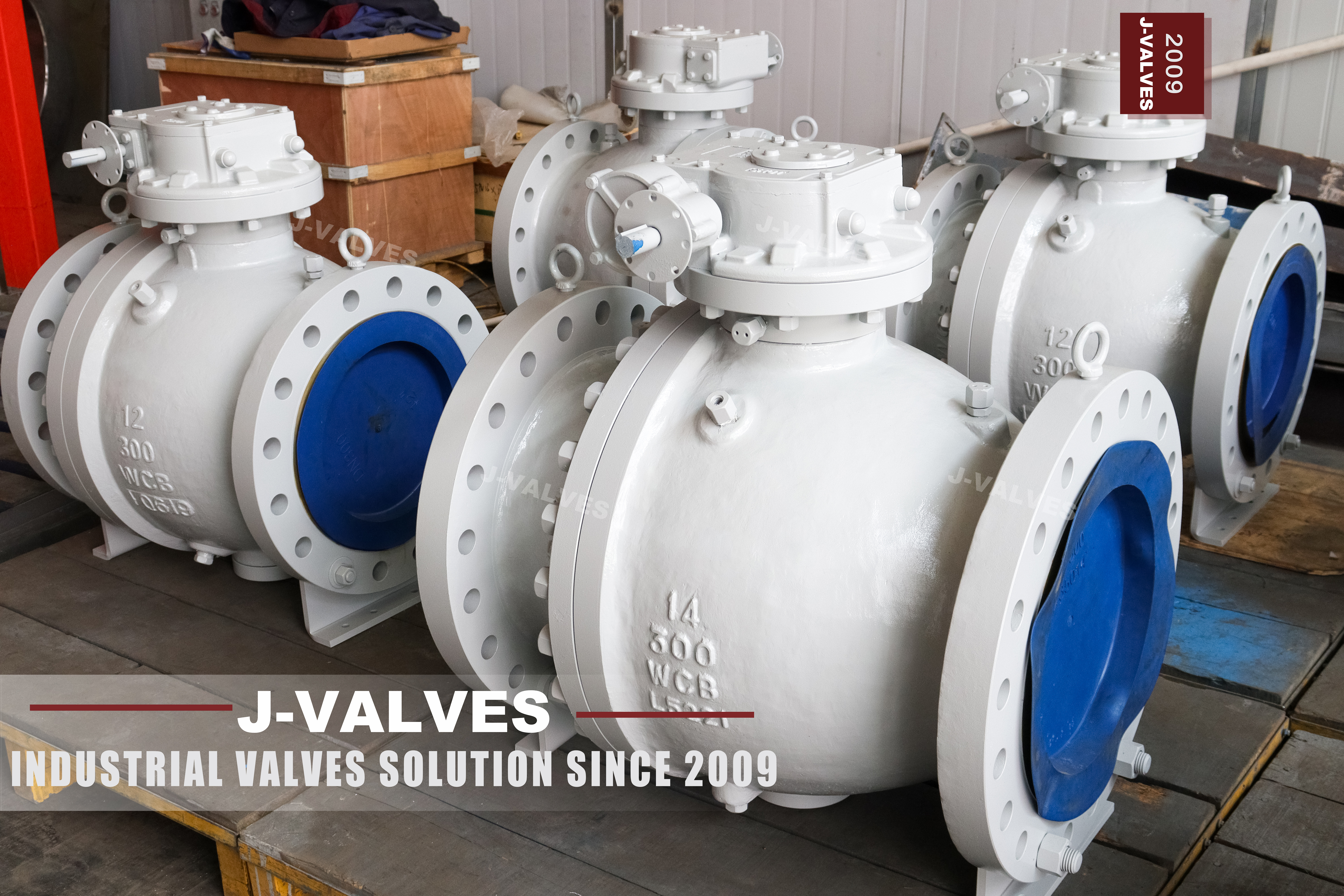
Look closely at the barrel of the body in the photograph and the lettering is not a plate. There is no stainless tag riveted to it and no engraved strip. The figures are in relief, standing out of the cast surface and painted over with the same coat as the body, which means they came out of the mould with the casting.
That is the whole subject of this page. A cast body carries marks that belong to the pattern, and a pattern is used for many castings over many years, so the marks it carries are the ones that do not change: the nominal size, the pressure class and the material grade. The fourth line on this body is different, and it is different on every casting, which tells you it is not part of the pattern in the ordinary sense.
The argument here is that these four lines are a foundry statement and not a product specification. They tell you what was poured and how big it is. They do not tell you the trim, the seat, the operator, the standard the valve was built to, or who built it, and all of those are things a buyer needs and none of them are in the casting.
Design and Construction
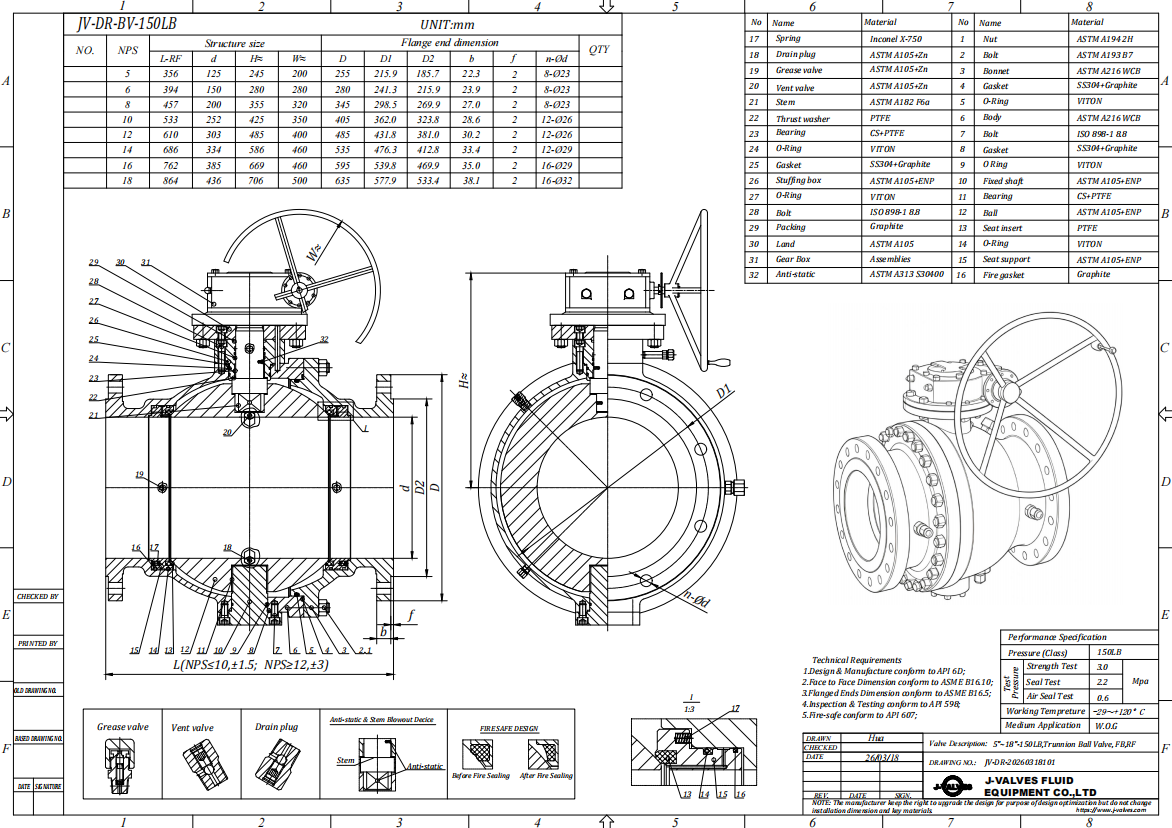
The body is a two piece cast trunnion design: a main body with a spherical shell around the ball, and one end piece closing the other side, with a single ring of studs through lugs around the joint. The ball is carried on an upper and a lower trunnion, the seats sit in pockets on either side of it, and the stem comes out through a bonnet to a gearbox.
The joint is on one side only, so the ball is loaded from one end. On a body whose end opening passes the ball that is all the access needed for assembly, and it is why a two piece body is sufficient at this size. A three piece body would give an identical end piece at both ends and one more joint, and the choice between the two is made on the size of the ball against the size of the opening.
The gearbox on top is a worm gear with a handwheel input, and it is there because the torque at fourteen inch is beyond a lever. The housing is bolted to a pad on the bonnet and the input shaft carries the wheel, and the gearbox has its own end stops which are set against the valve at the works.
Two features on the shell are worth naming because they are cast in and then machined. There are eye bolts on the top of the body, one on each side, and the bosses for them are part of the casting. There are also feet under the body, cast with the shell and faced afterwards. Neither is an accessory: both are in the pattern, and a body without them cannot have them added later without welding.
Material Options
The plate says WCB, and WCB is the cast carbon steel grade in the A216 specification. It is the default for a body of this size at this class, and the alternatives are the low temperature and stainless cast grades, all of which would look identical under the paint.
| Part | Material on This Build | Note |
|---|---|---|
| Body and end piece | A216 WCB cast carbon steel | Two castings, each with its own heat |
| Ball | Carbon steel with a hard facing, or stainless | Trim item, not in the plate |
| Stem | F6a, F304 or F316 | Trim item, not in the plate |
| Seat | Reinforced PTFE, polyimide, or metal | Sets the temperature limit |
| Body joint gasket | Spiral wound | One joint on a two piece body |
| Studs and nuts | B7 with a coating, or B8M | Through lugs into the body |
| Gearbox | Cast iron housing, steel worm and wheel | Separate assembly, separate plate |
The two castings have two heat numbers, and that is a point worth keeping straight when the certificate package is read. The centre body and the end piece are poured separately, so a package with one certificate for a two piece body is a package that covers one casting. Both castings are pressure retaining and both need a line.
The trim does not appear on the body at all, and that is the gap the plate leaves. A buyer who reads fourteen, three hundred and WCB has established the shell, and everything that determines whether the valve seals, wears and operates is somewhere else in the documentation.
Technical Specifications
| Item | Value |
|---|---|
| Size | Fourteen inch, DN 350 |
| Pressure class | Class 300, PN 50 in the API 6D table |
| Rating at 38 Celsius | 51.1 bar, ASME B16.34 group 1.1 |
| Body | A216 WCB cast carbon steel, two piece |
| Body joints | One, through lugs into the centre body |
| Ends | Raised face or ring joint to ASME B16.5 |
| Face to face | ASME B16.10 for fourteen inch Class 300 |
| Temperature | Minus 29 to plus 425 Celsius, seat dependent |
| Operator | Worm gear with a handwheel |
| Lifting | Eye bolts on the shell, cast bosses tapped |
| Support | Feet under the body, cast and faced |
| Design | API 6D, ASME B16.34 |
The rating row is the one the plate does not give. Three hundred is a class and not a pressure, and the pressure it corresponds to depends on the material group and on the temperature. For WCB at 38 Celsius the tabulated figure is 51.1 bar, and it falls from there as the temperature rises, so a valve quoted by class alone has had its pressure specified and its temperature left open.
The PN figure beside Class 300 is 50, and it is a designation in the API 6D list rather than a pressure in bar. The list runs 150 as PN 20, 300 as PN 50, 600 as PN 100, 900 as PN 150, 1500 as PN 250 and 2500 as PN 420, and every one of those pairings is fixed. A page that prints PN 40 beside Class 300 has converted a pressure and rounded it down.
Standards and Compliance
| Requirement | Document | What It Means Here |
|---|---|---|
| Product requirements | API 6D | Design, materials, marking, testing |
| Wall and rating | ASME B16.34 | Class 300 for the group set by WCB |
| Flanges | ASME B16.5 | Fourteen inch is inside the tabulated range |
| Casting quality | MSS SP-55 | Visual acceptance, level named on the order |
| Pressure test | API 598 | Shell at 1.5 times, seat at 1.1 times |
| Fire test | API 607 or ISO 10497 | Type test against a stated scope |
| Material certificate | EN 10204 3.1 | One line per casting, two heats here |
The marking requirement in API 6D is a nameplate, and the cast lettering on this body is not one. A nameplate carries the manufacturer, the size, the class, the body material and the standard, and it is a separate item fixed to the valve. A body with four cast lines and no plate has four pieces of information and a missing nameplate, and the missing plate is the one that names the article.
The same four lines are also the reason a cast body is a poor place to look for a trim code. Nothing on the barrel distinguishes a body built with a reinforced PTFE seat from one built with a metal seat, or a hard faced ball from a stainless one, because those parts are chosen after the casting and are not in the pattern. Two valves can leave the works from the same batch of castings with different trims and different temperature limits, and the outside of both of them reads fourteen, three hundred, WCB.
That distinction is worth a line in a receiving procedure. Cast marks identify the casting, a nameplate identifies the valve, and the certificate identifies the heat. Three different documents for three different questions, and a valve that arrives with only the first one has not been identified.
Manufacturing Process
The pattern is made first and it carries the size, the class and the grade in relief, along with the feet, the eye bolt bosses and the lettering position. The heat number is not in the pattern, because a pattern outlives many heats; it is set into the mould as a loose insert or stamped into the casting after shakeout, which is why it sits differently on the surface from the three lines above it.
The casting is cleaned, stress relieved and machined. The flange faces, the joint face, the trunnion bores and the seat pockets are all cut from one centreline, and the feet are faced on the same setting so that the body sits level when it is set down.
The end piece is a second casting with its own pattern, its own heat and its own certificate. It is machined to fit the joint spigot on the centre body rather than to a free dimension, so the two castings are a matched pair even though they come from separate pours.

Quality Control and Testing
| Step | Check | Acceptance |
|---|---|---|
| 1 Pattern | Size, class and grade lettering before first pour | Drawing |
| 2 Chemistry | Ladle analysis for each heat | A216 WCB |
| 3 Casting | Visual to MSS SP-55 | Level named on the order |
| 4 Machining | Flange faces, joint face, pockets, feet | One setting |
| 5 Shell test | Body and joint at 1.5 times | API 598, no leakage |
| 6 Seat test | Each seat at 1.1 times, both directions | API 598 rate |
| 7 Marking | Nameplate, plus the heat matched to certificates | API 6D marking |
| 8 Final | Faces protected, bores capped, crated | Works standard |
The marking row is the one this page exists to argue for. The heat number on the body is the only line that can be matched against a certificate, and a body whose fourth line cannot be read has lost its link to the paperwork even though its first three lines are perfectly legible. That is why the number is protected through painting and why a photograph of it belongs in the delivery file.

Applications and Industry Service
A fourteen inch Class 300 WCB two piece body belongs on large bore block service at moderate pressure: water and utility headers, product pipelines, tank farm isolation and the isolation points around rotating equipment. In those duties the valve is open most of its life, closed for maintenance, and judged on whether it still seals after years of that.
The features that are cast into the body are the ones that duty needs. The feet carry the valve on a structural support so the flanges are not loaded by its mass. The eye bolts let it be lifted from the body rather than slung around the gearbox. The gearbox makes it operable by one person. None of the three is an accessory, and all three are decisions taken when the pattern was made.
It is the wrong valve where the body has to be examined internally and the order did not ask for radiography, because a casting's internal quality is then an assumption. A radiographed body and a painted one look the same on the crate, so the scope has to be written into the order rather than agreed in a conversation. It is also the wrong valve where the line is above a walkway with no platform, because the handwheel is then out of reach and a chainwheel or an actuator would have been the right choice.

Installation, Operation and Maintenance
Lifting is from the eye bolts, with a spreader if the sling angle would load them sideways. The gearbox and the handwheel are not lifting points, and a valve lifted on its wheel is a valve with a bent gearbox input and a wheel that runs out of true for the rest of its life.
The valve is set on its feet and shimmed before the flange studs are tensioned, so that the structure carries it and the pipe flanges only seal. The joint studs are not touched at installation, because on a correctly built body the joint is set at the works and the seat compression is set by the pocket depth rather than by the stud tension.
Operation is a quarter turn through the gearbox, and the gearbox stops are checked once a year rather than adjusted.
The packing is reached from the top without breaking the body joint, and on a valve this size that is the maintenance that actually happens. A gland that is nipped up once a year on a schedule is a gland that does not become a reportable leak, and the alternative, waiting for a drip, is how a small nuisance becomes a body joint that has to be broken on a live unit. Maintenance is the packing and the gearbox lubrication on a schedule, and the seat and ball replacement on a strip down, which on this body means breaking one joint and lifting the ball out of the open end.
How to Specify and Order
The six entries are size, class, body grade, seat, end connection and operator, and on this body none of the trim entries appear in the casting, so the order is the only place they exist. A purchase order that quotes the cast marks back at the supplier has quoted the shell and nothing else.
The second thing to write is the nameplate content. API 6D marking is a plate and not a cast mark, and an order that does not ask for it can be met with a body that carries four lines and no nameplate at all. That is a legitimate question to raise at the receiving dock, and it is cheaper to raise it in the order.
Documents to name: the EN 10204 3.1 certificate for both castings with their two heat numbers, the MSS SP-55 acceptance level and the inspector, the heat treatment record, the shell and seat test record, the nameplate content, and the general arrangement drawing with the face to face dimension, the foot position, the eye bolt thread and the gearbox orientation.
FAQ
Q: Why are the size, class and grade standing out of the surface?
A: Because they are part of the pattern and they come out of the mould with the casting, in relief. A pattern is used for many castings over many years, so the lines it carries are the ones that never change on that body.
Q: Why is the fourth line different?
A: Because it is the heat and a pattern outlives many heats. It is set into the mould as a loose insert or stamped into the casting after shakeout, and it is the only line on the body that can be matched against a material certificate.
Q: Is the cast lettering a nameplate?
A: No. API 6D marking is a nameplate carrying the manufacturer, size, class, body material and standard. The cast lines identify the casting; the plate identifies the valve; the certificate identifies the heat. A body with four cast lines and no plate has two of the three missing.
Q: Why are there two certificates for a two piece body?
A: Because the centre body and the end piece are two castings poured separately, each with its own heat. A certificate package with one line for a two piece body covers one casting, and both castings are pressure retaining.
Q: Why does the body have feet and eye bolts if they are not accessories?
A: Because they are cast with the shell and then machined, so a body without them cannot have them added later without welding. The feet carry the valve on a structural support and the eye bolts are the lifting points, and both are decisions taken when the pattern was made.



Hot Products


News
Your Ball Valve Is Not A Test Blind: What A Hydrotest Does To The Seats
A line test puts pressure on the wrong side of the seat logic, above the valve's own seat test, with water that stays in the pocket. What to arrange instead.
Read More
Remanufactured Ball Valves: Five Checks That Decide Whether A Rebuild Deserves A Certificate
A rebuild at 45 percent of price with half the life is no saving. Five checks that separate a real remanufacture from a repaint with a certificate.
Read More
The Squeeze Is A Residual: How Tolerance Stack-Up Decides Whether A Ball Valve Seals
No dimension sets the seat squeeze. Five tolerances do, in series. Why identical valves feel different, and why a new ball changes the arithmetic.
Read More
Why A Ball Valve Gets Harder To Turn: Five Causes, And The Test That Tells Them Apart
A ball valve that stiffens over months points at one of five parts. Measure torque with the line pressurised and again vented, and the split becomes visible.
Read More