


CHINA J-VALVES Offers Various High-quality I ndustrial Ball Valves
J-VALVES, a distinguished professional ball valve manufacturer rooted in China, takes pride in its extensive product portfolio. Our offerings span a wide range, including trunnion-mounted ball valves, floating ball valves, high-temperature ball valves, high-pressure ball valves, metal-sealed ball valves, ultra-low temperature ball valves, DBB ball valves, Three-way And Four-way Ball Valve, and fully welded ball valves. Each product is a testament to our commitment to precision engineering and reliable performance. Meticulously crafted, they are designed to not only meet but exceed the most stringent industrial demands, ensuring stable operation even under extreme conditions. This enables us to provide our clients with high-value services and makes our valves widely sought-after in industries.
Product Category
Contact Us


-
J-VALVES-Q47F
-
J-VALVES
Overview of the J-VALVES trunnion mounted reduced bore valve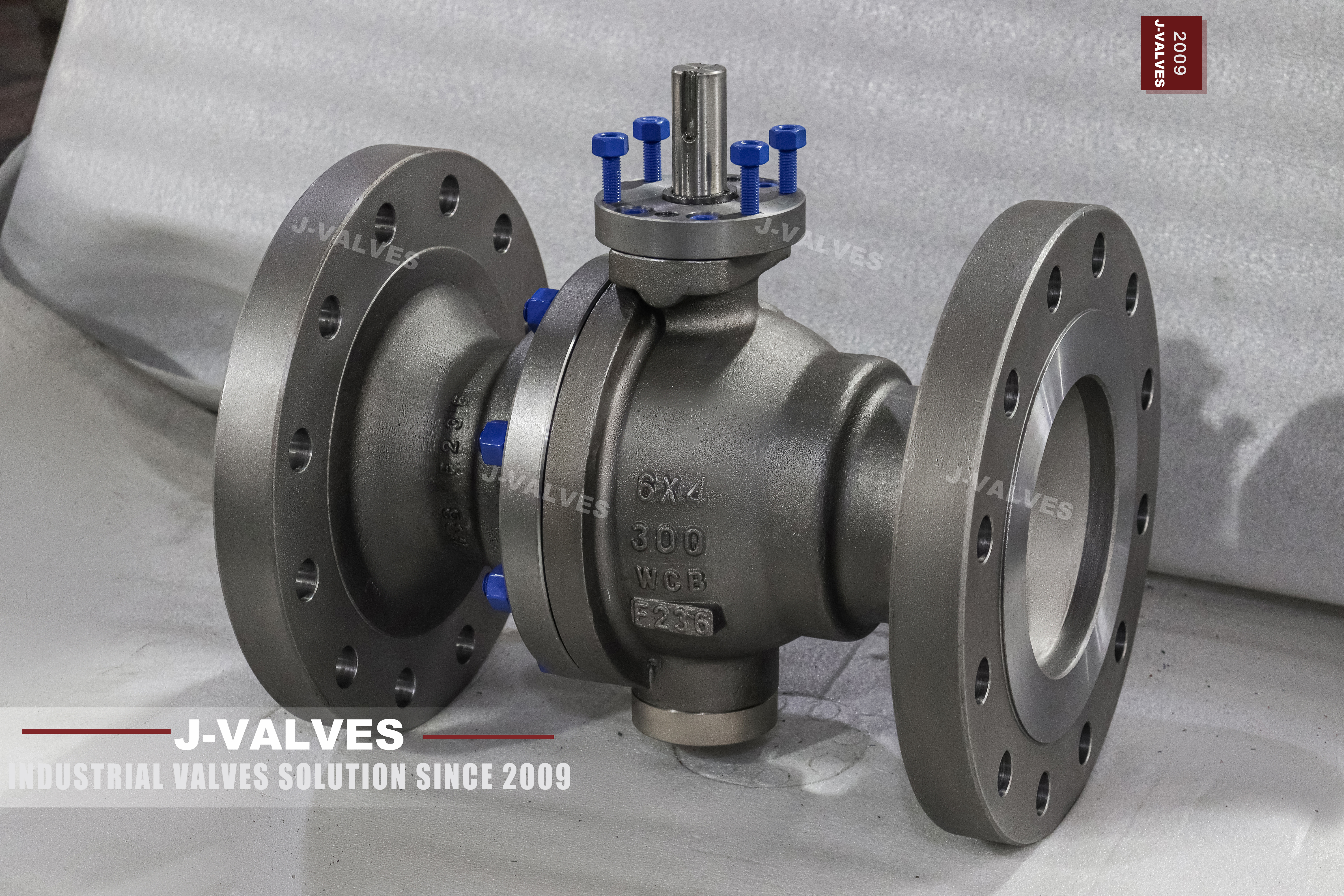
A ball valve of this kind is made of three materials that do three different jobs, and the most common specification error on a carbon steel valve is to treat the body grade as if it described the whole article. The plate here reads six by four, three hundred, WCB, and WCB describes the shell. It says nothing about the ball, nothing about the stem and nothing about the seat.
The three materials are chosen for three different loads. The shell carries pressure and is chosen for strength and weldability. The ball carries wear and is chosen for hardness. The stem carries torque and passes through the packing, so it is chosen for a combination of torsional strength and corrosion resistance at the gland. On this build the three are A216 WCB, a 410 stainless ball and a 316 stem.
The argument of this page is that the trim is a separate specification from the body, and that a purchase order which names the body grade and leaves the trim to the supplier has specified a pressure vessel and not a valve. The three materials meet at the seat, and the seat is where the temperature limit of the whole article comes from.
Design and Construction
The body is a three piece cast pattern: a centre section carrying the ball and both seats, and two end pieces bolted to it. The ball is trunnion mounted, so it turns on an upper and a lower shaft and the pressure load goes into bearings rather than into the seats. The stem in the photograph comes out of the body bare, on a square pad with four stud holes, with no lever fitted.
The reduced bore is the first number pair on the plate and it is a decision about the line rather than about the body. A four inch bore in a six inch body passes the flow of a four inch line with a pressure drop that a four inch valve would have, and the flanges stay six inch so the valve bolts to the pipe that is already there. The alternative is a full bore six inch body, which is larger, heavier and more expensive for the same duty.
The trunnion mounting is what allows the valve to be built at Class 300 in this size with a polymer seat. In a floating design the whole pressure load goes onto the downstream seat, and at six inch the seat area is large enough that the load becomes the deciding factor. A trunnion takes that load into bearings and leaves the seat with only the sealing task.
The bare stem on the pad is the third decision in the photograph. No lever is fitted, so the operator is a separate item, and the four stud holes on the pad are the mounting for whatever is fitted. On a valve that will be actuated this is the right way round; on a valve that will be turned by hand, the lever is cheaper bought with the valve.
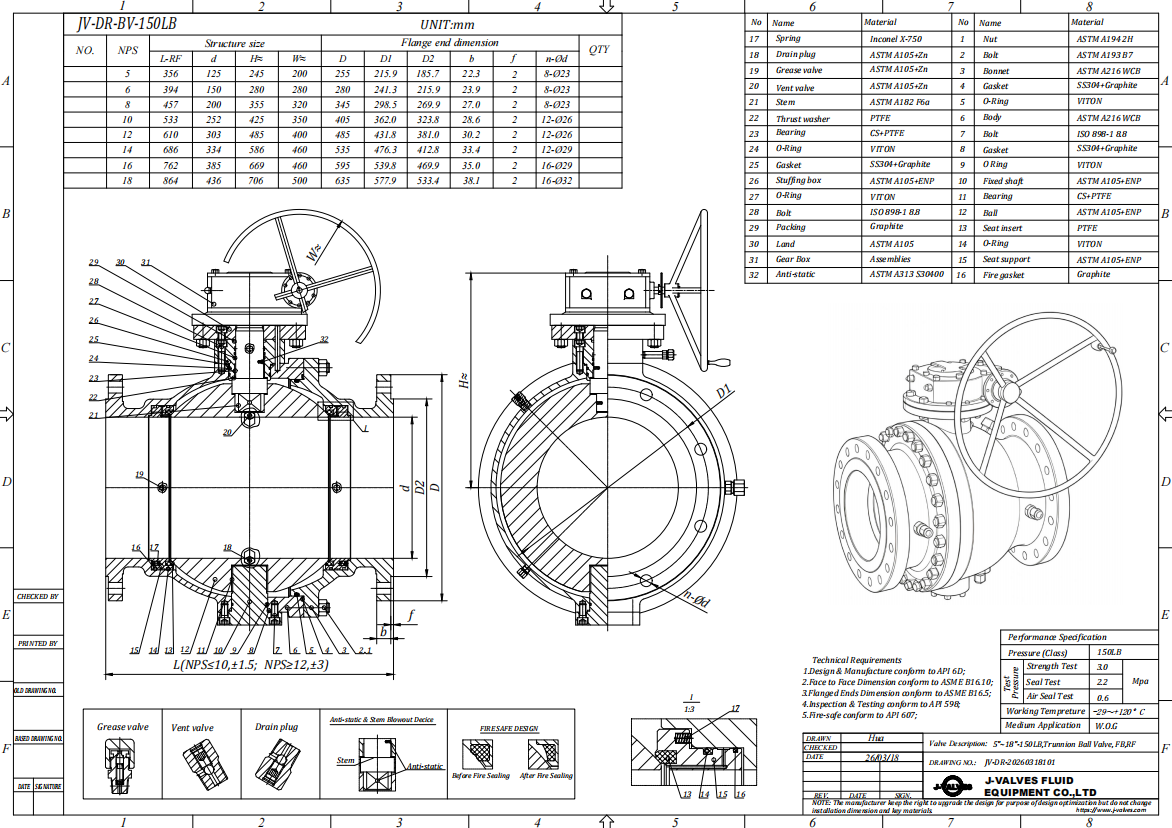
Material Options
The three materials on this build are chosen by load, and the table below is arranged that way rather than by grade family, because the question a buyer actually asks is which part does what.
| Part | Material on This Build | The Load It Carries |
|---|---|---|
| Body and end pieces | A216 WCB cast carbon steel | Pressure, and the pipe loads through the flanges |
| Ball | 410 stainless, hardened | Wear against the seat, and erosion from the medium |
| Stem | 316 stainless | Torque, and corrosion at the packing |
| Seat | Reinforced PTFE or polyimide | Sealing, and the temperature limit |
| Body joint gaskets | Spiral wound or graphited sheet | Sealing at the two joints |
| Studs and nuts | B7 with a coating | Preload at the joints and the flanges |
| Packing | PTFE or graphite | Sealing the stem at the gland |
The ball grade is the one most often misread. A 410 stainless is a martensitic chromium steel with about twelve percent chromium, and it is chosen because it can be hardened to a wear resistant surface. It is not a corrosion resistant grade in the sense that 316 is, and a valve with a 410 ball is not a stainless valve, whatever the ball is made of.
The stem grade is chosen for a different reason again. The stem is in torsion, it is the part that transmits every newton metre the operator applies, and it passes through the packing where any corrosion product becomes a leak path. A 316 stem on a carbon steel body is normal and it is not an inconsistency: the two parts see different environments and carry different loads.
Technical Specifications
| Item | Value |
|---|---|
| Size | Six inch by four inch, DN 150 by DN 100 |
| Pressure class | Class 300, PN 50 in the API 6D table |
| Rating at 38 Celsius | 51.1 bar, ASME B16.34 group 1.1 |
| Body | A216 WCB cast carbon steel, three piece |
| Bore | Reduced, four inch through a six inch body |
| Ball | 410 stainless, hardened |
| Stem | 316 stainless, bare on a four stud pad |
| Seat | Reinforced PTFE, polyimide, or metal |
| Flange | Six inch Class 300, twelve bolt holes |
| Face to face | ASME B16.10 for six inch Class 300 |
| Temperature | Minus 29 to plus 425 Celsius, seat dependent |
| Design | API 6D, ASME B16.34, API 608 |
The 51.1 bar beside Class 300 is the ASME B16.34 tabulated rating for group 1.1 at 38 Celsius, and it is worth writing out because Class 300 is routinely printed as a round 50 bar, which is a conversion rather than the table. The difference matters when a line is designed close to the limit, and it matters more when the design temperature is above ambient, because the rating falls as the temperature rises.
The twelve bolt holes on the six inch Class 300 flange are a list value from ASME B16.5, and the count is visible in the photograph. Bolt count, bolt circle, facing type and facing height are four separate checks on a flange, and a valve that matches on three of them still will not bolt up to the pipe.
Standards and Compliance
| Requirement | Document | What It Means Here |
|---|---|---|
| Product requirements | API 6D | Design, materials, marking, testing |
| Alternative product standard | API 608 | Only to DN 600 and Class 600 |
| Wall and rating | ASME B16.34 | Class 300 for the group set by WCB |
| Flanges | ASME B16.5 | Twelve bolt holes at this size and class |
| Casting quality | MSS SP-55 | Visual acceptance, level named on the order |
| Pressure test | API 598 | Shell at 1.5 times, seat at 1.1 times |
| Material certificate | EN 10204 3.1 | One line per pressure part and per trim part |
The certificate row is where the three materials become three documents. A WCB body, a 410 ball and a 316 stem come from three different mills, and each has a heat number of its own. A certificate package that covers the body and stops there has left two of the three materials unproven, and those are the two that wear.
The two standards also treat the trim differently, and that difference matters on a valve built from three materials. API 6D requires the pressure retaining parts to be traceable to their certificates and the marking to name the standard, while API 608 has its own marking requirements and its own view of what the test record has to show. A valve whose body is certified to one document and whose trim is documented to nothing has a gap that neither standard closes for the buyer.
API 608 covers this size and class, and it is the document many small and medium bore floating and trunnion valves are built to. API 6D also covers it. The two are not interchangeable in their marking and testing requirements, so the order should name one rather than accept whichever the works prefers.
Manufacturing Process
The body is cast, stress relieved and machined with the flange faces, the joint faces, the trunnion bores and the seat pockets referenced to one centreline. The ball is machined from a stainless blank, hardened, and then ground and lapped so that the sealing band is spherical to the tolerance the seat needs.
The stem is machined from bar, and the drive end is formed to the pad's drive form. The stem passes through the packing box and the gland, and the surface finish in the packing region is a sealing requirement rather than a cosmetic one, which is why the stem is one of the few parts on a carbon steel valve that is routinely specified as stainless.
Assembly stacks the seat, the ball, the second seat and the two end pieces, and the joint studs are tensioned so that the seat compression is set by the pocket depth rather than by the stud tension. That is a design point worth understanding: on a properly built trunnion valve the body joint does not adjust the seat load, and a joint tightened to stop a leak does not squeeze the seat harder.

Quality Control and Testing
| Step | Check | Acceptance |
|---|---|---|
| 1 Incoming | Heat numbers for body, ball and stem | Three certificates |
| 2 Identity | Positive material identification on the trim | Ball and stem match the order |
| 3 Machining | Ball sphericity and surface finish | Drawing |
| 4 Assembly | Seat compression set by pocket depth | Drawing |
| 5 Shell test | Body and both joints at 1.5 times | API 598, no leakage |
| 6 Seat test | Each seat at 1.1 times, both directions | API 598 rate |
| 7 Marking | Size, class, grade on the body | API 6D marking |
| 8 Final | Faces protected, bores capped, crated | Works standard |
The marking row is the one that ties the plate to the paperwork. The plate records the shell and not the trim, so a valve whose ball has been changed in service still carries the same plate. That is why the trim grade belongs on the delivery documentation and on the tag, and why a receiving inspection that reads the plate alone has checked one third of the materials.
Positive material identification on the trim is worth its cost on a valve of this kind. A 410 ball and a 316 ball look the same on the bench and behave differently in service, and the difference only shows when the medium is corrosive or the seat is metal. The check is a few minutes at the receiving dock and it settles the question for the life of the valve.

Applications and Industry Service
A six by four inch Class 300 WCB trunnion valve belongs on the medium pressure block service that makes up most of a plant: cooling water, utility headers, product lines, tank farm isolation and the isolation points around equipment. In those services the carbon steel shell is adequate, the stainless trim is what keeps the valve working, and the reduced bore is invisible because the flow is well inside the capacity of a four inch bore.
The material split on this valve is what makes it economic in that duty. A fully stainless valve would do the same job and cost a multiple of this one, and the parts that actually benefit from stainless are the two that see sliding contact and the packing gland. Putting stainless where it is needed rather than everywhere is the engineering decision behind the plate.
It is the wrong valve where the medium is corrosive enough to attack the shell, because the shell is carbon steel and no trim choice changes that. It is also the wrong valve where the line has to be pigged, because a four inch bore inside a six inch body is an obstruction that a pig will not pass.

Installation, Operation and Maintenance
The valve goes in with the pipe supported and the faces clean, and the flange studs are tensioned in a cross pattern. The body joints are not touched at installation; on a correctly built trunnion valve they are set at the works and there is no reason to break them to make a flange joint up.
Operation is a quarter turn, fully open or fully closed, and the valve is not a flow control device. The reduced bore makes the valve look like it could throttle, and it cannot: a part open ball valve puts the seat and the ball edge into the flow and erodes both, and the pressure drop through a reduced bore is a fixed cost rather than an adjustable one.
A trim replacement is the maintenance this valve actually needs. The body joints are broken, the ball and both seats come out as a set, the bore is inspected for erosion and the new trim goes in with new gaskets. The stem packing is renewed at the same time, because the packing is the other wear item and it is reached from the same strip down.
How to Specify and Order
The six entries are size, class, body grade, seat, end connection and operator, and on this valve the body grade entry has to be followed by three more lines for the trim: ball material and hardness, stem material, and seat material. Those three lines are what turn a pressure vessel into a valve, and leaving them out is how a carbon steel body ends up with a trim nobody intended.
The size has to be written as two numbers. Six by four means a six inch flange and a four inch bore, and an order that says six inch without the second number can be supplied as a full bore article which will not have the pressure drop the line was designed around, or as a different reduced bore which will have more.
Documents to name: the EN 10204 3.1 certificate for the body, the ball and the stem with three heat numbers, the positive material identification report for the trim, the MSS SP-55 acceptance level for the casting, the shell and seat test record, and the general arrangement drawing with the face to face dimension, the bore and the pad size for the operator.
FAQ
Q: Is this a stainless valve because the ball is stainless?
A: No. The shell is A216 WCB cast carbon steel and that is what decides the corrosion allowance and the medium the valve can carry. A 410 ball is chosen for wear resistance, not for corrosion resistance, and a stainless ball on a carbon steel body does not make a stainless valve.
Q: Why is the ball 410 rather than 316?
A: Because the ball sliding against the seat is a wear pair, and a martensitic chromium steel can be hardened to resist that wear. A 316 ball is more corrosion resistant and softer, which is the wrong trade on a valve whose seat is doing the wiping.
Q: Why is the stem 316 on a carbon steel body?
A: Because the stem passes through the packing and carries the whole operating torque. The packing region is where a corrosion product becomes a leak, and the stem is the one part of the pressure boundary that also has to be a torsion member, so it is specified for both.
Q: What sets the temperature limit of this valve?
A: The seat, not the body. WCB holds its strength well above the point where a polymer seat has extruded, so a valve ordered with a reinforced PTFE seat has a service temperature set by the polymer while the certificate still describes a carbon steel body.
Q: How many bolts does the six inch Class 300 flange have?
A: Twelve, and the count is visible in the photograph. Bolt count, bolt circle, facing type and facing height are four separate checks on a flange, and a valve that matches on three of them still will not bolt up.



Hot Products


News
Your Ball Valve Is Not A Test Blind: What A Hydrotest Does To The Seats
A line test puts pressure on the wrong side of the seat logic, above the valve's own seat test, with water that stays in the pocket. What to arrange instead.
Read More
Remanufactured Ball Valves: Five Checks That Decide Whether A Rebuild Deserves A Certificate
A rebuild at 45 percent of price with half the life is no saving. Five checks that separate a real remanufacture from a repaint with a certificate.
Read More
The Squeeze Is A Residual: How Tolerance Stack-Up Decides Whether A Ball Valve Seals
No dimension sets the seat squeeze. Five tolerances do, in series. Why identical valves feel different, and why a new ball changes the arithmetic.
Read More
Why A Ball Valve Gets Harder To Turn: Five Causes, And The Test That Tells Them Apart
A ball valve that stiffens over months points at one of five parts. Measure torque with the line pressurised and again vented, and the split becomes visible.
Read More