


Introduction
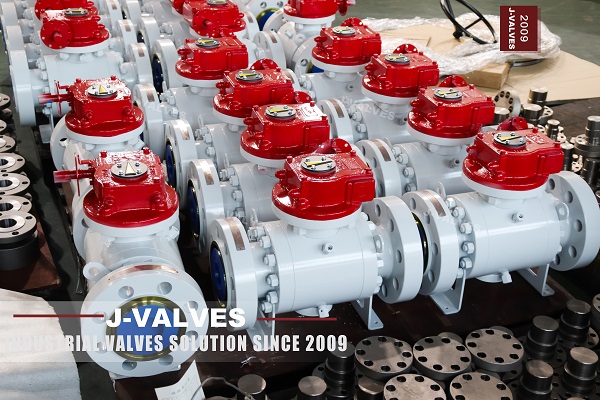
In high-pressure pipeline systems, valve reliability and sealing performance are critical for safe operation. The Trunnion Mounted Ball Valve has become a preferred solution for oil & gas, LNG, petrochemical, and industrial applications due to its stable structure, low operating torque, and long service life.
Unlike floating ball valves, the ball of a trunnion mounted ball valve is fixed by upper and lower trunnions, reducing seat load and improving performance under high-pressure conditions.
As a professional valve manufacturer, J-VALVES provides high-quality API 6D Trunnion Mounted Ball Valves designed for demanding pipeline applications.
1. Structural Advantages of Trunnion Mounted Ball Valve
A trunnion mounted ball valve consists of:
Valve body
Fixed ball
Trunnion support
Stem
Seat assembly
Actuator system
The fixed ball structure provides better mechanical stability compared with floating ball valves.
Key advantages include:
Lower operating torque
Reduced seat wear
Better pressure resistance
Longer service life
This design is especially suitable for large diameter and high-pressure pipeline systems.
2. Sealing Performance and Safety Features
Reliable Seat Sealing
Trunnion mounted ball valves usually adopt spring-loaded seats to maintain continuous contact with the ball.
Benefits include:
Reliable sealing at different pressures
Compensation for seat wear
Reduced leakage risk
Double Block and Bleed Capability
For critical applications, trunnion ball valves can be designed with DBB functions, allowing:
Double isolation
Cavity pressure release
Safer pipeline maintenance
Fire Safe and Anti-Static Design
J-VALVES trunnion mounted ball valves can be manufactured with fire-safe and anti-static structures according to international standards, improving operational safety in hazardous environments.
3. Applications of Trunnion Mounted Ball Valve
Oil and Gas Pipelines
Trunnion mounted ball valves are widely used in:
Natural gas transmission pipelines
Crude oil pipelines
Pipeline stations
Storage facilities
Their strong structure ensures reliable shut-off under continuous operation.
LNG and Petrochemical Systems
Due to their excellent sealing performance and durability, these valves are suitable for:
LNG transportation systems
Refinery pipelines
Chemical process equipment
4. J-VALVES Advantages in Trunnion Mounted Ball Valve Manufacturing
Professional Design Capability
J-VALVES designs trunnion mounted ball valves according to international standards, including:
API 6D
ASME B16.34
ISO 14313
The valve structure is optimized for safety, reliability, and easy maintenance.
Advanced Manufacturing and Testing
J-VALVES applies strict quality control procedures, including:
Material inspection
CNC machining
Assembly inspection
Hydrostatic testing
Seat leakage testing
Every valve is tested to ensure reliable performance.
Customized Solutions
J-VALVES provides customized options including:
Carbon steel and stainless steel materials
Different pressure classes
Pneumatic, electric, and hydraulic actuators
Special temperature applications
Conclusion
The Trunnion Mounted Ball Valve provides excellent performance for high-pressure and large-diameter pipeline systems through its fixed ball structure, low torque operation, and reliable sealing capability.
Compared with floating ball valves, trunnion designs offer better stability and longer service life, making them widely used in oil & gas, LNG, and petrochemical industries.
With professional manufacturing experience and strict quality control, J-VALVES delivers reliable API 6D Trunnion Mounted Ball Valve solutions for critical industrial applications worldwide.


