Introduction
Large diameter pipeline systems require valves that can deliver high strength, reliable sealing, low operating torque, and long service life under demanding pressure conditions. The trunnion mounted ball valve (TMBV) is widely recognized as one of the most reliable solutions for high-pressure and large-bore pipeline isolation.
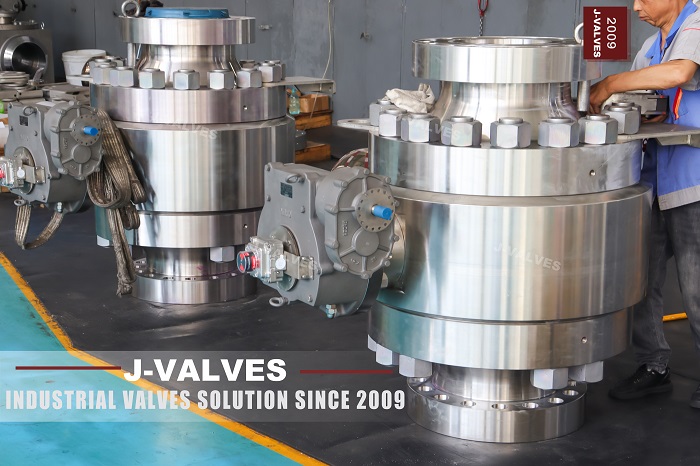
The valve shown represents a large diameter trunnion mounted ball valve designed for industrial pipeline systems, typically used in oil & gas transmission, petrochemical plants, LNG terminals, and offshore platforms. J-VALVES, a professional industrial valve manufacturer since 2009, provides engineered trunnion ball valves that comply with API 6D, API 608, API 598, and ASME B16.34 standards, ensuring global reliability and safety.
What Is a Large Diameter Trunnion Mounted Ball Valve?
A trunnion mounted ball valve is a quarter-turn valve in which the ball is mechanically supported by upper and lower trunnions. Unlike floating ball valves, the ball does not move freely under pressure.
Key characteristics include:
Fixed ball supported by trunnion structure
Pressure-assisted sealing system
Low operating torque even in large sizes
Suitable for high-pressure and large-diameter pipelines
Large diameter versions are typically used in DN400 to DN1200+ pipeline systems.
Engineering Advantages of Large Diameter Design
1. Stable Operation Under High Pressure
In large diameter pipelines, internal pressure force increases significantly. The trunnion structure ensures:
Mechanical support of the ball
Reduced seat stress
Stable sealing performance under high pressure
This makes it suitable for Class 150–Class 2500 applications depending on design configuration.
2. Low Operating Torque
One of the most important advantages is reduced torque requirement.
Ball is fixed, not floating
Seats are spring-loaded or pressure-assisted
Friction is minimized during operation
This allows manual, gear-operated, or actuator-driven systems even in large sizes.
3. Bi-Directional Sealing Performance
J-VALVES trunnion mounted ball valves provide:
Tight shut-off in both flow directions
Reliable sealing under pressure fluctuation
Reduced leakage risk in pipeline isolation
4. Fire-Safe and Emergency Reliability
For oil & gas applications, fire-safe design is essential.
Typical features include:
API 607 / API 6FA fire-safe compliance
Anti-blowout stem design
Secondary metal sealing in emergency conditions
API & ASME Standard Compliance
J-VALVES large diameter trunnion ball valves are engineered under strict international standards:
API 6D – Pipeline valve specification
API 608 – Metal ball valve design
API 598 – Pressure testing requirements
ASME B16.34 – Pressure-temperature rating design
ASME B16.5 / B16.47 – Flange connection standards
These standards ensure safe operation in critical pipeline systems worldwide.
Material Selection for Large Diameter Trunnion Ball Valves
To meet different industrial environments, J-VALVES offers multiple material options:
Carbon steel (WCB, WCC, A105)
Low temperature steel (LF2, LCC)
Stainless steel (304, 316)
Duplex stainless steel (F51, F53)
C95800 Nickel Aluminum Bronze (marine applications)
Each material is selected based on pressure, temperature, and corrosion requirements.
Industrial Applications
Large diameter trunnion mounted ball valves are widely used in:
Oil & Gas Transmission
Long-distance crude oil pipelines
Natural gas trunk lines
Pumping and compressor stations
LNG Systems
Storage tank inlet/outlet isolation
Cryogenic pipeline control
Loading/unloading terminals
Petrochemical Plants
Reactor isolation systems
High-pressure process lines
Offshore Engineering
Seawater injection systems
Firewater networks
Utility pipeline isolation
J-VALVES Engineering Advantages
1. Precision Manufacturing
Advanced CNC machining ensures:
Accurate ball-roundness control
Tight sealing surface tolerance
Stable torque performance
2. Advanced Seat Technology
Options include:
Soft seated (PTFE / RPTFE) for zero leakage
Metal seated for high temperature service
Double piston effect (DPE) design for enhanced sealing
3. Strict Quality Control
Each valve undergoes:
Hydrostatic shell test
Seat leakage test
Torque testing
Dimensional inspection
4. Project Experience
J-VALVES products are widely used in global EPC projects including offshore platforms, LNG terminals, and refinery systems.
Advantages in Real Industrial Operation
Large diameter trunnion ball valves provide:
Reduced pipeline pressure loss
Improved safety during isolation
Lower maintenance frequency
Extended service life in harsh conditions
These benefits make them a preferred solution in critical energy infrastructure.
Conclusion
Large diameter trunnion mounted ball valves are essential components in modern high-pressure pipeline systems. Their mechanical stability, low torque operation, and reliable sealing performance make them ideal for demanding industrial applications.
With full compliance to API and ASME standards, advanced engineering design, and proven project experience, J-VALVES delivers high-performance trunnion mounted ball valves that ensure safety, efficiency, and long-term reliability in global oil & gas, LNG, petrochemical, and offshore industries.