


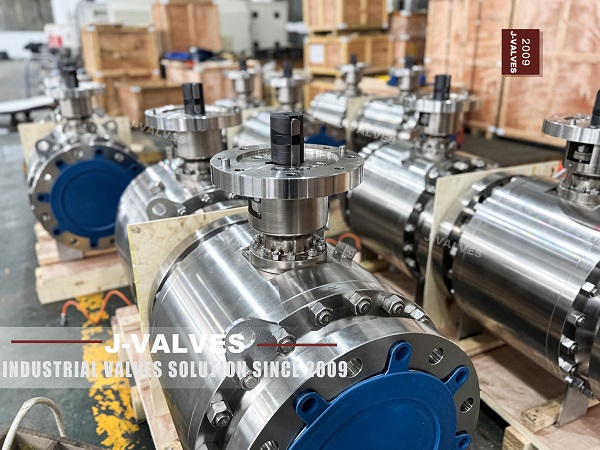
Where soft seats stop working
Soft seats are the default because they seal with very little force, but they have a hard ceiling. PTFE degrades well below the upper end of the temperature range, RPTFE extends that limit modestly, and PEEK pushes it further, yet all three remain polymers. Above their limits the seat deforms, extrudes or carbonises and the valve loses its seal. Abrasive media cause a second and independent failure: particles cut and score a soft seat far more quickly than a metal one. Where temperature and abrasion combine, a metal seated design becomes the only practical choice. The full J-VALVES range runs from -196 C to 650 C, and metal seating is what makes the top of that range achievable.
Metal seat designs compared
Metal seated ball valves fall into a few families. A simple metal-to-metal seat relies on lapped surfaces and close machining tolerance; it is robust but needs higher operating force. A metal seat with a coated or inserted sealing surface improves tightness while keeping metal behind the seat. A spring-loaded design uses a flexible element to keep the seat in contact as temperature changes. Some designs add a secondary soft insert for low-pressure tightness while retaining metal for high-temperature duty. The choice depends on the required leakage class, the temperature cycle and whether the medium is abrasive. In most specifications the seat and ball are lapped to a defined surface finish, because tightness in metal seating depends as much on finish as on geometry.
Hard facing and coating options
Hard facing and coatings raise the surface hardness of the ball and seat and extend life in abrasive service. Common approaches include tungsten carbide based coatings, chromium carbide, nickel-based hard facing alloys and hard chrome plating on the ball. Coating thickness and bond quality matter more than the headline hardness number, because a coating that spalls will fail faster than an uncoated part. Surface finish after coating also matters: a lapped finish is required to reach a tight leakage class. Coating selection should also consider corrosion, because a hard coating on a corrosive medium can fail at the coating interface rather than at the surface itself. The right choice is matched to the medium and to the number of operating cycles the valve is expected to see in its life.
Torque and actuator consequences
Metal seats need more force to seal, and that force appears as torque. Break torque and running torque are both higher than for a soft-seated valve of the same size, and torque rises further at temperature extremes as clearances and lubrication change. The result is a larger actuator, higher air consumption and, in some cases, a different mounting interface. Designers should size the actuator from the break torque with a safety factor rather than from the running torque, because the moment of opening is when the valve is most likely to stall. A valve that opens smoothly in the workshop can still stall on site if the actuator was sized from the wrong figure.
Applications: steam, hydrogen, slurry and solids
Metal seated ball valves fit several demanding duties. In steam service the temperature alone rules out standard soft seats, and metal seating keeps tightness through thermal cycling. In hydrogen service, where permeation and rapid pressure changes are concerns, metal seats avoid the swelling that affects polymers. In slurry and solids handling, metal seats resist the cutting action that destroys soft seats, and a coated ball extends life further. These duties usually also require fire-safe qualification to API 607 or ISO 10497, and the same metal sealing path that delivers high-temperature performance supports that claim. J-VALVES builds metal seated ball valves across 1/2 to 56 inch and Class 150 to 2500.
Frequently Asked Questions
What leakage class can a metal seated ball valve achieve? It depends on the seat design. A simple lapped metal-to-metal seat typically achieves ISO 5208 Rate D to Rate C. A coated seat, or one with a lapped sealing surface, can reach Rate C to Rate B, and a spring-loaded or soft-inserted design can approach Rate A at lower pressures. The required class should always be stated on the datasheet.
Why does metal seating increase torque? Metal seats need higher contact force to seal than soft seats, because there is no compliant material to fill surface imperfections. That higher force appears directly as break torque and running torque, so the result is a larger actuator and greater air consumption. Actuators should be sized from break torque with a safety factor rather than from running torque alone.
Can metal seats be refurbished? Often, yes. Lapped metal seats and coated balls can be re-machined or re-lapped, and worn coatings can be stripped and reapplied, provided the base material retains enough thickness after machining. Refurbishment is usually more economical on larger valves. The decision depends on the remaining wall and coating allowance and on whether the original leakage class must be restored.


