


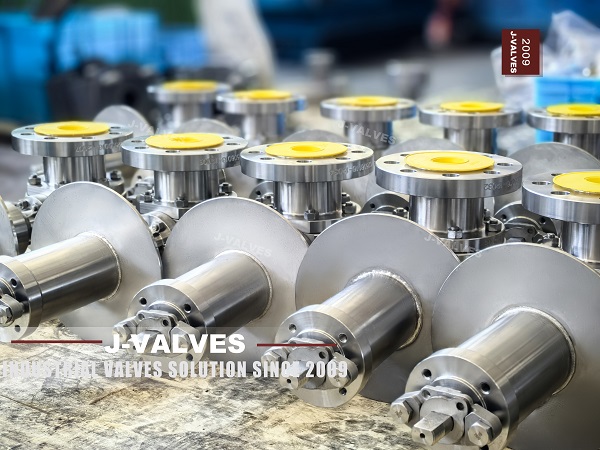
What changes when the valve goes cold
Cold changes three things at once: material toughness, sealing behaviour and the amount of heat that reaches the valve stem. Ordinary carbon steel becomes brittle at cryogenic temperature, so the material selection changes completely below roughly -46 C. Soft seats contract and lose elasticity, which weakens the seal unless the design compensates for it. Frost and ice form on any exposed surface, and the packing and the operator must be kept clear of that build-up. The valve also has to remain operable while it is cold, which is a separate requirement from sealing and is checked on its own during qualification. BS 6364 is the standard that addresses these points for ball valves in cryogenic service. J-VALVES operates its own cryogenic laboratory with liquid nitrogen testing down to -196 C.
The three jobs of an extended bonnet
An extended bonnet does three jobs. First, it puts distance between the cold body and the stem seal, so the packing and gland operate at a temperature where the material still works. Second, it allows the body to be insulated while the operator stays outside the insulation and remains accessible. Third, it manages the thermal gradient so that ice does not build up around the stem. The bonnet length is chosen so that the top of the extension stays above the frost line in normal service. A short bonnet may pass a factory test and still ice up in the field, which is why length is specified rather than left to the manufacturer.
Material behaviour at cryogenic temperature
Material selection is driven by impact toughness. Austenitic stainless steels such as 316 remain tough at low temperature and are common for the body and trim. For the coldest duty, aluminium alloys such as ASTM B148 and copper alloys such as ASTM B62 appear in specific components, and the material list in the standard is matched to the service temperature. Impact testing is required to prove toughness at the design minimum. Soft seat materials are chosen for low-temperature elasticity; PTFE, RPTFE and PEEK are used depending on the temperature and pressure. Thermal contraction also changes clearances, so the design must keep the seat loaded as the parts shrink, which is why spring assistance appears in many cryogenic seat designs. Standard carbon steel is not acceptable at -196 C.
Cryogenic test procedure and acceptance
Cryogenic testing is performed with the valve at the service temperature, normally using liquid nitrogen. The valve is cooled to the design minimum, held there, and pressure tested while still cold; both shell and seat performance are checked. Testing cold matters because a valve that seals at ambient temperature can leak once the seats have contracted. The acceptance criteria are the specified leakage rates, and operation of the valve is confirmed while it is cold. J-VALVES applies a shell test at 1.5 times the rated pressure and a seat test at 1.1 times the rated pressure, with the low-temperature tests performed in its own laboratory.
Installation practice: insulation, purging, orientation
Installation decides whether a correctly built cryogenic valve performs. The body is insulated, but the extended bonnet must be left partly exposed so that the seal area stays warm and frost does not reach the packing. The line is purged to remove moisture before cooldown, because trapped water freezes and can jam the valve. Orientation is normally set so the bonnet points upward or to the side, keeping the stem seal clear of liquid. Bolting is tightened to the specified torque and rechecked after the first cooldown, since thermal contraction loosens joints. Vapour barriers and closed cell insulation are common, and any gap that lets moist air reach a cold surface will produce ice, so insulation continuity matters as much as insulation thickness. J-VALVES builds cryogenic ball valves to BS 6364 across 1/2 to 56 inch and Class 150 to 2500, in NACE MR0175 materials where the service also requires sour resistance.
Frequently Asked Questions
Why is an extended bonnet required for cryogenic valves? The extension keeps the stem seal away from the cold body so the packing operates at a temperature where it still works, and it allows the body to be insulated while the operator stays accessible. It also manages the thermal gradient so ice does not build up around the stem. A short bonnet can pass a factory test and still ice up in service.
How is a cryogenic test performed? The valve is cooled to the design minimum temperature, normally using liquid nitrogen, and pressure tested while it is still cold. Both shell and seat performance are checked, and the valve is operated at temperature to confirm it still works. Testing cold is essential because a valve that seals at ambient temperature can leak once the seats have contracted.
Can standard carbon steel be used at -196 C? No. Standard carbon steel becomes brittle at cryogenic temperature and is not acceptable at -196 C. Austenitic stainless steels are the usual choice because they remain tough at low temperature, and impact testing is required to prove toughness at the design minimum. Aluminium bronze and copper alloys appear in specific components where the standard permits them.


