


CHINA J-VALVES Offers Various High-quality I ndustrial Ball Valves
J-VALVES, a distinguished professional ball valve manufacturer rooted in China, takes pride in its extensive product portfolio. Our offerings span a wide range, including trunnion-mounted ball valves, floating ball valves, high-temperature ball valves, high-pressure ball valves, metal-sealed ball valves, ultra-low temperature ball valves, DBB ball valves, Three-way And Four-way Ball Valve, and fully welded ball valves. Each product is a testament to our commitment to precision engineering and reliable performance. Meticulously crafted, they are designed to not only meet but exceed the most stringent industrial demands, ensuring stable operation even under extreme conditions. This enables us to provide our clients with high-value services and makes our valves widely sought-after in industries.
Product Category
Contact Us


-
J-VALVES-Q47F
-
J-VALVES
Overview of the J-VALVES two inch Class 1500 A105N forged ball valve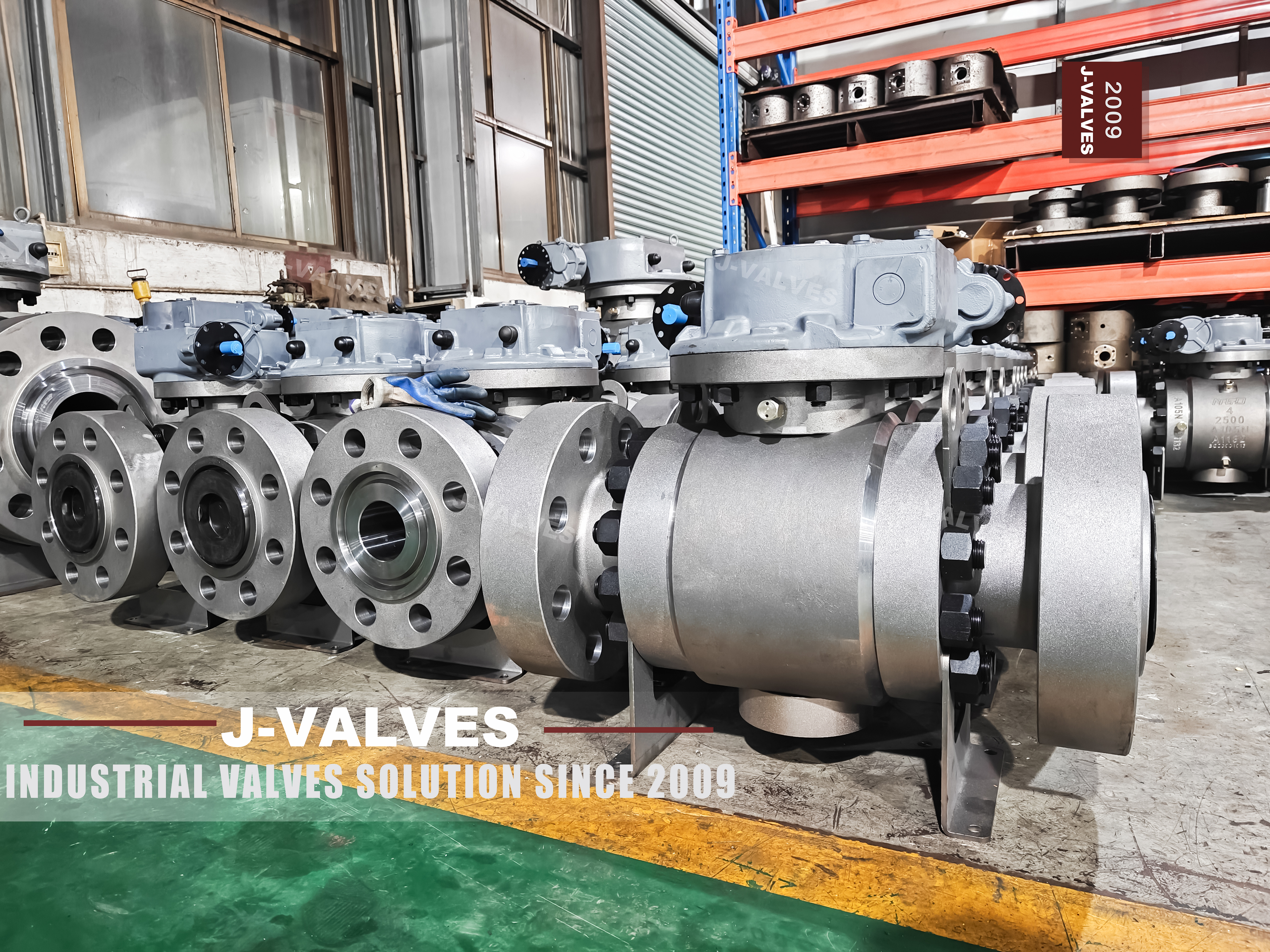
Class 1500 is a row in a table. It becomes a pressure only when two more things are supplied: a material and a temperature. The page under discussion converts it three times, and each conversion fails in a different way, which makes it a useful page to read carefully. Written that way, Class 1500 stops being a number that can be converted three ways and becomes a valve: a two inch normalized A105N forged body, a trunnion ball on named seats, ends to a named standard, bolting with a stated grade and a stated hardness, and a temperature window that belongs to the seat rather than to the plate.
The second conversion is the class to a pressure in megapascals. The page prints 25.5 MPa at ambient temperature. That is a real arithmetic result from a real table row, and it is still the wrong kind of number to print, because a class has no single pressure: the allowable stress of the material falls as the temperature rises, and the table is a column of pressures against temperatures. The number at ambient is the top of the column, not the rating.
The third is the least obvious and the most consequential. The page names API 608 as a design standard. API 608 covers steel ball valves from DN 15 to DN 600 in Class 150 to Class 600. At 1500 the document does not reach, and the ball valve standard that does is API 6D. A page can carry both names and be describing a family; a two inch 1500 valve cannot be built to a document whose scope stops at 600.
The valve itself is a small bore, high class, forged carbon steel body in the normalized condition, with a trunnion mounted ball, ends that the table lists as threaded, socket weld or butt weld, and a bare stem on a mounting pad in the photographs.
Design and Construction
At two inch and Class 1500 the proportions surprise people who have not handled one. The flanges are large, the body is short and thick, and the ball inside is smaller than the flanges suggest. Most of the metal is there to hold the pressure at the joints rather than to contain the bore, which is why a high class small valve looks overbuilt and is not.
The ball is carried on a stem above and a trunnion below, so the seats do not have to hold it up. That matters more at high differential pressure than at high class: a floating ball at 1500 would push its downstream seat with the full line pressure behind the bore area, and the seat would be loaded far beyond what a polymer can carry without extruding.
The ends are the part of this page that does not match its own photographs. The table offers NPT, socket weld and butt weld. The photographs show a flanged body. Both can be true of the same product family and only one can be true of a single valve, which is why the end line on an order is not a formality.
A threaded end at 1500 class also raises a question the table does not answer. The thread standard that the page cites defines the thread form and the gauging and says nothing about pressure. A valve whose ends are threaded is rated for its body and, at the joint, by whatever the piping can hold, which is a different statement from a class.

Material Options
A105N is the normalized version of the standard forged carbon steel, and the N is a condition rather than a grade. Normalizing refines the grain and relieves forging stress, which changes toughness at the low end of the range and the hardness the certificate reports, without changing the chemistry.
| Part | Material on This Build | What It Decides |
|---|---|---|
| Body | Normalized forged A105N | Shell strength and low temperature toughness |
| Ball | A105N with ENP, F304 or F316 | Wear at the band, and corrosion if stainless |
| Stem | F6a, F304 or F316 | Strength at the drive and corrosion at the packing |
| Seats | RPTFE, PEEK, or metal with a cobalt based overlay | Temperature and tightness |
| Packing | PTFE V rings, graphite, or graphite with wire reinforcement | Stem sealing at temperature |
| Bolting | A193 B7, or B7M for sour service | Preload, and resistance to cracking |
| Gasket | Spiral wound with graphite | The body joints |
The bolting line is the one that gets copied without thought, and the two grades are not interchangeable. B7 is the standard chrome moly bolting and it is the ordinary choice for a dry line at this class. B7M is the same chemistry with a cap on hardness, and the cap exists because a hard bolt is the part that cracks in wet sour service. The cost of that cap is tensile strength, so B7M is specified when the medium asks for it rather than when the class is high.
The seat line carries the same logic as every other ball valve page and it is worth repeating because it is where the temperature window comes from. A polymer seat conforms and is limited by the temperature at which it stops recovering; a metal seat does not conform and is limited by the leakage rate it will pass. The page lists reinforced PTFE, PEEK and metal, and those three are three different products.
The ball grade choice interacts with the seat. A polymer seat against a stainless ball is a normal combination. A metal seat against a stainless ball needs a hardness difference between the two, or the two faces will gall and the seat will be destroyed by the first few cycles rather than by the medium.
Technical Specifications
The table keeps the page entries and puts the class conversions on separate lines so that the correct one can be quoted.
| Item | Value |
|---|---|
| Size | Two inch, DN 50 |
| Pressure class | Class 1500 |
| Class to PN | PN 250, per API 6D clause 7.2 |
| The page's PN | PN 260, which appears in neither 6D nor EN 1092-1 |
| The page's pressure | 25.5 MPa at ambient, a conversion rather than a rating |
| Body | Normalized forged A105N |
| Ends the page lists | NPT, socket weld, butt weld |
| Ball | A105N with ENP, F304 or F316 |
| Stem | F6a, F304 or F316 |
| Seats | RPTFE, PEEK, or metal with a cobalt based overlay |
| Temperature | Minus 29 to plus 425 Celsius, a body figure |
| Design | API 6D and ASME B16.34 |
| Test | API 598 and API 6D |
The temperature range printed on the page is a body figure and it does not survive contact with the seat list. At 425 Celsius a reinforced PTFE seat is long out of service and a PEEK seat is past its continuous limit, so the only seat that reaches the top of that range is the metal one. That is not a contradiction in the valve; it is a contradiction in reading one number as if it applied to three different builds.
The size line is exact, because two inch is two inch. Everything that follows from it, however, depends on the bore: a full bore two inch valve and a reduced bore two inch valve at the same class are different bodies with different balls and different torques, and the page does not say which one it is selling.
Standards and Compliance
Four documents do the work on this valve, and the scope of each is worth setting out because one of them does not apply.
| Document | What it fixes | What it does not fix |
|---|---|---|
| API 6D | Valve requirements for pipeline service, including fire test | Seat material or a seat temperature |
| ASME B16.34 | Wall, material groups, class ratings | The ends or their threads |
| API 598 | Shell and seat test procedure and acceptance | The valve design |
| ASME B16.10 | Face to face for flanged valves | Threaded or weld end lengths |
| ASME B1.20.1 | NPT thread form and gauging | A pressure rating for a threaded joint |
| API 608 | Ball valves to DN 600, Class 150 to Class 600 | A Class 1500 valve |
The 608 line is the one to remove from this page rather than to explain. A document's scope is a boundary, not a preference, and a valve cannot be to a standard that does not cover its class. If the intention was to say that the same works builds smaller valves to 608, that is a statement about the factory and it belongs in a sentence, not in a design standard field.
The threaded end line is the other boundary worth naming. ASME B1.20.1 defines the taper, the thread form and the gauges, and it deliberately does not assign a pressure rating, because the pressure a threaded joint can hold depends on the pipe, the sealant and the make up. A valve rated by its body and joined by threads is a valve with two different limits, and the lower one is at the joint.
The fire test belongs to the valve and it is a type test. API 6D names its own fire test document, and the qualification is on a design and a size, so a certificate is evidence about the design rather than about the unit. Where a project needs unit testing, that is a separate requirement and it has to be written into the order.
Manufacturing Process
The body starts as a forged billet or a die forging. A die forging is closer to the finished shape and keeps the grain flow following the contour, which is what the page means when it says the structure is dense; a billet removes more material and cuts across the flow, which is acceptable at small sizes and less so as the class rises.
After forging, the body is normalized as a recorded cycle with a chart, and that chart is what turns the N on the certificate into evidence. A grade written as A105 without the N and a grade written as A105N are the same chemistry and different conditions, and the difference only exists if the heat treatment is documented.
Machining establishes the bore axis and both flange faces from the same setup where possible, then cuts the seat pockets from the joint faces. On a body this short and this thick, the risk is not deflection but heat: a pocket cut without coolant in a heavy section will move when it cools, and a pocket that has moved is a seat that sits at an angle.
The ball is turned, ground and lapped, then plated if the build calls for ENP. Plating after lapping would leave a coating over the geometry that was just produced, so the order is grind, plate where specified, then lap the band. The stem is machined from bar, its square is cut after the packing gland face, and the assembly is tested before the operator is fitted.

Quality Control and Testing
The shell test is applied with the ball open at the multiple of the class that the test standard names, and both body joints are watched. A shell test on a body this size is quick, which is why there is no excuse for skipping the joint watch or for testing with the valve already painted. Written that way, Class 1500 stops being a number that can be converted three ways and becomes a valve: a two inch normalized A105N forged body, a trunnion ball on named seats, ends to a named standard, bolting with a stated grade and a stated hardness, and a temperature window that belongs to the seat rather than to the plate.
Non destructive examination is the step that a high class forging earns and a casting does not. The body can be examined by magnetic particle or ultrasonic methods before machining, and the stem and the ball by dye penetrant after. What is examined, and to what acceptance level, belongs on the order because the page does not state it. Written that way, Class 1500 stops being a number that can be converted three ways and becomes a valve: a two inch normalized A105N forged body, a trunnion ball on named seats, ends to a named standard, bolting with a stated grade and a stated hardness, and a temperature window that belongs to the seat rather than to the plate.

Applications and Industry Service
High pressure gas is the ordinary duty: wellhead and gathering lines, injection skids, and the small bore isolation points around compressors. At two inch and 1500 class the valve is usually doing isolation rather than control, and it is usually bought in a size that matches an existing line rather than chosen from a range. Written that way, Class 1500 stops being a number that can be converted three ways and becomes a valve: a two inch normalized A105N forged body, a trunnion ball on named seats, ends to a named standard, bolting with a stated grade and a stated hardness, and a temperature window that belongs to the seat rather than to the plate.
Test benches and high pressure test loops are the third, and they are a different kind of duty: frequent cycling, clean medium, and a valve that is expected to seal dead tight every time. A metal seat is the wrong choice there for the tightness reason, and a polymer seat is the wrong choice at temperature. Written that way, Class 1500 stops being a number that can be converted three ways and becomes a valve: a two inch normalized A105N forged body, a trunnion ball on named seats, ends to a named standard, bolting with a stated grade and a stated hardness, and a temperature window that belongs to the seat rather than to the plate.

Installation, Operation and Maintenance
A threaded installation is made up to the standard the order named, with a sealant suited to the medium, and the body is supported so the pipe does not hang from the threads. A taper thread seals in the thread and a parallel thread seals on a face, and mixing the two produces a joint that either will not seal or will not come apart.
A socket weld or butt weld installation has its own rules on fit up and root gap, and the valve should be in the open position while welding so that heat does not distort a seat that is already lapped. Welding a closed valve is a way to make a leaking valve out of a good one without any visible damage. Written that way, Class 1500 stops being a number that can be converted three ways and becomes a valve: a two inch normalized A105N forged body, a trunnion ball on named seats, ends to a named standard, bolting with a stated grade and a stated hardness, and a temperature window that belongs to the seat rather than to the plate.
Maintenance reaches the packing from the top and the seats through the body joints, and the joints are renewed whenever the body is opened. On a high class valve the parts that are replaced are usually the seats, the gaskets and the packing, and the body, ball and stem are inspected and returned to service.
How to Specify and Order
The lines below are the ones the page's three conversions do not settle, and the first two are the ones that decide whether the quotation is for the right valve.
| Line on the order | What to write | Why it matters |
|---|---|---|
| Class and size | Class 1500, two inch, with the bore | The bore changes ball, body and torque |
| End form | Threaded, socket weld or butt weld, with the standard | The page and its photographs disagree |
| Seat material | RPTFE, PEEK, or metal | It sets the temperature window |
| Bolting | B7, or B7M with a hardness result | B7M is bought for its hardness cap |
| Examination | Method and acceptance level | The page does not state one |
| Operator | Lever, gear, or actuator with a failure position | The pad follows the bracket |
Written that way, Class 1500 stops being a number that can be converted three ways and becomes a valve: a two inch normalized A105N forged body, a trunnion ball on named seats, ends to a named standard, bolting with a stated grade and a stated hardness, and a temperature window that belongs to the seat rather than to the plate.
FAQ
Q: Is Class 1500 PN 250 or PN 260?
A: PN 250. The seven line table in API 6D clause 7.2 pairs 1500 with PN 250, and EN 1092-1 carries PN 250 as well. PN 260 does not appear in either document. It looks like a rating converted into bar and then rounded, and it has no place on a nameplate or in an enquiry.
Q: Is 25.5 MPa the working pressure?
A: It is a conversion, not a rating. A class becomes a pressure only when a temperature is named, because the allowable stress of the material falls as the temperature rises. The number to use is the table row for the material group at the design temperature, and the conversion at ambient is the highest number in that row rather than the only one.
Q: Can a Class 1500 valve cite API 608?
A: No. API 608 covers steel ball valves from DN 15 to DN 600 in Class 150 to Class 600. At 1500 the only ball valve standard left in this family is API 6D, and a page that lists both at 1500 is describing a scope that does not exist.
Q: Does the N in A105N do anything at ambient?
A: It is a heat treatment condition rather than a grade, and at ambient it changes little. What it changes is toughness at the low end of the range and the hardness that the certificate reports. Normalizing refines the grain and relieves forging stress, which is why the same page offers it for low temperature and for welded installation.
Q: B7 or B7M for the body bolts?
A: B7M is the same chemistry with a cap on hardness, and the cap exists for wet sour service where a hard bolt is the part that cracks. The cost is tensile strength. On a dry 1500 class line B7 is the ordinary choice, and B7M is specified when the medium, not the pressure, asks for it.


Hot Products


News
Direct Air Capture Ball Valves The Vacuum Side Runs The Seal Backwards, And Three Hundred Thousand Strokes Decide The Design
A solid sorbent DAC plant moves 1.3 million cubic metres of air per tonne of CO2, then asks a DN50 ball valve to hold 0.9 bar from the wrong side.
Read More
Your Ball Valve Is Not A Test Blind: What A Hydrotest Does To The Seats
A line test puts pressure on the wrong side of the seat logic, above the valve's own seat test, with water that stays in the pocket. What to arrange instead.
Read More
Remanufactured Ball Valves: Five Checks That Decide Whether A Rebuild Deserves A Certificate
A rebuild at 45 percent of price with half the life is no saving. Five checks that separate a real remanufacture from a repaint with a certificate.
Read More
The Squeeze Is A Residual: How Tolerance Stack-Up Decides Whether A Ball Valve Seals
No dimension sets the seat squeeze. Five tolerances do, in series. Why identical valves feel different, and why a new ball changes the arithmetic.
Read More