

CHINA J-VALVES Offers Various High-quality I ndustrial Ball Valves
J-VALVES, a distinguished professional ball valve manufacturer rooted in China, takes pride in its extensive product portfolio. Our offerings span a wide range, including trunnion-mounted ball valves, floating ball valves, high-temperature ball valves, high-pressure ball valves, metal-sealed ball valves, ultra-low temperature ball valves, DBB ball valves, Three-way And Four-way Ball Valve, and fully welded ball valves. Each product is a testament to our commitment to precision engineering and reliable performance. Meticulously crafted, they are designed to not only meet but exceed the most stringent industrial demands, ensuring stable operation even under extreme conditions. This enables us to provide our clients with high-value services and makes our valves widely sought-after in industries.
Product Category
Contact Us

-
J-VALVES-Q11F
-
J-VALVES
Overview of the J-VALVES DIN three piece stainless steel floating flange ball valve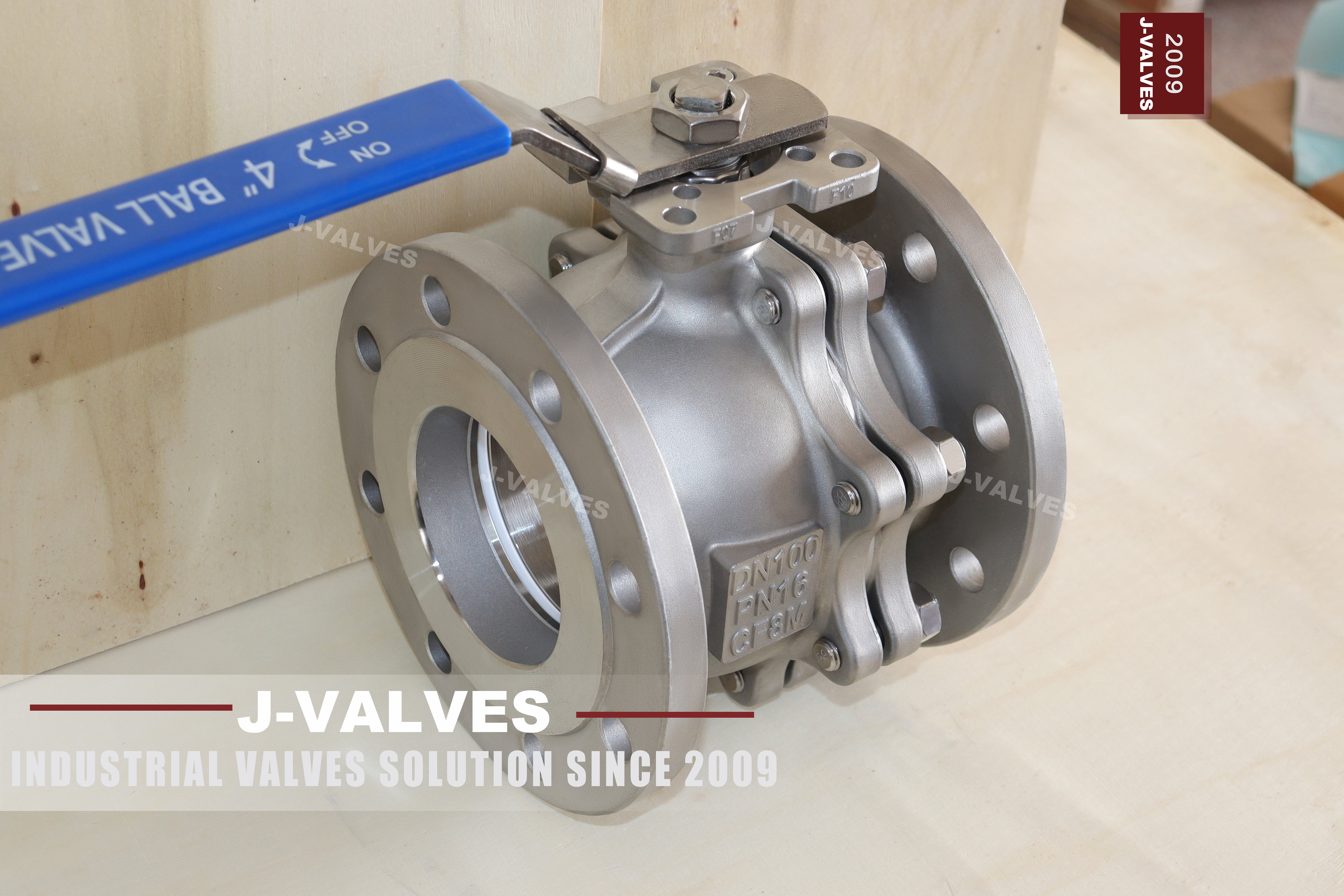
A valve marked PN16 is usually described as a PN16 valve, and that description is one word too generous. PN is a marking that belongs to a flange face: it says which pressure class the joint belongs to under the European flange standard. It is not a statement about the shell, the wall, the seat or the temperature.
That distinction sounds academic until a buyer tries to use the number. A PN16 valve cannot be quoted against the class table in API 6D, because that table has no PN 16 row: its seven lines start at PN 20. It cannot be evaluated at 16 bar without also naming a temperature, because the flange marking is referenced to 20 Celsius while the body's allowable stress is a curve. And it cannot be compared with a Class 150 valve, because the two numbers come from tables that were never meant to meet.
The valve itself is a three piece stainless floating ball valve with flanges to the European standard, from half inch to twelve inch, in 316, with polymer seats and a lever or an actuator on a pad. It is the ordinary small and medium bore isolation valve on a plant whose piping classes are written to EN.
The argument of this page is about which part each number belongs to. A valve is a set of statements about different parts: the flange has a marking, the wall has a table, the seat has a temperature and the body has a design standard. Reading one statement as if it covered the whole valve is how a specification ends up with a valve that is correct on paper and wrong in the line.
Design and Construction
The body is three pieces: a centre piece carrying the ball and both seats, and an end piece at each end carrying a flange and a seat pocket. Two gasketed joints close it, and two sets of studs hold those joints. The reason for the layout is machining: both seat pockets are cut from the two end faces, so they are concentric by setup rather than by a transfer between operations.
The pad is worth pointing out because it changes what the valve can become. A cast pad with a bolt circle and a drive form is an ISO 5211 interface, so an actuator is selected against the pad rather than against the valve model. A valve without the pad can still be actuated, but it needs a bracket that clamps around the neck, and a clamped bracket moves under torque in a way a bolted one does not.
The ball is floating, so it is loaded into the downstream seat by the medium and held at the upstream seat by preload. At the small end of the range that is a good arrangement: the seat load is modest, the torque is low, and a lever is enough. At the top of the range it is the arrangement that stops working, and the range statement on the page is where that becomes visible.
The seat is polymer, and the polymer is what sets the real temperature line. The page prints 425 Celsius, which is a body figure: 316 keeps its strength far above the point where a PTFE seat stops recovering. The seat is what touches the ball, and the number that decides whether the valve survives is the one on the seat.

Material Options
The material list is short and the interesting decisions are not in it. What matters is the facing, the seat and the pad, and only one of those appears on the page as a material.
| Part | Material on This Build | What It Decides |
|---|---|---|
| Centre piece | 316 stainless cast or forged | The pressure boundary in the middle |
| End pieces | 316 stainless, one per end | Flange, seat pocket and joint face |
| Ball | 316 stainless, floating | The sealing band |
| Stem | 316 stainless, blowout proof | Torque and packing wear |
| Seats | PTFE or reinforced PTFE | The real temperature ceiling |
| Body gaskets | PTFE or spiral wound | The two joints |
| Flange facing | Raised face to EN 1092-1 | Which gasket can be used |
| Pad | Cast on the body, ISO 5211 drilling | Which actuator can be fitted |
The facing is the decision that most often goes unstated. A raised face takes a flat or spiral wound gasket and seals over an area; a confined facing seals by trapping the gasket, and the two are not interchangeable. A valve with the wrong facing is not repairable with a different gasket, because the gasket is not the part that is wrong.
The seat is the decision that sets the service. Reinforced PTFE carries a filler that reduces creep under load, which matters on a valve that is left closed at pressure for long periods. Plain PTFE seals better at low load and deforms more at high load, and the choice between them follows the duty rather than the price.
Technical Specifications
The table keeps the page entries and separates the four statements that belong to four different parts of the valve.
| Item | Value |
|---|---|
| Size range | One half inch to 12 inch, DN 15 to DN 300 |
| Pressure marking | PN 16, on the flange face |
| What PN 16 labels | The flange, to EN 1092-1 |
| What rates the body | The material group table and the design standard |
| Body | 316 stainless, three pieces |
| Ball | 316 stainless, floating |
| Seats | PTFE or reinforced PTFE |
| Temperature printed | Minus 20 to plus 425 Celsius |
| Temperature on a polymer seat | Minus 20 to plus 200 Celsius |
| Ends | Flange to EN 1092-1, PN16 drilling |
| Face to face | EN 558 |
| Design | ASME B16.34 |
| Test | API 598 or EN 12266-1 |
The two temperature lines are the clearest example of the page's problem. Minus 20 to 425 is a body statement and it is true of the stainless. Minus 20 to 200 is a seat statement and it is true of the PTFE. Only one of them is the valve, and which one depends on the seat that was ordered.
The size range carries a second version of the same problem. Twelve inch is the top of what this family is written for, and it is not the top of what a floating ball can do. Above roughly eight inch the seat load and the torque stop being manageable with a ball that is not supported, and the same duty is built with a trunnion mounted ball. A range statement that runs to twelve is a statement about the catalogue, not about the mechanism.
Standards and Compliance
Four documents touch this valve, and the one that is missing is as important as the ones that are present.
| Document | What it fixes | What It Does Not Fix |
|---|---|---|
| EN 1092-1 | Flange dimensions and the PN marking | The body wall or the seat |
| ASME B16.34 | Wall, material groups, class ratings | A PN marking |
| EN 558 | Face to face for the DIN build | An ASME build |
| API 598 | Shell and seat test | A PN rating |
| EN 12266-1 | Test procedures for industrial valves | An American class |
| API 6D | Pipeline valves, seven class lines starting at PN 20 | A PN 16 valve |
The absence of PN 16 from the API 6D table is the fact that makes this page worth writing. A PN16 valve is not a poorly documented class 150 valve; it is a valve from a different system, and a project that requires 6D should be specifying a class rather than a PN. When a quotation mixes the two, one of them is being used as decoration.
The design standard line is where the page is most honest and most easily misread. Wall thickness for a 316 body comes from the material group table in ASME B16.34 because that is where the table exists, and the PN marking on the flange comes from a European document. Both statements are true of the same valve, and neither one covers the other.
The test standard is a choice with a consequence. A valve tested to API 598 produces a record in one form and a valve tested to EN 12266-1 produces one in another; both are valid, and a project file that expects one will not accept the other. That is a line on the order rather than a property of the valve.
Manufacturing Process
The three pieces are cast or forged, then machined with the flange face and the seat pocket referenced to one bore axis. The centre piece carries the ball and the seats; the end pieces carry the flanges and close the pockets. Each piece is a pressure boundary, which is why each joint is tested rather than only the shell.
The flange is drilled to the European bolt circle on a jig, and the facing is machined after the drilling so that the facing is square to the bolt circle rather than to the outside diameter. A facing that is square to the diameter and not to the circle produces a joint that compresses unevenly, and the leak that follows is blamed on the gasket.
The seat pocket is bored from the joint face and finished to suit the polymer seat. At these sizes the pocket is small and the finish is what matters: a polymer conforms to a slightly rough pocket and cannot correct one that is out of square. Written that way, a PN16 three piece valve stops being a number and becomes a valve: a 316 body in three pieces, a named seat, flanges to a named standard with a named facing, a pad if it is to be actuated, and a test record in the form the project will accept.

Quality Control and Testing
The shell test is applied with the ball open at the multiple of the rating the standard names, and both body joints are watched, because on a three piece body there are two of them and either can be the one that weeps. Written that way, a PN16 three piece valve stops being a number and becomes a valve: a 316 body in three pieces, a named seat, flanges to a named standard with a named facing, a pad if it is to be actuated, and a test record in the form the project will accept.
The flange is checked for drilling, facing and thickness against the standard on the order. On a PN16 valve that check is the one that prevents the return that cannot be repaired, because a valve drilled to the wrong circle is not usable and not fixable.
The plate is struck after the tests and carries the size, the PN, the grade and the heat number. The model code is also on the plate on some builds, and on this valve that is where a second inconsistency appears: the code on the page reads Q11F, whose first digit names a threaded end, and the valve has flanges.

Applications and Industry Service
Utility and plant water service in EN specification plants is the ordinary duty. The valve is small to medium bore, the pressure is modest, and the requirement is isolation with a lever or a simple actuator. There the flange standard is not a preference but the rule the whole plant was drawn to.
Chemical and food service uses the same body in 316 for the wetted path, often with a polished bore and a seat chosen for the cleaning regime. The three piece body is an advantage there because the internals can be reached and cleaned without cutting the line. Written that way, a PN16 three piece valve stops being a number and becomes a valve: a 316 body in three pieces, a named seat, flanges to a named standard with a named facing, a pad if it is to be actuated, and a test record in the form the project will accept.
Where this valve should not be used is above the seat temperature, above the size where a floating ball is sensible, and on any line where the class is written to API 6D. The first is a seat question, the second is a mechanism question, and the third is a paperwork question that becomes a rejection at the gate.
Installation, Operation and Maintenance
Installation is a flange joint at each end with the faces parallel before the bolts are tightened, and with a gasket that matches the facing. A raised face and a confined facing take different gaskets, and using one in the other is a joint that will not seal.
The bolts are tightened in a crossing pattern to a torque the gasket asks for. On a three piece body the body studs are a separate set from the flange bolts, and the two are tightened to different values; confusing them is a way to crush a body gasket while the flange joint is still loose.
Operation is a quarter turn, by lever or by a quarter turn unit on the pad. The unit is selected against the pad and against the torque at the duty pressure, and a unit chosen only by size will be either oversized or short of torque at the top of the range. Written that way, a PN16 three piece valve stops being a number and becomes a valve: a 316 body in three pieces, a named seat, flanges to a named standard with a named facing, a pad if it is to be actuated, and a test record in the form the project will accept.
How to Specify and Order
The lines below are the ones a PN marking does not carry, and the first one is the line that keeps the valve out of the wrong standard.
| Line on the order | What to write | Why it matters |
|---|---|---|
| Flange standard and marking | EN 1092-1, PN 16, with the facing | PN alone does not define the joint |
| Governing design standard | ASME B16.34, or the EN basis the project uses | 6D has no PN 16 row |
| Size | For example three inch, DN 80 | The range runs past what floats |
| Body construction | Three pieces, with or without a pad | It changes the actuator interface |
| Seat material | PTFE or reinforced PTFE | It sets the 200 Celsius ceiling |
| Test standard | API 598 or EN 12266-1 | The certificate has to match the file |
Written that way, a PN16 three piece valve stops being a number and becomes a valve: a 316 body in three pieces, a named seat, flanges to a named standard with a named facing, a pad if it is to be actuated, and a test record in the form the project will accept.
FAQ
Q: Is PN16 the rating of the valve or of its flanges?
A: Of its flanges. PN is a marking that belongs to a flange face under EN 1092-1, and it tells the piping side which class the joint belongs to. The body has its own wall and its own allowable stress, and those come from a material group table in a design standard rather than from the PN number.
Q: Can this valve be quoted against API 6D?
A: Not on the PN number, because the class table in API 6D does not carry a PN 16 row at all; its seven lines run from PN 20 upward. A valve at this level is quoted on the EN basis, or it is re-expressed as the class the piping specification asks for. Mixing the two on one line is where the arguments start.
Q: Is there a twelve inch three piece floating valve?
A: Not as a floating pattern. Up to about eight inch a floating ball is the ordinary construction; above that the seat load and the torque stop being manageable and the same duty is built with a trunnion mounted ball. The twelve in the range is the top of what the family is written for, not the top of what floats.
Q: What does the model code Q11F say about this valve?
A: It says the code was written for a female threaded valve: the first digit names a threaded end and the pattern is a floating straight one. On a flanged body the code should sit in the family that names a flanged end. A code and a body that disagree are a drafting problem, not a valve problem, and the drawing wins.
Q: Where does 425 Celsius come from if the seat is PTFE?
A: From the body. 316 keeps its strength far above the polymer limit, and the figure on the page is a body figure carried over from a family table. The seat is what the ball touches, and a continuous duty polymer seat stops being the right choice well below 425.
Hot Products


News
Direct Air Capture Ball Valves The Vacuum Side Runs The Seal Backwards, And Three Hundred Thousand Strokes Decide The Design
A solid sorbent DAC plant moves 1.3 million cubic metres of air per tonne of CO2, then asks a DN50 ball valve to hold 0.9 bar from the wrong side.
Read More
Your Ball Valve Is Not A Test Blind: What A Hydrotest Does To The Seats
A line test puts pressure on the wrong side of the seat logic, above the valve's own seat test, with water that stays in the pocket. What to arrange instead.
Read More
Remanufactured Ball Valves: Five Checks That Decide Whether A Rebuild Deserves A Certificate
A rebuild at 45 percent of price with half the life is no saving. Five checks that separate a real remanufacture from a repaint with a certificate.
Read More
The Squeeze Is A Residual: How Tolerance Stack-Up Decides Whether A Ball Valve Seals
No dimension sets the seat squeeze. Five tolerances do, in series. Why identical valves feel different, and why a new ball changes the arithmetic.
Read More