



Introduction
In modern industrial pipeline systems, safety isolation and leakage prevention are critical requirements for oil & gas, LNG, petrochemical, and energy industries. Traditional isolation methods often require multiple valves and additional piping arrangements, which increase installation complexity and potential leakage points.
The Double Block and Bleed (DBB) ball valve provides an advanced integrated solution by combining two independent sealing barriers and a bleed function within a single valve body. Through optimized structural design, advanced sealing technology, and strict manufacturing control, DBB ball valves deliver reliable isolation performance for critical industrial applications.
As a professional valve manufacturer, J-VALVES focuses on developing high-performance DBB ball valves that meet international standards such as API 6D, ASME B16.34, and project-specific requirements.
1. Understanding Double Block and Bleed Ball Valve Design
A Double Block and Bleed ball valve is a specialized isolation valve designed to provide:
Two independent sealing barriers
Controlled cavity pressure release
Leakage verification capability
Improved maintenance safety
The basic operating principle is:
The upstream seat blocks incoming pressure.
The downstream seat provides a secondary isolation barrier.
The cavity between two seats can be vented through the bleed port.
Operators can confirm isolation integrity before maintenance.
This design is particularly important in systems where complete isolation is required.
2. Advanced Structural Design Principles of DBB Ball Valves
2.1 Trunnion Mounted Ball Structure
Most industrial DBB ball valves adopt a trunnion mounted ball design.
The ball is supported by upper and lower trunnions, which provide:
Stable ball positioning
Reduced operating torque
Lower seat loading
Improved performance in high-pressure applications
Compared with floating ball valves, trunnion-supported structures are more suitable for:
Large diameter pipelines
High pressure systems
Frequent operation applications
2.2 Dual Seat Sealing Technology
The sealing system is the core of DBB valve performance.
Advanced DBB ball valves use:
Spring-loaded seats
Pressure-energized sealing structures
Double piston effect (DPE) or single piston effect (SPE) seat designs
These technologies provide:
Reliable shutoff performance
Automatic compensation for pressure changes
Improved sealing stability during temperature fluctuations
2.3 Independent Block and Bleed Function
The unique feature of a DBB valve is the ability to isolate and monitor the valve cavity.
The bleed system allows:
Release of trapped pressure
Confirmation of seat sealing condition
Safe equipment maintenance
This function reduces operational risks in high-pressure systems.
3. Key Engineering Features for Industrial Applications
3.1 Zero Leakage Isolation Performance
For critical pipeline systems, leakage control is essential.
DBB ball valves achieve high-integrity isolation through:
Precision-machined ball surfaces
Advanced seat materials
Accurate assembly control
Pressure-assisted sealing design
This ensures reliable performance under demanding conditions.
3.2 Low Operating Torque Design
The trunnion structure minimizes friction between the ball and seats.
Advantages include:
Smaller actuator requirements
Reduced energy consumption
Longer service life of operating components
This makes DBB ball valves suitable for automated pipeline systems.
3.3 Fire Safe and Anti-Static Design
Industrial DBB ball valves often incorporate additional safety features:
Fire Safe Design:
Metal backup sealing
Graphite secondary seals
Maintained sealing capability under fire conditions
Anti-Static Design:
Conductive devices between ball, stem, and body
Prevention of static electricity accumulation
These features improve operational safety in hydrocarbon applications.
4. Material Selection for DBB Ball Valve Performance
Material selection directly influences valve reliability.
Common materials include:
Carbon Steel
Examples:
ASTM A105
WCB
Applications:
Oil pipelines
General industrial systems
Low Temperature Carbon Steel
Examples:
LF2
LCB
Applications:
LNG systems
Cryogenic applications
Stainless Steel
Examples:
F316
CF8M
Applications:
Corrosive media
Chemical processing systems
Special Alloy Materials
Used for:
Offshore applications
Seawater systems
High-corrosion environments
J-VALVES provides customized material solutions based on pressure rating, temperature range, and media characteristics.
5. Manufacturing Advantages of J-VALVES DBB Ball Valves
J-VALVES applies advanced manufacturing technology and strict quality control throughout the production process.
5.1 Precision Machining Technology
Critical components including:
Ball
Seat rings
Stem
Sealing surfaces
are manufactured with high machining accuracy to ensure:
Proper alignment
Stable torque performance
Reliable sealing
5.2 Strict Inspection and Testing
Each DBB ball valve can undergo comprehensive testing:
Hydrostatic shell test
High-pressure seat test
Low-pressure gas leakage test
Cavity bleed test
Dimensional inspection
Non-destructive testing (NDT)
These procedures ensure consistent performance before delivery.
6. Industrial Applications of DBB Ball Valves
DBB ball valves are widely used in:
Oil and Gas Pipelines
Applications include:
Transmission pipelines
Metering stations
Pipeline isolation systems
LNG Facilities
Used for:
LNG storage systems
Loading and unloading systems
Cryogenic process lines
Petrochemical Plants
Suitable for:
Process isolation
Chemical transfer systems
High-pressure equipment protection
Offshore Platforms
DBB ball valves provide:
Compact installation
Reliable isolation
Reduced maintenance requirements
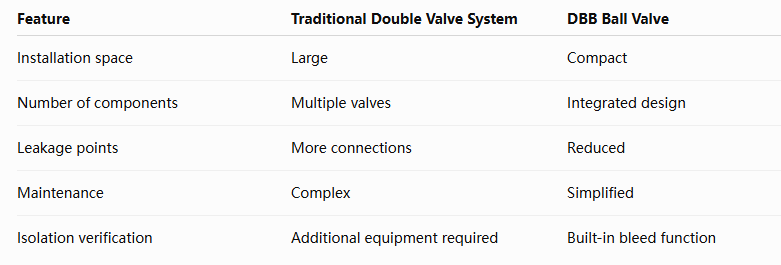
7. DBB Ball Valve Advantages Compared with Traditional Isolation Systems
8. Future Development Trends of DBB Ball Valve Technology
With increasing requirements for pipeline safety and environmental protection, DBB ball valve technology continues to improve.
Future trends include:
Enhanced low-emission sealing systems
Smart valve monitoring technology
Improved cryogenic performance
Advanced corrosion-resistant materials
Digital manufacturing and inspection systems
These developments help DBB valves meet increasingly demanding industrial requirements.
Conclusion
The Double Block and Bleed ball valve represents an advanced isolation solution for modern industrial pipeline systems. Through innovative structural design, dual sealing technology, cavity pressure monitoring, and high-performance materials, DBB ball valves provide reliable safety performance in critical applications.
With professional engineering capabilities, advanced manufacturing processes, and strict quality control systems, J-VALVES delivers high-quality DBB ball valve solutions designed for oil & gas, LNG, petrochemical, and industrial pipeline projects worldwide.


