


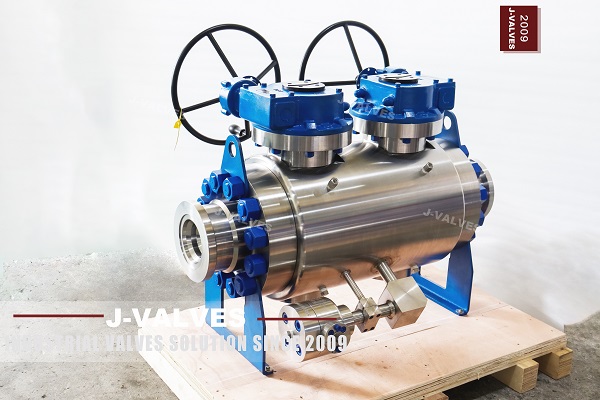
What a DBB valve must prove in service
A double block and bleed valve is specified when a single barrier is not accepted, and it must prove three things at once: isolation upstream, isolation downstream, and a cavity that can be bled to show that both barriers hold. In practice the operator opens the drain between the two seats; if nothing comes out, both seats are sealing. That is why double block and bleed is written into the isolation philosophy for pipelines, metering stations and any service where positive isolation must be verified rather than assumed. Trunnion mounted ball valves with two independent seats are the usual hardware. The cavity must be able to relieve or equalise pressure by design, because trapped liquid that warms can generate very high cavity pressure. Cavity tightness is checked at 1.1 times the rated pressure during the seat test, and the result is recorded on the test certificate.
DIB-1 and DIB-2 seat behaviour
DIB-1 and DIB-2 differ in how the seats react to pressure trapped between them. In a DIB-1 valve, in most specifications, the upstream seat is single piston effect and self-relieving, so cavity overpressure escapes back into the upstream line, while the downstream seat is double piston effect and seals from both sides. In a DIB-2 valve both seats are double piston effect, so cavity pressure cannot pass the seats in either direction and an external cavity relief valve is required. The practical consequence is simple. DIB-1 vents the cavity upstream and needs no extra device, while DIB-2 provides a positive double seal in both directions but must be protected against trapped pressure. The choice is normally fixed by the isolation philosophy, not by the valve supplier.
Single and double piston effect explained
Piston effect describes which pressure pushes the seat against the ball. A single piston effect seat is a ring that line pressure assists from one side only. Pressure from the assisted side drives the seat into the ball and tightens the seal; pressure from the other side pushes the seat away and opens a path to the cavity. That reverse path is what makes the seat self-relieving. A double piston effect seat is arranged so that pressure from either side, including cavity pressure, drives the seat into the ball, so the seat seals in both directions and the cavity cannot vent through it. Soft seated and metal seated variants are both available, and the same body casting can be built in either configuration.
Testing DBB in the factory and in the field
Factory testing follows the seat test sequence of API 598 and ISO 5208, plus a specific check that the cavity holds pressure and that the bleed point operates. Each seat is tested separately with the cavity drained and monitored, so a leaking seat cannot be hidden behind a good one. In the field the same logic is applied with a portable pressure source: the cavity is pressurised between the seats and the bleed is opened to confirm the result. Operators record the outcome because the test is also the proof of isolation before maintenance. J-VALVES applies shell tests at 1.5 times the rated pressure and seat and cavity tests at 1.1 times, with results traceable to the heat number.
Where DBB construction is mandatory
Double block and bleed is normally mandatory wherever a single valve must provide a verified barrier. Typical cases include pipeline isolation and pig trap service, custody transfer and metering runs, separator and compressor station isolation, and any location where maintenance work proceeds while the line is live. It is also common on large diameter lines, typically 24 inch and above, where a single seat is not accepted as positive isolation. In most specifications the requirement appears as a function rather than a valve type: the valve must vent and prove the barrier. Where two independent barriers and a drain are not practical, a double block and bleed valve replaces the traditional arrangement of two valves and a spool piece.

Frequently Asked Questions
Can a standard trunnion ball valve be used as a DBB valve? Only if both seats block from the cavity side and the body has a bleed port between them. A standard trunnion valve with two self-relieving seats vents cavity pressure through the seats, so it cannot prove both barriers independently. Many enquiries therefore end with a DIB-1 or DIB-2 seat configuration rather than a catalogue trunnion valve.
When is an external cavity relief valve required? It is required when both seats are double piston effect, which is the DIB-2 configuration. In that design cavity pressure cannot escape through the seats, so trapped liquid that warms can generate very high pressure between them. An external relief device, usually a small spring loaded or thermal relief valve, protects the cavity. DIB-1 vents upstream and normally does not need one.
Does DBB cost more than a standard valve? Yes, normally. A double block and bleed valve uses two independently sealing seats, a bleed port with a small valve or plug, and in the DIB-2 case an external relief device, so it carries more parts and more testing. The added cost is usually small compared with the isolation function it replaces. Pricing depends on size, pressure class and material.


