


Introduction
In modern industrial pipeline systems, maintaining process purity and preventing unwanted mixing between different media streams are critical requirements. Industries such as oil and gas, LNG, petrochemical processing, chemical production, and power generation often handle multiple fluids under high pressure and temperature conditions. Any internal leakage between isolated sections can lead to cross contamination, safety risks, production losses, and equipment damage.
Double Block and Bleed (DBB) Ball Valves are specifically designed to provide reliable isolation by combining two independent sealing barriers with a bleed function between them. This advanced valve configuration helps prevent fluid migration, allowing operators to safely isolate pipeline sections during maintenance, inspection, or process switching.
As an experienced industrial valve manufacturer, J-VALVES specializes in engineering high-performance DBB ball valves with advanced sealing structures, precision machining, and strict quality control to meet demanding industrial applications worldwide.
1. Understanding DBB Ball Valve Design
A DBB ball valve is an advanced isolation valve that integrates:
Two independent shut-off sealing systems
A cavity pressure relief or bleed function
Reliable isolation performance under demanding conditions
Unlike conventional single isolation valves, DBB ball valves provide an additional safety barrier. When the valve is closed, both upstream and downstream seats create separate sealing points, while the intermediate cavity can be monitored or depressurized through the bleed port.
The basic working principle includes:
Closing the valve to stop pipeline flow
Creating dual sealing barriers through two seats
Opening the bleed system to release trapped pressure
Confirming zero-pressure conditions in the valve cavity
This design significantly reduces the possibility of fluid mixing between different pipeline sections.
2. How DBB Ball Valves Prevent Cross Contamination
2.1 Dual Isolation System
The most important feature of a DBB ball valve is its double block function.
Traditional valves usually rely on one sealing barrier. If the sealing element fails, the isolated medium may pass through the valve.
DBB ball valves provide two independent sealing points:
Primary upstream sealing
Secondary downstream sealing
If one sealing surface experiences unexpected leakage, the second barrier continues to provide isolation protection.
This design is especially important in systems handling:
Different hydrocarbon products
Hazardous chemicals
High-purity process fluids
Cryogenic media
2.2 Bleed Function for Leakage Detection
The bleed system between the two seats allows operators to monitor the valve cavity condition.
During operation:
The valve is closed
The cavity pressure is released through the bleed port
Any leakage from the seats can be detected
If pressure builds up inside the cavity after bleeding, it indicates possible seat leakage.
This function provides an effective method for verifying isolation integrity and preventing unnoticed cross contamination.
3. DBB Ball Valve Seat Design and Isolation Performance
3.1 Double Piston Effect Seat Design
Many advanced DBB ball valves use double piston effect seat structures.
This design allows pressure from the valve cavity to assist sealing by pushing the seat toward the ball surface.
Advantages include:
Improved sealing reliability
Stable performance under pressure changes
Enhanced isolation capability
The seat design is particularly suitable for high-pressure pipeline applications.
3.2 Soft Seat and Metal Seat Options
Different industrial conditions require different sealing materials.
Soft-Seated DBB Ball Valves
Common seat materials include:
PTFE
RPTFE
PEEK
Advantages:
Excellent tight shut-off performance
Low operating torque
Suitable for clean fluids
Applications:
Natural gas systems
LNG facilities
General process pipelines
Metal-Seated DBB Ball Valves
Metal seats provide enhanced resistance against:
High temperatures
Abrasive particles
Severe service conditions
Applications include:
Oil pipelines
Mining industries
High-temperature process systems
4. Applications Where Cross Contamination Prevention Is Critical
4.1 Oil and Gas Pipeline Systems
Oil and gas pipelines often transport different products through interconnected systems.
DBB ball valves help prevent:
Product mixing
Pressure transfer between sections
Uncontrolled fluid movement
They are commonly installed in:
Pipeline terminals
Metering stations
Pump stations
Storage facilities
4.2 LNG and Cryogenic Systems
LNG systems require extremely reliable isolation due to low-temperature operating conditions.
DBB ball valves provide:
Tight sealing at cryogenic temperatures
Reduced leakage risk
Safe maintenance isolation
Proper material selection and extended bonnet designs help protect valve operation in cryogenic environments.
4.3 Chemical Processing Plants
Chemical plants frequently handle multiple aggressive media.
DBB ball valves reduce contamination risks between:
Different chemical processes
Storage systems
Transfer pipelines
Reliable isolation helps improve process safety and product quality.
5. Engineering Advantages of J-VALVES DBB Ball Valves
5.1 Advanced Valve Structure Design
J-VALVES designs DBB ball valves according to industrial application requirements, focusing on:
Optimized flow passage
Reduced pressure loss
Reliable sealing structure
Long operational life
The engineering team evaluates operating pressure, temperature, media characteristics, and installation requirements to provide suitable solutions.
5.2 High-Quality Material Selection
Material selection directly affects DBB valve performance.
J-VALVES provides various material options including:
Carbon steel
Stainless steel
Low-temperature carbon steel
Alloy materials
Nickel aluminum bronze
Each material is selected according to application conditions such as corrosion resistance, temperature range, and mechanical requirements.
5.3 Strict Manufacturing and Testing Process
To ensure reliable isolation performance, J-VALVES applies comprehensive quality control procedures:
Material inspection
Dimensional inspection
Shell pressure testing
Seat leakage testing
Functional operation testing
These procedures help ensure DBB ball valves meet demanding industrial standards.
6. DBB Ball Valve Advantages Compared with Conventional Isolation Valves
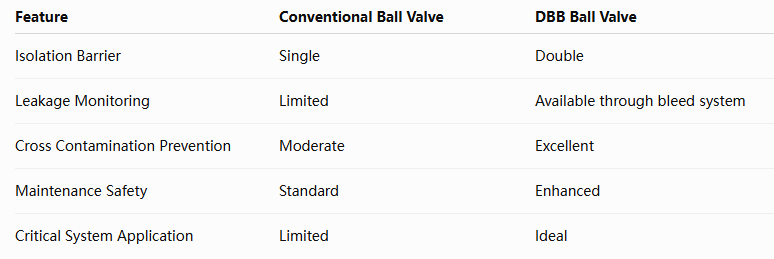
For critical pipeline applications, DBB ball valves provide a higher level of operational confidence.
Conclusion
DBB Ball Valves play an important role in preventing cross contamination in industrial pipelines by providing double isolation and reliable bleed monitoring capability. Their advanced sealing design, flexible material selection, and high safety performance make them suitable for oil and gas, LNG, petrochemical, and chemical processing applications.
With professional engineering experience, precision manufacturing technology, and strict quality management, J-VALVES delivers reliable DBB ball valve solutions designed to improve pipeline safety, operational efficiency, and isolation reliability.


