


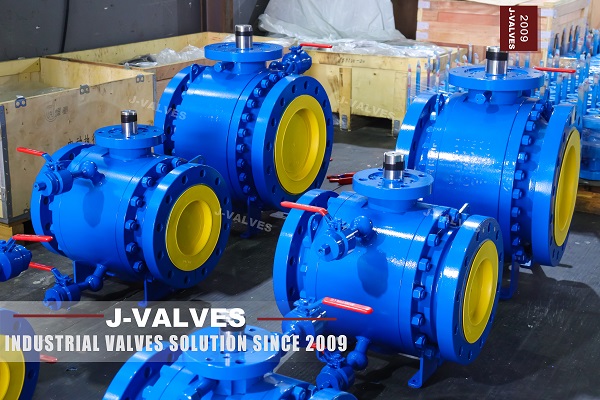
Two ways for a valve to stand still, and they are not the same
Most ball valves in a plant are not regulating anything. They are open, or they are closed, and they stay that way for months or years until a piece of equipment needs isolating or a line needs to be put into service. This is ball valve standby service, and it is the largest population of valves on any site and the smallest amount of attention any of them receives.
Standing still happens in two ways, and the difference decides what fails. A closed valve on a pressurised line keeps its seat loaded: line pressure pushes the seat against the ball by the same mechanism that makes the valve seal, and that load does not vary for as long as the line stays up. An open valve on a line with flow keeps its seat unloaded but leaves half of the sphere exposed to the process, with the bore in the flow path and the sealing band rotated away from the seats.
This is what ball valve static duty means in practice, and it is the opposite of everything a test bench reproduces. The first case is a contact under permanent load. The second is a surface under permanent exposure. Both lead to a valve that cannot be operated when it is finally needed, but by different mechanisms, and a plant that treats them as one problem ends up applying the wrong fix. What follows is mostly about the first case, because a seat that has been loaded for years is where the phenomenon called ball valve stiction actually comes from.
What a loaded contact does over a year
A seat pressed against a ball is not two surfaces sliding with oil between them. The seat load squeezes out whatever film is present at the contact, so the polymer and the metal come into a proximity where the forces between molecules matter. An elastomer wets steel and stainless steel, which is why it seals so well in the first place, and wetting is the first half of adhesion.
Time completes the other half. Under load, the polymer conforms to the micro-texture of the ball, so the real area of contact grows from the tops of the asperities to something much closer to the apparent area. At the same time the polymer chains at the interface rearrange, and the joint that results is part seal and part bond. Raise the temperature and both processes run faster. Raise the pressure and the area grows. Leave it alone and nothing interrupts either one.
Seat adhesion is therefore a function of four things that a specification usually records separately and never together: the contact pressure, the temperature, the time, and the pair of materials. This is elastomer adhesion in the sense that matters here: not a coating failure, but two materials that have been pressed together long enough to need a finite force to separate. PTFE is not exempt. It does not bond in the same way, but it cold flows into the same texture under the same load, and the film that has to be sheared before the ball can turn is just as real. A filled PTFE compound creeps less than a virgin one, which is one of the reasons the filled grades exist, but the mechanism is present in every soft seat that has been closed for a long time.
The result is a valve whose resistance to motion has two separate values: one to start, one to keep going. Before installation they are almost the same, which is why the valve felt fine in the workshop. After years of standing they are not the same at all, and the gap between them is what the actuator has to cross.
The signature is a step, not a ramp
A valve that has bonded gives a torque trace with a shape. The torque rises steeply as the operator or the actuator takes up the slack, peaks at the moment the seat releases, and then falls away within the first few degrees of travel to something close to normal. The rest of the stroke is easy. Close it again and the peak is gone, because the adhesion was broken by the first movement and does not rebuild in an afternoon.
That shape is worth more than any single number, because it separates two problems that are otherwise described in the same words. Used this way, torque as a diagnostic is the cheapest instrument in the plant: it needs no sensor on the valve, only the discipline of writing down what the last operation felt like. A wearing valve gives the opposite trace: the torque stays high for the whole stroke, in both directions, and it climbs cycle by cycle as the band roughens. A valve with a mechanical fault, a tight gland or a dry stem, also stays high through the stroke and often rises as the ball approaches one seat. Only the bonded seat produces a peak that appears once and then disappears.
The table is a reading guide rather than a fault list. Its value is that the first row and the second row look identical to an operator who only knows that the valve was hard to turn, and they lead to completely different repairs.
The half of the sphere that nobody designed
Look at what a closed ball valve actually exposes. The seat contacts a ring on the sphere. Inside that ring, facing upstream, is a disc of the ball's surface that is in contact with the process and is not in contact with anything else. It is the only part of the sealing system that has been sitting in the fluid for years.
When the valve is finally operated, that disc rotates under the seat. The surface that has been facing the process becomes the surface that has to seal, in one quarter turn, with no chance to be inspected. If the line has been wet, the disc carries corrosion products and shallow pits. If the water was hard, it carries scale. If the product polymerises, coats or crystallises, it carries a film. If the fluid was clean and dry, it carries nothing, and this is the case where a valve that stood for years works perfectly.
This is the reason the phrase "the valve was fine, we never used it" does not hold. An unused valve is not a preserved valve. It is a valve whose sealing surface has been quietly exchanging with the process while the seat, the spring and the operating mechanism were doing nothing at all, and the first closure is made on a surface that nobody has looked at since the day it was packed.
The packing takes the shape of the stem
Packing is compressed to seal, and it also creeps. Over years of standing, the packing rings take the exact shape of the stem they surround, the lubricant within them migrates, and on a hot line the outer fibres oxidise slowly where air can reach the gland. None of this is visible and none of it matters while the stem is not moving.
The ball valve first movement changes all of it. The stem turns, the packing loses the fit it had grown into, and the gland that was tight while nothing moved is now a gland that needs adjustment. A weep at the gland on the first stroke after years of standing is therefore the expected sequel rather than evidence of a damaged packing, and the correct response is a small, even tightening of the gland nuts rather than a rebuild.
The distinction matters because the weep is usually reported as the failure. The valve is described as having leaked when it was operated, the gland is blamed, and the fact that the seat was bonded and the valve had to be forced is not recorded anywhere. The next valve in the same service is treated the same way, and the same thing happens on the same schedule.
The first stroke is a full differential event
The question the operator asks is always the same, and it is usually phrased as a ball valve that will not open. What is actually happening is that the valve is being asked to do two things at once: break a bond and hold a differential. A standby isolation valve is not opened gradually. The seat cracks, and the full differential of the line is applied across the gap that has just opened, with the seat still loaded by the pressure that has not yet equalised. In a trunnion valve the seat load at that instant is at its highest, because the differential is at its highest, so the friction at the band is at its highest at the same moment as the adhesion that has to be broken. The two effects add.
That is why a standing valve can need far more torque on the first movement than its own test record suggests, and why the number on the test sheet is not wrong. The sheet records a valve that had just been stroked, at ambient, with clean water on both sides. It is a measurement of the running condition, and a ball valve breakaway torque after years of standing is a different quantity entirely.
An actuator sized on the test sheet therefore has no margin for the event it will actually face, and the failure mode is characteristic: the valve does not move at all, the torque switch trips, and the operator concludes that the valve is jammed. The valve is not jammed. It is being asked to break a bond with a mechanism that was chosen for a smaller number, which is why sizing the actuator on the torque chain has to start from the duty and not from the works record.
Why forcing it is the expensive option
A ball valve stuck closed is not necessarily a valve that is seized, and the two are treated differently once the difference is seen. The obvious response to a valve that will not move is more leverage, then more air pressure, then a bigger actuator. Each step moves the load path. A pipe over the handle puts a bending moment into the stem that the stem was never designed to take, and the first thing to give is usually the smallest section in the drive train rather than the bond. Raising the air supply does the same thing with a larger force and no more control.
The damage that results is not the damage the operator was trying to fix. A sheared key or a twisted stem is a repair that has to be done with the line open; a seat that is dragged across a bonded surface under an overload can be torn, and a torn seat is no longer a component that can be replaced in line without disturbing the body joint. What began as a valve that needed one firm stroke becomes a valve that needs to come out — and on a line where that is not acceptable, the alternative is a valve that can be opened without cutting the pipe out.
There is a second, quieter cost. Once a valve has been forced, the record of how much force it needed is lost, and with it the only evidence of how fast the adhesion is growing on that line. The next valve is then judged by feel, and feel is exactly the instrument that failed the first time.
Keeping a standing valve able to move
The control that works is movement, and the interval is set by how fast the adhesion grows on that particular line rather than by a general rule. Temperature is the strongest influence, because it accelerates both the wetting and the creep; the fluid matters, because a film that polymerises or crystallises adds to the bond; and the seat material matters, because a filled compound and a metal seat behave differently from a plain elastomer.
What the movement has to be is a full stroke, not a nudge. A ball valve partial stroke breaks the bond and proves the drive train, which is worth having, but it leaves the ball parked between positions, and for an isolation valve the middle position is not a valid state to leave it in. A partial stroke is a test, and a test ends with the valve back where it started.
The design choices that reduce the problem are unglamorous. A metal seat does not bond the way a polymer does, which is why hot standby service often ends up there even when the leakage class would allow a soft seat; the trade is set out in any honest comparison of seat material, and adhesion is one of the lines that comparison usually leaves out. A seat with a lower installed squeeze has less adhesion to break, at the cost of less tolerance for a damaged ball. A cavity bleed lets the seat be proved without operating the valve, so that the valve can be left alone and still be known to be holding. And a stem that is accessible and a gland that can be adjusted without dismantling anything turn a gland weep into a five-minute task instead of a shutdown.
What a standby valve teaches about tight shut-off
A closed valve is tight today. Whether it is tight on the day it is needed depends on whether it can still move, and a valve that cannot be unloaded cannot be proved. The seat that has bonded is, for practical purposes, a valve that has been converted into a blind: it holds, but it holds by not being operable, and the isolation it provides cannot be verified by a bleed that nobody can open.
That is the argument for treating standby valves as a population rather than as individual items. The ones that fail are not the ones that are worn out. They are the ones that were never asked to do anything until the day everything depended on them, and the only maintenance that changes the outcome is the one that happens before that day.
J-VALVES supplies floating ball valves from 1/2 inch to 8 inch and trunnion mounted ball valves from 2 inch to 56 inch (DN15 to DN1400) in ASME Class 150 to 2500, with soft and metal seated options, shell tests at 1.5 times and seat tests at 1.1 times the rated pressure to API 598 and ISO 5208, and EN 10204 3.1 certificates for body, ball and stem. For valves that will spend most of their life closed, the seat compound and the installed squeeze are worth agreeing at the enquiry stage, because those two choices decide how much force the first stroke will need.
Frequently Asked Questions
Why will a ball valve not open after standing closed for a year? Because the seat has had a year to bond to the ball. The polymer conforms to the surface, the film at the contact is squeezed out, and the force needed to start the ball moving becomes much larger than the force needed to keep it moving. The valve is not worn out; it is stuck by adhesion, and the trace shows a peak that falls away as soon as the ball has turned a few degrees.
How is stiction different from a stiff valve? Shape of the resistance, not its size. A bonded seat gives a peak at the start and then releases; a stiff valve stays stiff for the whole stroke and in both directions, which points at the gland, the packing, the stem or a bearing. The first case needs one firm movement and a schedule; the second needs the gland worked on before anything else is touched.
Can the seat be damaged when a stuck valve is finally forced? Yes, and that is the usual way a repairable problem becomes an unrepairable one. Forcing the handle overloads the smallest part of the drive train, and dragging a bonded seat under an overload can tear it. A torn seat cannot be replaced without disturbing the body joint, so a valve that needed one stroke now needs to come out of the line.
Should standby valves be stroked on a schedule? Yes, and the interval is set by the line rather than by a general rule: temperature, the fluid's tendency to leave a film, and the seat compound all change how fast the bond builds. The stroke has to be full, with the valve returned to its normal position, because a partial stroke leaves the ball parked between positions where an isolation valve should never be left.
Does a bigger actuator solve the problem? It hides it, and it moves the damage. An actuator sized on the works test figure has no margin for adhesion, so a larger one will break the bond, but it will also apply the same oversized force to a seat that may already be bonded again next year. The cheaper answer is to stop the bond forming, and the second cheapest is to measure the breakaway every time the valve is operated so that the trend exists before the failure does.


