


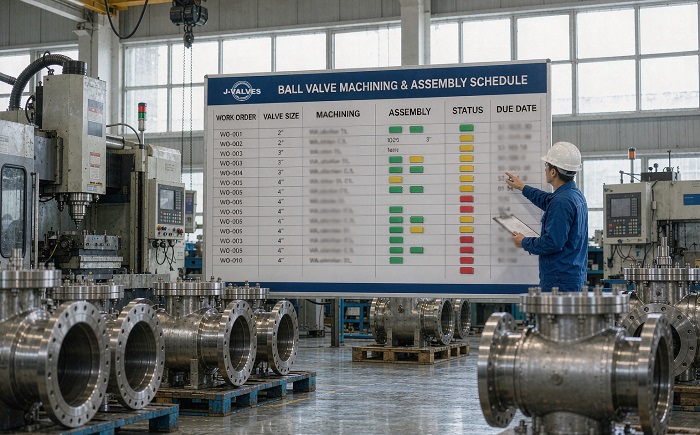
1. What lead time is made of
Ball valve lead time from China is not one number. It is the sum of several stages, some of which run in sequence and some of which overlap: raw material or casting procurement, machining, assembly, pressure testing, inspection and packing. Understanding the sequence lets a buyer see which stage is actually driving the date.
The dominant driver is rarely machining, which is predictable on CNC equipment. It is more often foundry availability for the body casting or forging, or the inspection calendar when a third-party witness is required.
Material certificates run in parallel. EN 10204 2.2, 3.1 and 3.2 packages are issued from the mill or from the manufacturer quality department, and their timing depends on when the heat was poured and tested.
A useful planning rule: treat each stage as a range rather than a date. For sizes between 1/2 and 56 inch (DN15 to DN1400), the total is usually set by the longest path, not by the sum of every stage.

2. Material and casting procurement
Casting and forging procurement is the longest single stage on many orders. The foundry must schedule the pattern, pour the heat or forge the billet, heat treat the part, and issue the material certificate before machining can begin.
Standard materials in common demand move faster, because carbon steel and the common stainless grades sit closer to the front of a foundry schedule. Less common grades, such as duplex and super duplex, and alloys required for sour service under NACE MR0175 / ISO 15156, often wait for a scheduled heat.
Size matters here as well. A 1/2 inch valve and a 56 inch valve do not share a casting route, and the largest bodies are normally made to order rather than drawn from stock.
Where the project allows it, confirming the material grade early is the single most effective way to protect the schedule.
3. Machining, assembly and testing slots
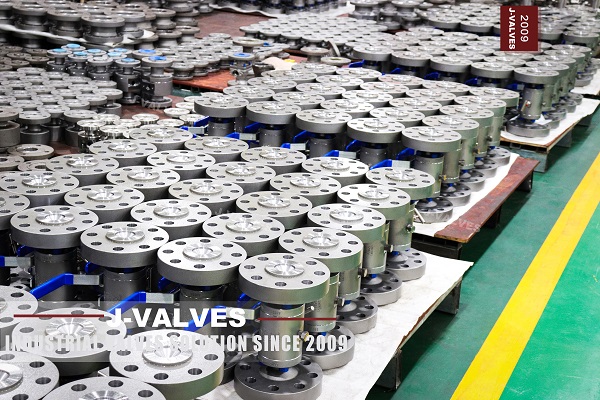
Once the bodies are released, the schedule becomes internal and therefore more controllable. CNC machining runs the body, the ball, the stem and the seat carriers. Assembly follows, and then pressure testing.
Testing is a defined operation rather than a variable. Shell tests are applied at 1.5 times the rated pressure and seat tests at 1.1 times, with duration and acceptance criteria set by API 598 or ISO 5208. A quotation returned within 3 working hours covers pricing, not testing, so the two expectations should be kept separate.
Torque testing, actuator mounting and functional cycling add time when the valve is actuated. If an operator is supplied, its mounting and cycle test should be listed as separate lines in the schedule.
4. Third-party inspection timing
| Stage | Typical duration | Main driver |
|---|---|---|
| Foundry or material procurement | 2 to 6 weeks | Heat scheduling and material grade |
| Machining | 1 to 3 weeks | Size, bore and tolerance class |
| Assembly and pressure testing | 1 to 2 weeks | Reference standard and acceptance criteria |
| Third-party witness inspection | 1 to 2 weeks added | Inspector availability and notice period |
| Packing and documentation | 3 to 5 days | Certificate package and crate design |
These figures are typical planning assumptions for standard carbon and stainless steel valves, not commitments, and they move with the specification. Third-party inspection is scheduled rather than instantaneous.
An inspector from SGS or TUV must be booked against a production stage, and the notice period, not the inspection itself, is usually the constraint.
Witness and hold points should be agreed when the inspection and test plan is approved. If the inspector is booked after testing is complete, the test must be repeated under witness, which adds both time and cost.
5. How buyers can compress the schedule
Compression comes from removing uncertainty, not from pushing the factory. The fastest orders tend to share the same features: a complete specification at enquiry, an approved drawing, no open material questions, and witness points agreed early. An enquiry carrying the full data set is typically answered within 3 working hours, which is where the clock should start.
Buyers can also decide early which stages genuinely need witnessing. Witnessing only the final pressure test is faster than witnessing machining, non-destructive testing and pressure testing in sequence. Rank the hold points by risk and keep the list short.
Finally, avoid late change. A material or dimensional change after machining has started resets the affected stage, and on a large body that can cost more time than the change is worth. Confirm the configuration before the order is released to the shop floor.
6. Frequently Asked Questions
What is the fastest realistic delivery?
The fastest realistic case applies to small standard valves in common carbon or stainless steel, where the casting is already available and no third-party witness is required. Under those conditions machining, assembly and testing dominate and the schedule is short. An uncommon alloy, a large body or a witnessed inspection all add procurement and scheduling time, so the fastest case is not a planning basis.
Does a larger order take longer?
Quantity increases lead time mainly through machining and testing capacity rather than engineering. A large order of standard valves is scheduled across the available slots, so the last units ship later than the first. Order size also affects casting procurement, because a large release may need more heats than a small quantity of the same valve.
How much does witnessed inspection add?
Witnessed inspection typically adds one to two weeks, driven by the inspector notice period rather than by the inspection itself. If witness points are agreed when the inspection and test plan is approved, the inspection runs alongside production. If the inspector is booked after testing, the test is repeated under witness and both time and cost increase.


