


CHINA J-VALVES Offers Various High-quality I ndustrial Ball Valves
J-VALVES, a distinguished professional ball valve manufacturer rooted in China, takes pride in its extensive product portfolio. Our offerings span a wide range, including trunnion-mounted ball valves, floating ball valves, high-temperature ball valves, high-pressure ball valves, metal-sealed ball valves, ultra-low temperature ball valves, DBB ball valves, Three-way And Four-way Ball Valve, and fully welded ball valves. Each product is a testament to our commitment to precision engineering and reliable performance. Meticulously crafted, they are designed to not only meet but exceed the most stringent industrial demands, ensuring stable operation even under extreme conditions. This enables us to provide our clients with high-value services and makes our valves widely sought-after in industries.
Product Category
Contact Us

-
J-VALVES-Q947F
-
J-VALVES
Overview of the J-VALVES 3PC forged steel trunnion mounted ball valve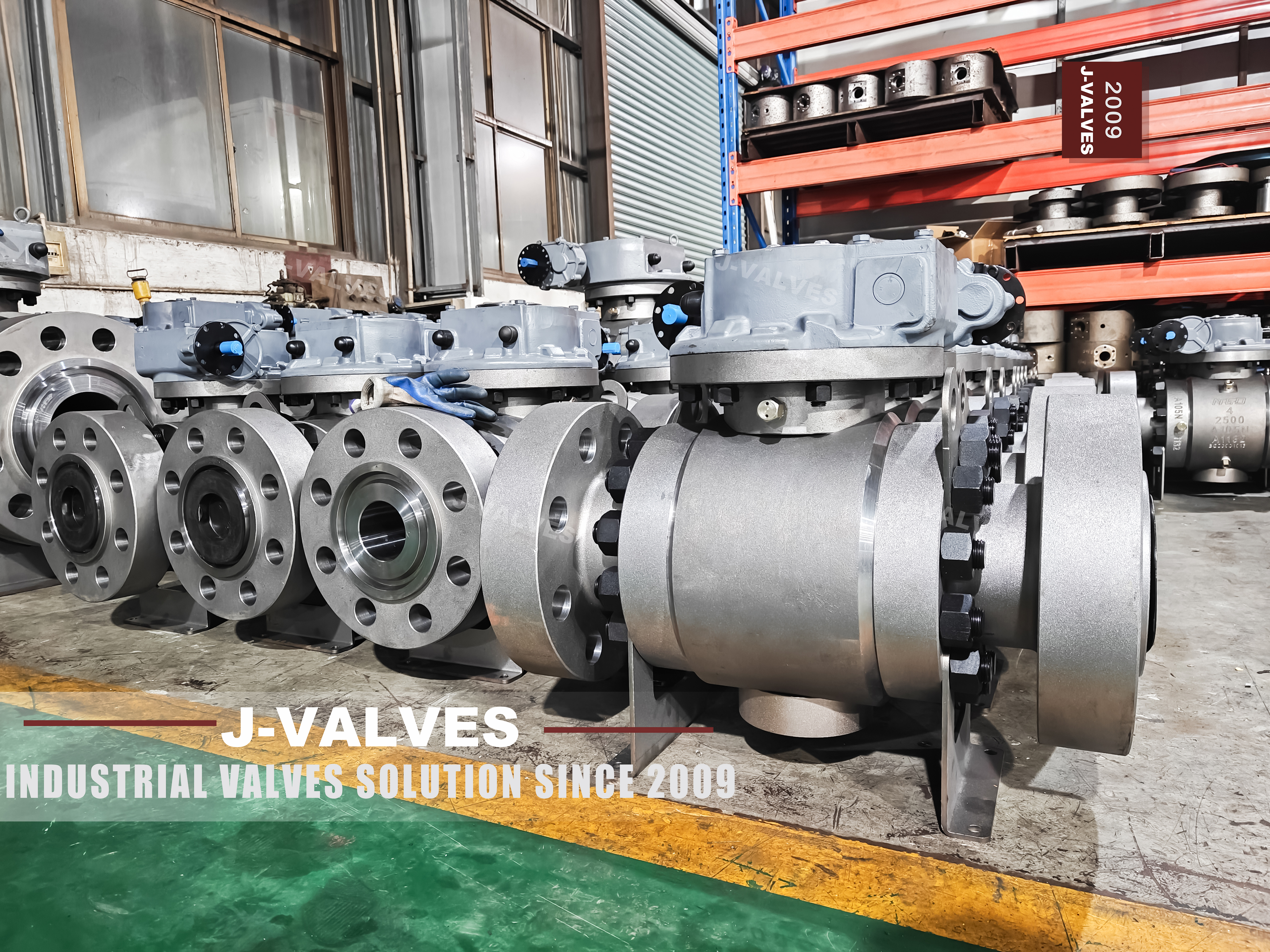
A three piece valve is sold on one promise: you can open it and change the seats without cutting the pipe out. The promise is real, and it is conditional. Between the pipe and the seats there are two rings of bolts on each end, and only one of them belongs to the valve.
This is a forged trunnion valve from two to fifty six inches, Class 150 to Class 2500, with flanged or butt weld ends and polymer or metal seats. The body is split into a centre section and two end pieces, the ball runs on trunnions, and the joints between the sections are bolted and gasketed.
The original page argues that the split body makes maintenance easy and also improves the structural strength and the sealing performance. The first half is true with a condition attached. The second half is not true at all, and it matters, because a buyer who believes that a three piece body is stronger will use it where a welded body belongs.
Design and Construction
The centre section holds the ball, the seats and the trunnion bearings. The two end pieces carry the connections and bolt onto the centre, one at each end, with a gasket in each joint. The ball is supported top and bottom, so the pressure load goes into the body through the trunnions rather than into the downstream seat.
Each end of the valve therefore has two circles of fasteners. The outer one holds the pipe flange to the valve flange, and it belongs to the piping. The inner one holds the end piece to the centre section, and it belongs to the valve. They are different sizes, they compress different gaskets and they are tightened for different reasons.
That geometry is the whole subject of this page. The body ring is smaller than the flange and it is set back behind it, which is fine on a bench and awkward between two installed pipe flanges. Whether it can be reached is a dimension that appears on no data sheet.
The comparison is the useful part. Two valves with the same size, the same class and the same three piece construction can differ by the length of the body, and that length is the only thing standing between a fitter and the studs.

The Ring That Opens Is The Ring You Cannot Reach
Start with what the two rings do. The pipe flange joint carries the axial load of the line and is made once, during installation, by a pipe fitter with the pipe in front of him. The body ring carries the same pressure and is meant to be made and unmade more than once, by a maintenance fitter with the valve in place.
A joint that is meant to be opened has to satisfy three conditions that a welded body never has to think about. There has to be room for a tool, there has to be a gasket available, and there has to be a torque value that the next person can reproduce.
| Condition | Pipe Flange Joint | Body Ring Joint |
|---|---|---|
| Who makes it | The pipe fitter, once | The valve fitter, whenever |
| Gasket | Line gasket, stocked on site | Valve gasket, a factory part |
| Access | Open, it faces the pipe | Behind the flange hub |
| Torque | In the piping specification | In the valve drawing |
| If it leaks | Visible at the joint | Visible at the joint |
The access line is the one that decides whether the promise holds. On a short face to face valve, the two pipe flanges sit close together, and the body ring is inside the shadow of the one nearest to it. At Class 150 with a thin flange there is usually room for a socket and a wrench. At Class 900 or 2500 the flange is a heavy forging with a long hub, and the gap between the hub and the body ring can be smaller than the tool.
That is why a three piece valve should be judged on its face to face dimension as well as its pressure class. The two numbers together decide whether the body ring can be worked on after installation, and neither number on its own tells you anything. A short valve at a high class is the combination where the ring is hardest to reach.
The second condition is the gasket, and it is where three piece maintenance quietly fails. A body gasket that is reused will weep, a gasket that is cut from sheet in the workshop is not the gasket the joint was designed for, and a gasket that is not in the store is a valve that waits. The spare that matters is not the seat; it is the body gasket, and it is ordered with the valve or not at all.
The third condition is the torque record, and it is the one that most often goes missing. A body ring tightened by feel after a seat change will pass a leak check at ambient and weep at temperature, because the studs were loaded unevenly and the gasket has been compressed in one arc and not in another. The drawing has a value; the record is what makes the next opening possible.
Technical Specifications
The table follows the factory data. The two lines to read carefully are the body line, which is where the split is, and the gasket line, which is the part that decides whether the valve can be reopened.
| Item | Value |
|---|---|
| Size range | 2 inch to 56 inch, DN 50 to DN 1400 |
| Pressure class | Class 150 to Class 2500, PN 20 to PN 420 |
| Temperature | Minus 46 to plus 200 Celsius, material dependent |
| Body | Forged carbon steel A105, three piece |
| Body sections | Centre section and two bolted end pieces |
| Body gasket | Spiral wound stainless with graphite, or ring joint |
| Ball | Hardened stainless or alloy steel, trunnion mounted |
| Stem | Stainless or alloy steel, anti blow out |
| Seat, soft | PTFE or RPTFE at the lower end of the range |
| Seat, metal | Hardfaced ring for high temperature and abrasive duty |
| Seat design | Single or double piston effect, stated on the order |
| Ends | Flanged RF per ASME B16.5, or butt weld per ASME B16.25 |
| Face to face | ASME B16.10 for the size and class |
| Operation | Handwheel, pneumatic, or electric |
| Top flange | Actuator mounting pad on the gear or on the stem |
| Lifting | Eyes on the end pieces, not on the centre section |
| Design standard | API 6D and ASME B16.34 |
| Test standard | API 598, shell and seat |
| Fire test | API 607 and API 6FA on the design |
| Anti static | Device fitted, continuity checked at assembly |
The gasket line is not a detail. It is the difference between a valve that can be reopened and one that can be opened once, and it should be quoted as a part number with a spare quantity rather than as a material description.
Standards and Compliance
API 6D governs the design, the test and the marking, and ASME B16.34 governs the wall. The body joint sits between them: 6D requires that the joint holds, and B16.34 gives the wall around it, but neither document tells you how much room a fitter needs to reach the studs.
| Document | What It Fixes | What It Does Not Fix |
|---|---|---|
| API 6D | Design, test, marking of the valve | Access to the body ring in service |
| ASME B16.34 | Wall thickness and pressure temperature ratings | The bolted joint and its gasket |
| ASME B16.5 | Flange dimensions and drilling by class | The clearance behind the flange |
| ASME B16.10 | Face to face by size and class | The tool that has to fit in that length |
| API 598 | Shell and seat test at ambient | The body joint after it has been reopened |
| API 607 | Fire test of the design | A joint remade in the field |
The clearance question is not covered anywhere, and it is the reason two valves of the same size and class can have very different service lives. A buyer comparing quotations on price and lead time will not see it, and a maintenance planner will discover it in the first shutdown.
There is a second gap in the same place. API 598 tests the shell and the seats on a new valve, and it says nothing about a body joint that is opened and closed in the field. That is not a criticism of the standard; it is a statement that the repairability of a three piece valve is a procedure the owner writes, not a property the manufacturer certifies.
Manufacturing Process
The three sections are forged separately, normalised, and machined. The centre section gets the ball chamber, the seat pockets and the trunnion bores in one set up so the two bearings share an axis. The end pieces get the flange or the weld preparation on one side and the joint face on the other, and the two faces have to be parallel within the tolerance or the valve will not sit square in the line.
The joint faces are the parts that decide how the valve behaves after its first opening. They are machined flat, and on a spiral wound gasket they carry a finish that the gasket needs in order to seat. A face that is scored during a seat change, or cleaned with a grinder, will not seal again at the same torque, and the valve will be blamed for a leak that the maintenance did.
The ball and the seats are matched as a pair. On a metal seated valve the ball is ground and the seat is lapped against it, and the pair is kept together through assembly because the contact pattern is specific to those two parts. That is also why a seat change on a metal seated valve is a matched set and not a single ring.
The three sections are also matched to each other. Each end piece is bored for its own joint face and its own connection, so the two ends of one valve are not interchangeable with the two ends of another of the same size. In a workshop where several valves of a family are open at once, that is worth a tag on each end piece, because a swapped pair will bolt up and then leak at a face that was never machined against its partner.

Quality Control and Testing
The shell test is done with the body assembled, which means the body joints are pressurised and can be watched. The seat test follows in both directions with the cavity monitored, and the two together are the only proof that the joints and the seats are sound before the valve leaves.
The body joints get a torque check and a record. On a valve that will be reopened in service, that record is the baseline: it tells the next fitter what the joint was closed to when it did not leak. Without it, the first field reassembly is an experiment.
The joint faces are inspected before assembly for flatness and for damage, and the gaskets are checked against the part number on the drawing. A spiral wound gasket of the right size and the wrong winding is a gasket that will not compress as designed, and it looks identical in the box.

Applications and Industry Service
The split body is chosen where the valve is expected to be opened: custody transfer metering, compressor station suction and discharge, terminal manifolds, and any service where a seat replacement is a planned event rather than an emergency. In those places the cost of the gasket is trivial against the cost of cutting a line.
It is also chosen where the valve is expensive and the spares are slow. A large forged trunnion valve at a high class is a long lead item, and being able to change the seats and the ball without replacing the body is the difference between a repair and a project.
It is a poor choice where nobody will ever open it and where the line cannot be taken out of service to do it. In that case the two bolted joints are two leak paths that were bought for a benefit that will never be used, and a welded body is the better answer.

Installation, Operation and Maintenance
Installation follows the end type. A flanged valve is bolted with the correct gasket and the studs tightened in a cross pattern to the piping specification; a welded valve is aligned and welded with the valve part open. In both cases the body rings are checked for torque before the valve is put into service, because a body ring that was loosened for transport and not re-tightened is a leak waiting for pressure.
Before the first shutdown, measure the clearance between the body ring and the nearest pipe flange. It takes a minute with the line cold and it answers the question the drawing does not. If there is no room for a socket, the plan for the first seat change is a pipe cut, and knowing that in advance is the whole point of buying a valve that is supposed to avoid one.
Maintenance is a procedure with four steps: isolate, drain, break the body ring in a cross pattern, and lift the end piece clear. The gasket is replaced, not reused. The joint faces are cleaned without abrasives. The ring is closed to the recorded torque and the joint is checked with the cavity pressurised before the line is returned.
How to Specify and Order
An order for this valve needs the split body stated, and it needs the three things that make the split usable: the gasket part number, the spare quantity and the torque value. None of them appears on a quotation unless it is asked for.
| Line on the Order | What to Write | Why It Matters |
|---|---|---|
| Body style | Three piece, with the number of joints stated | It is the reason to buy, and the reason to doubt |
| Body gasket | Part number, material and spare quantity | A reused gasket will weep |
| Bolting | Grade, coating and the torque value | It is the only way to remake the joint |
| Clearance | Tool clearance behind the flange, checked against the pipe | It decides whether the ring is reachable |
| Face to face | ASME B16.10 for the size and class | It sets the gap the tool has to work in |
| Ends | Flanged RF or butt weld, with the pipe wall | The bevel follows the pipe |
| Seat material | Polymer, or metal with the hardfacing stated | It sets the top of the temperature range |
| Seat design | Single or double piston effect | It decides cavity relief |
| Test | Shell and seat both directions, cavity monitored | One direction hides a cavity leak |
| Spares | One set of body gaskets per valve | The store is the difference between a repair and a wait |
FAQ
Q: Does a three piece body make the valve stronger?
A: No. The centre section is stiffer than a two piece body of the same wall because the load path is shorter, but the bolted joints are planes where the body is held together by studs rather than by metal. In bending and in thermal cycling a bolted joint is the softest part of the assembly, so the split trades strength for access rather than adding both.
Q: Can the body be opened with the valve still in the line?
A: That is what the design is for, and it depends on tool clearance rather than on the valve alone. The body ring sits on a smaller circle than the pipe flange and behind its hub. On a short face to face valve at a high class there may be no room for a socket, which turns the first seat change into a pipe cut.
Q: Which gasket should be kept as a spare?
A: The body gasket, in the quantity of body joints the valve has. A seat can be ordered when it is needed; a body gasket that is reused will weep, and one cut in the workshop is not the winding the joint was designed for. The spare set is the difference between a repair that takes a shift and one that waits for a shipment.
Q: Why is the torque value so important on these joints?
A: Because the joint has to be remade by someone who was not there the first time. A ring tightened by feel passes an ambient leak check and weeps at temperature, because the gasket has been compressed in one arc and not in another. The value on the drawing plus the record of the last closing is what makes the next opening predictable.
Q: Is a metal seated three piece valve repairable in the same way?
A: The body opens the same way, and the seat is a different proposition. On a metal seated valve the ball and the seat are lapped as a pair and the contact pattern belongs to those two parts, so a seat is replaced as a matched set. A single ring dropped into an old ball will not reproduce the seal that was tested.



Hot Products


News
A Ball Valve Is A Tuning Fork: Vibration, Fretting And The Joints That Only Hold By Friction
A ball valve holds seat, stem and body joint by preload alone. Vibration turns that preload into micro-motion, and the wear arrives with no cycle at all.
Read More
Urea Plant Ball Valves: The Wetted Path Survives Only While Oxygen Is Being Fed To It
Carbamate at 150 bar and 185 C eats stainless 50 times faster once the passive film starves. The valve cavity is where the oxygen runs out first.
Read More
Stiction: What A Ball Valve Becomes When Nobody Turns It
A valve that stood closed for years has not worn out. The seat has bonded to the ball, and the first stroke is a step, not a ramp. What the trace shows.
Read More
Molten Salt Ball Valves: The Valve Works at 565 C And Dies at 219 C
Salt freezes at 220 C and decomposes at 565 C. Everything a molten salt ball valve does happens in that 345 kelvin gap, and the gap is not generous.
Read More