


CHINA J-VALVES Offers Various High-quality I ndustrial Ball Valves
J-VALVES, a distinguished professional ball valve manufacturer rooted in China, takes pride in its extensive product portfolio. Our offerings span a wide range, including trunnion-mounted ball valves, floating ball valves, high-temperature ball valves, high-pressure ball valves, metal-sealed ball valves, ultra-low temperature ball valves, DBB ball valves, Three-way And Four-way Ball Valve, and fully welded ball valves. Each product is a testament to our commitment to precision engineering and reliable performance. Meticulously crafted, they are designed to not only meet but exceed the most stringent industrial demands, ensuring stable operation even under extreme conditions. This enables us to provide our clients with high-value services and makes our valves widely sought-after in industries.
Product Category
Contact Us

-
J-VALVES-Q347F
-
J-VALVES
Overview of the J-VALVES high pressure forged steel trunnion mounted ball valve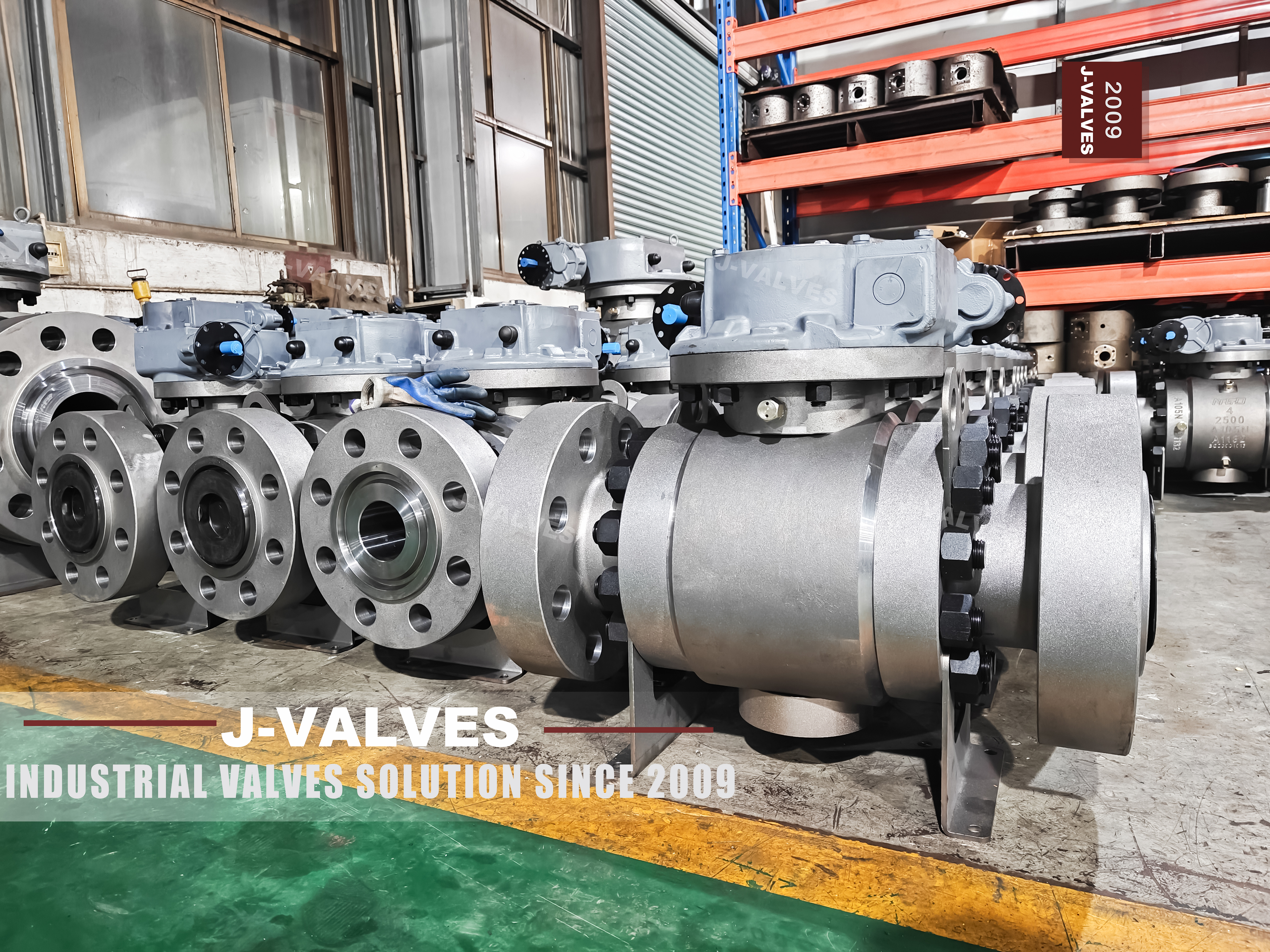
High pressure is an adjective. It describes how a valve feels to the person specifying it, and it cannot be tested, certified or compared. What can be tested is a class, and a class comes with a wall thickness, a test pressure and a rating table. The first useful thing to say about this page is that it sells a high pressure valve and then writes a pressure range that includes a designation the governing standard does not contain.
This is a three piece forged trunnion valve from two to fifty six inches, offered from Class 150 to Class 2500, with flanged or butt weld ends and a metal seat available for the hot and abrasive end of the range. The body is forged carbon steel, the ball and the stem are hardened, the ends are flanged or welded, and the operation can be manual, pneumatic or electric.
The pressure line on the original page reads 150LB to 2500LB and then adds PN 16 to PN 420. The lower end of that is wrong twice over: PN 16 is not one of the designations in the API 6D list, and the designation that corresponds to Class 150 is PN 20. So the page offers a valve from a pressure classification that does not exist in the standard it is designed to.
Design and Construction
The valve is a three piece body: a centre section holding the ball, the seats and the trunnions, closed by two side sections that carry the ends. The joints are bolted and gasketed. On a high pressure valve those bolted joints are the most highly loaded part of the assembly, because the axial force from the pressure acts on the projected area of the joint and has to be carried by the studs.
The ball is carried on an upper and a lower trunnion. At Class 1500 and above the ball is large and the pressure is high, and a floating design would press the ball into the downstream seat with a force no seat can survive, so the trunnion arrangement is not a refinement at these classes: it is what makes the valve possible. The seats are polymer at the lower end of the range and metal at the top, and the metal seat is what allows the valve to work where the polymer would extrude or burn.
That is the structural argument of the page in one sentence: at high pressure the body joint becomes a pressure part. A welded body removes that joint and the studs with it, and a three piece body keeps the joint because it wants to be openable. Those are the two designs, and the choice between them is a choice about which risk the buyer prefers.
The ends are the other place where class matters. A flanged end has a bolt circle and a gasket whose dimensions come from the class, and a welded end has a wall that comes from the pipe. The valve body's wall comes from ASME B16.34 at its class. Three different sources, three different dimensions, and the one that decides whether the joint fits is the pipe.

PN 16 Is Not On The List
API 6D lists seven pressure designations for valves, and it pairs each of them with a class. The list is short and it is closed: PN 20, PN 50, PN 64, PN 100, PN 150, PN 250 and PN 420, standing for Class 150, 300, 400, 600, 900, 1500 and 2500. There is no PN 16 in it, and there is no class below 150 in it, so a valve described as starting at PN 16 is either not an API 6D valve or is a valve whose data sheet has been written by copying a DIN flange table.
| Designation | Class | Where The Number Comes From |
|---|---|---|
| PN 20 | Class 150 | The 6D list, not a conversion of 150 into bar |
| PN 50 | Class 300 | The same list |
| PN 64 | Class 400 | The same list |
| PN 100 | Class 600 | The same list |
| PN 150 | Class 900 | The same list |
| PN 250 | Class 1500 | The same list, and the same number as EN 1092-1 uses |
| PN 420 | Class 2500 | The same list, at the top of the range |
| PN 16 | No class | A flange designation from EN 1092-1, not a valve class |
The distinction is not pedantic. PN 16 is a real designation, and it belongs to flanges: an EN 1092-1 PN 16 flange is a perfectly good flange with a defined bolt circle and facing. It is not a valve class, and a valve cannot be designed to a class that the standard does not define. When a data sheet offers PN 16 to PN 420, what it has actually done is put a flange pressure designation at one end of a valve class range, and the ends do not join.
The practical consequence is that the buyer cannot tell what they are getting at the bottom of the range. Is the valve a Class 150 valve with a PN 16 flange? Is it a valve designed to a DIN pressure rating? Is it a Class 150 valve whose flanges happen to be drilled to PN 16? Those are three different products, and the answer decides the gasket, the bolt circle and whether the valve can be certified at all.
There is a second, quieter problem in the same line. A range written as 150LB to 2500LB and then as PN 16 to PN 420 implies a continuum, and the classes are not a continuum. Class 400 exists and is rarely used; Class 900 exists and is common; the gaps between them are large. A buyer who reads a range as a continuous capability will ask for a class that sits in a gap and be offered the nearest one, which is how a Class 600 valve ends up on a line designed for 900.
Technical Specifications
The table below follows the factory data with the pressure line corrected. The range is written in classes, with the 6D designations beside them, and PN 16 is removed because it does not belong. Everything else is as published, and the seat lines are written as materials rather than as grades.
| Item | Value |
|---|---|
| Size range | 2 inch to 56 inch, DN 50 to DN 1400 |
| Pressure class | Class 150 to Class 2500, PN 20 to PN 420 |
| Temperature | Minus 46 to plus 200 Celsius, material and seat dependent |
| Body | Forged carbon steel A105, body, ball and stem all forged |
| Body style | Three piece, centre section with two bolted side sections |
| Ball | Hardened stainless or alloy steel, forged |
| Stem | Stainless or alloy steel, forged, anti blow out |
| Seat, soft | PTFE, RPTFE, for the lower part of the temperature range |
| Seat, metal | Hardfaced ring, for high temperature and abrasive service |
| Seat design | Single or double piston effect, stated on the order |
| Body gasket | Spiral wound stainless with graphite, or ring joint |
| Bolting | Alloy steel studs, grade and coating stated on the order |
| Ends | Flanged RF per ASME B16.5, or butt weld per ASME B16.25 |
| Face to face | ASME B16.10 for the size and class |
| Operation | Handwheel, pneumatic, or electric |
| Design standard | API 6D and ASME B16.34 |
| Test standard | API 6D and API 598 |
| Fire test | API 607 and ISO 10497, on the design |
Two lines matter more at high class than at low. The bolting line is the one that decides whether the body joint holds: a high class joint has a large number of large studs, they have to be the right grade, they have to be lubricated correctly, and they have to be tightened in a pattern that loads the gasket evenly. The seat design line is the one that decides whether the cavity can relieve, and at Class 1500 and above that is a decision about the piping as much as about the valve.
A soft seated ball valve is limited by its seat, not by its body. PTFE and RPTFE are the tightest sealing materials available and they are also the ones that stop working first, because at temperature they soften, creep and extrude into the clearance between the seat and the ball. A Class 2500 body with a PTFE seat is a body that can take the pressure and a seat that cannot take the temperature that usually comes with it.
The metal seat is the answer at the top of the range, and it changes three things. It needs a harder ball, because two metals in contact will wear each other. It needs more torque, because metal does not conform the way polymer does. And it seals by contact pressure rather than by elasticity, so the seat has to be pushed against the ball by something: a spring, the line pressure, or both.
That push is where the piston effect comes in. A single piston effect seat uses line pressure to add to the spring force, and lets the cavity relieve to the upstream side. A double piston effect seat uses pressure on both sides, which seals in both directions and does not relieve. The table that appears on every page of this family is the shortest statement of that trade, and at high pressure it is the most important table on the page.
The cavity is the reason. A double piston seat holds the cavity closed, and a cavity that cannot relieve will rise in pressure whenever the trapped liquid warms up. At Class 2500 the cavity is small and the wall is thick, and the pressure rise from a modest temperature change is enough to lift a seat or to overstress the body. A DPE valve at high pressure is a valve that needs a relief line, and a page that offers DPE without saying so has left out the consequence.
Standards and Compliance
The valve is designed to API 6D and rated to ASME B16.34, and those two documents do most of the work. The flanges are to ASME B16.5, the weld ends to ASME B16.25, the test to API 598 and the fire behaviour to API 607. The one document that is not in that list and is often assumed to be is the flange pressure designation table, which is where a PN 16 comes from and which is not a valve class.
| Document | What It Fixes | What It Does Not Say |
|---|---|---|
| API 6D | The seven designations, test, marking, cavity relief | Any designation below Class 150 |
| ASME B16.34 | Wall and the pressure temperature ratings by class | The flange drilling |
| ASME B16.5 | Flange dimensions and drilling by class | The valve body wall |
| EN 1092-1 | Flange dimensions by PN designation | Valve classes, which it does not define |
| ASME B16.10 | Face to face by size and class | The body joints, which add length |
| API 598 | Shell and seat test at ambient | Seat behaviour at the top of the temperature range |
| NACE MR0175 | Hardness limits for sour service | The hardness of a hardfaced seat, which is measured |
The trap is the boundary between B16.5 and EN 1092-1. A valve can have flanges drilled to either, and both are legitimate, but they are not the same flange and their gaskets and bolt circles differ. A buyer who orders a PN 16 flange and a Class 150 valve has ordered two things that will not bolt together, and the confusion starts with a data sheet that treats the two systems as one range.
Manufacturing Process
The body sections are forged, normalised and rough machined, and then the bores and seat pockets are cut. At high class the wall is thick, and the machining takes longer because there is more metal to remove and the dimensions have to hold across a heavier section. The trunnion bores are line bored so the upper and lower bearings are concentric, which matters more at high pressure because the ball is loaded harder.
The ball is forged, hardened and ground, and then coated or left bare depending on the seat. A metal seated ball is ground to a fine finish and its hardness is checked, because a soft ball against a hard seat will wear a groove that no amount of torque will seal. The seat rings are machined and hardfaced, and the hardfacing is ground back to the final geometry.
Assembly is dominated by the bolted joints. The gaskets are set, the side sections are drawn up in a cross pattern in stages, and the studs are lubricated to a stated friction so that the torque means what it is supposed to mean. A high class joint tightened dry, or tightened in one pass, will pass a pressure test and weep in service, and on a three piece body that weep is at a joint that has to be opened to fix.

Quality Control and Testing
The shell test is at the API 6D pressure for the class, and at Class 2500 that is a substantial test. The seats are tested in both directions with the cavity monitored, and on a metal seated valve the test is run at both low and high pressure, because a metal seat that seals cold may not seal hot and the reverse is also true.
The body joints get their own check. After the seat test the joints are examined for weeping with the cavity pressurised, and the bolting is checked for grade, coating and torque record. On a high class valve the torque record is worth keeping, because the next person to open the joint needs to know what it was closed to, and a joint closed to a guessed torque is a joint whose gasket has been loaded unevenly.
Hardness is checked on the body, on the hardfaced seats and on the stem. On a metal seated valve the seat hardness and the ball hardness together decide whether the pair will gall, and a mismatch found at the factory is a valve that is reworked rather than a valve that fails in service with a scored ball.

Applications and Industry Service
Class 1500 and 2500 valves appear where the pressure is the point: wellheads and test separators, high pressure letdown, hydrogen service, supercritical steam, and injection systems where the pump discharge is above anything a Class 600 valve will take. In all of those the valve is an isolation device, and its job is to hold with no leakage for a long time between shutdowns.
The metal seat is chosen in those services for two reasons. The temperature is often high enough that a polymer would fail, and the duty often involves solids, catalyst fines or hydrate particles that would damage a soft seat. A metal seat tolerates both, at the cost of a higher torque and a tighter manufacturing tolerance.
The three piece body is chosen for a third reason: at these classes the valve is expensive, and being able to open it and replace the seats and the ball is worth the bolted joint. A welded body at Class 2500 is a valve that has to be cut out for a seat replacement, and on a high value valve in a critical service that is a decision most operators do not want to make.

Installation, Operation and Maintenance
Installation follows the end type. A flanged valve is bolted with the correct gasket for the facing and the class, and the studs are tightened in a cross pattern to the stated torque; a welded valve is aligned, tacked and welded with controlled heat input. In both cases the valve is left part open during the work if the procedure allows it, so that the seats are not damaged by heat or by debris.
Commissioning includes a stroke and a leak check at the body joints. On a metal seated valve the stroke is also the first chance to feel the torque, and a valve that is stiff at the ends or tight in the middle is telling you something about the ball and the seats before it is in service.
Maintenance is the four items that can be reached: packing, seats through the injection ports, cavity through the drain, and the drive. Opening the body is possible on this design and it is the reason to buy it, but it consumes two gaskets and disturbs four sealing faces, and the bolting has a limited number of makeups. At high class those makeups are expensive and the gaskets are not stocked locally, so the decision to open the valve should be planned rather than reactive.
How to Specify and Order
An order for this valve has to state the class as a class, the seat design, the bolting and the flange standard. The first is the correction that the original page needs, and the rest are the lines that decide whether the valve works at the pressure it is bought for.
| Line on the Order | What to Write | Why It Matters |
|---|---|---|
| Pressure class | Class 150 to 2500, with the PN designation from the 6D list | PN 16 is not a valve class |
| Flange standard | ASME B16.5 or EN 1092-1, and the facing | The two are not interchangeable |
| Seat design | Single or double piston effect, and the cavity plan | DPE does not relieve and needs a relief line |
| Seat material | Polymer, or metal with the hardfacing class | It sets the top of the temperature range |
| Ball hardness | The value and the test | A mismatch with the seat will gall |
| Bolting | Grade, coating, lubricant and torque | A dry stud gives a false torque |
| Body gasket | Spiral wound with graphite, or ring joint | It is the joint that carries the axial load |
| Ends | Flanged or butt weld, with the pipe wall | The bevel follows the pipe |
| Test | Shell, seat both directions, cavity monitored | One direction hides a cavity leak |
| Design standard | API 6D and ASME B16.34 | A certificate to a different standard is not one |
FAQ
Q: Why is PN 16 wrong on a valve data sheet?
A: Because API 6D lists seven pressure designations for valves and PN 16 is not one of them. The list is PN 20, 50, 64, 100, 150, 250 and 420, standing for Class 150 to 2500, and the lowest class is 150, which is PN 20. PN 16 exists, but it is a flange designation from EN 1092-1, not a valve class.
Q: Does that mean the valve is not a Class 150 valve?
A: It means the page does not say what it is. A valve described as running from PN 16 to PN 420 could be a Class 150 valve with PN 16 flanges, a valve designed to a DIN pressure rating, or a Class 150 valve with flanges drilled to PN 16. Each of those is a different product with a different gasket and bolt circle, and the buyer has no way to tell which one is being quoted.
Q: Why does the seat decide the top of the pressure range?
A: Because the body is rarely the limiting part. A PTFE or RPTFE seat softens, creeps and extrudes at temperatures that a Class 2500 body handles easily, and at high pressure the extrusion is faster. A metal seat removes that limit at the cost of a harder ball, more torque and a sealing force that has to come from a spring or from the line pressure.
Q: What is the difference between single and double piston effect seats at high class?
A: A single piston effect seat uses line pressure to add to the spring force and lets the cavity relieve upstream. A double piston effect seat holds from both directions and does not relieve, so the cavity pressure rises if the trapped liquid warms up. At Class 1500 and above that rise is enough to lift a seat or overstress the body, so a DPE valve needs a relief line rather than a note on the data sheet.
Q: Why is the bolted body joint critical at these classes?
A: Because the axial force from the pressure acts on the projected area of the joint and is carried entirely by the studs. At Class 1500 and 2500 the studs are large, numerous and highly loaded, and the torque has to be applied in a cross pattern in stages with lubricated threads. A joint tightened dry or in one pass will pass a pressure test and weep in service.



Hot Products


News
A Ball Valve Is A Tuning Fork: Vibration, Fretting And The Joints That Only Hold By Friction
A ball valve holds seat, stem and body joint by preload alone. Vibration turns that preload into micro-motion, and the wear arrives with no cycle at all.
Read More
Urea Plant Ball Valves: The Wetted Path Survives Only While Oxygen Is Being Fed To It
Carbamate at 150 bar and 185 C eats stainless 50 times faster once the passive film starves. The valve cavity is where the oxygen runs out first.
Read More
Stiction: What A Ball Valve Becomes When Nobody Turns It
A valve that stood closed for years has not worn out. The seat has bonded to the ball, and the first stroke is a step, not a ramp. What the trace shows.
Read More
Molten Salt Ball Valves: The Valve Works at 565 C And Dies at 219 C
Salt freezes at 220 C and decomposes at 565 C. Everything a molten salt ball valve does happens in that 345 kelvin gap, and the gap is not generous.
Read More